• Fri frakt över 249 kr
  • •
  • Snabba leveranser
  • •
  • Billiga böcker
Kundservice

Du är på sajten för privatpersoner.

Företag, bibliotek eller offentlig verksamhet?

Du handlar på classic.bokus.com, där alla dina funktioner finns intakta.
Till classic.bokus.com
Bokus logotyp. Gå till startsidan.
  • Erbjudanden
  • Student
  • Topplistor
  • Barn & ungdom
  • Bokus Play
  • E-böcker
  • Ljudböcker
  • Pocketböcker
  • Spel och pussel

5% studentrabatt – använd koden KURSBOK27 →

Sidfot

Mina sidor

    Hjälp

    • Kundservice
    • Vanliga frågor och svar
    • Frakt och leverans
    • Retur vid ångerrätt
    • Reklamera vara
    • Betalning
    • Köpvillkor
    • Allmänna villkor
    • Information om webbplatsens tillgänglighet

    Om Bokus

    • Om oss
    • Pressrum
    • För studenter
    • För företag
    • För bibliotek och offentlig verksamhet
    • För leverantörer
    • Hållbarhet

    Populärt

    • Aktuella erbjudanden
    • Presentkort
    • Studentlitteratur
    • Nya böcker
    • Topplistor
    • Signerade böcker
    • Engelska böcker

    Inspiration

    • Boktips
    • BookTok
    • Barnbokskaraktärer
    • Populära författare
    Logotyp för Bokus
    Följ oss på Facebook (extern länk)Följ oss på Instagram (extern länk)Följ oss på YouTube (extern länk)Följ oss på TikTok (extern länk)
    bokus @ CookiesAnpassa cookiesIntegritetspolicyKöpvillkor
    Till Citymail hemsida (extern länk)Till Budbee hemsida (extern länk)Till Postnord hemsida (extern länk)Till Schenker hemsida (extern länk)Till Early Bird hemsida (extern länk)Till Walleys hemsida (extern länk)
    1. Naturvetenskap och teknik
    2. Teknik och industri
    3. Energiteknik

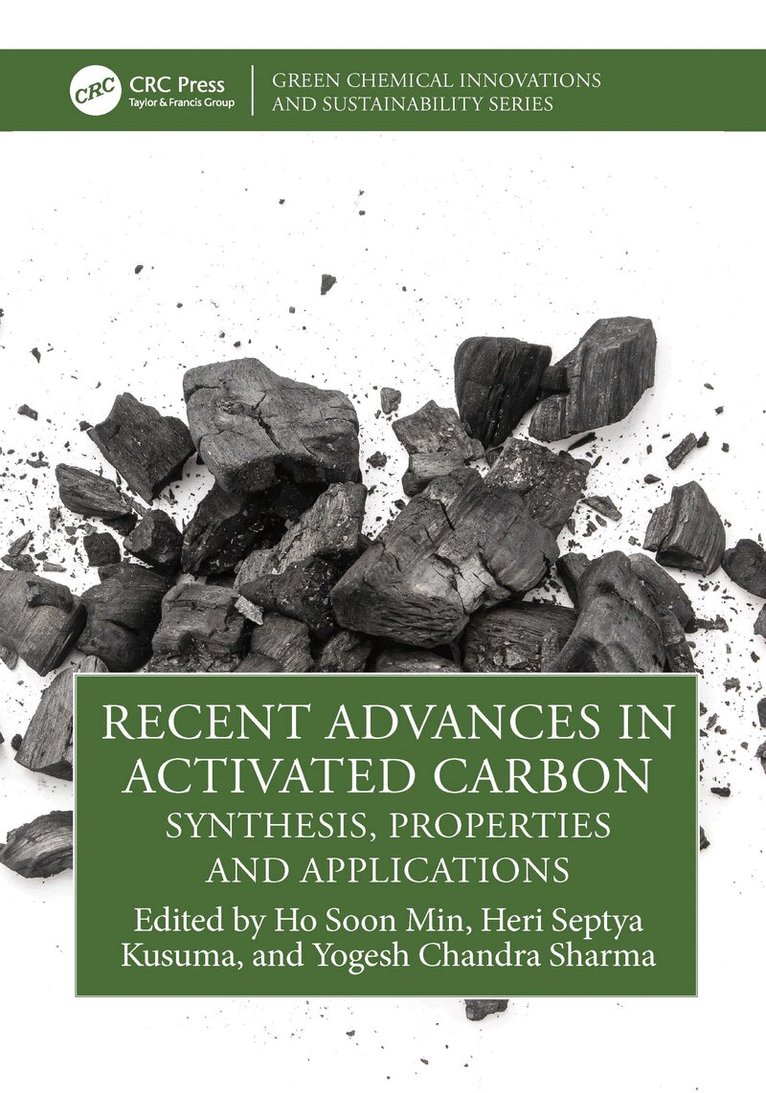
    Recent Advances in Activated Carbon

    Synthesis, Properties and Applications

    AvHo Soon Min,Heri Septya Kusuma

    Inbunden, Engelska, 2024

    Del i serien Green Chemical Innovations and Sustainability

    2 107 kr

    Beställningsvara. Skickas inom 10-15 vardagar. Fri frakt över 249 kr.

    Beskrivning

    The world’s activated carbon market volume has increased rapidly in recent years due to environmental regulations. It is being used in a variety of fields including water treatment, air purification, and food processing. This volume in the Green Chemical Innovations and Sustainability Series studies the physical, biological, and chemical modification of activated carbon to enhance the adsorption performance. Recent experimental results indicating improved adsorption capacity are presented as well as novel applications using activated carbon. The authors focus on identifying potential precursors from agricultural waste, municipal waste, and industrial waste and investigate toxic pollutants.FeaturesDemonstrates how researchers can produce synthetic adsorbents (activated carbon) via agricultural waste, industrial waste, and household waste.Describes the actions of adsorption capacity or percentage removal with respect to factors affecting the adsorption process.Investigates activated carbon's removal efficiency of dyes, organic compounds, pharmaceutically active compounds, heavy metals, pesticides, fungicides, herbicides, antibiotics, and other toxic pollutantsDiscusses the search for low-cost adsorbents that can be produced by using agricultural wastes, industrial wastes, and natural materials.

    Produktinformation

    • Utgivningsdatum:2024-12-26
    • Mått:178 x 254 x 20 mm
    • Vikt:670 g
    • Format:Inbunden
    • Språk:Engelska
    • Serie:Green Chemical Innovations and Sustainability
    • Antal sidor:268
    • Förlag:Taylor & Francis Ltd
    • ISBN:9781032772202

    Utforska kategorier

    • Energiteknik inom Naturvetenskap och teknik
    • Miljömedicin inom Medicin
    • Miljöteknik inom Naturvetenskap och teknik

    Mer om författaren

    Ho Soon Min is a professor at INTI International University in Malaysia. He received his PhD in Materials Chemistry from University Putra Malaysia in 2010. With over 15 years of experience, he has served as a lecturer, researcher, examination panel member, examination moderator, and conference committee. At INTI International University, he has taught a variety of chemistry courses, including physical chemistry, organic chemistry, general chemistry, chemistry & society, and methods & skills in research for undergraduate courses. Currently, he is a member of the Institute of Materials Malaysia, the Malaysian Institute of Chemistry, the Malaysian Analytical Sciences Society, the Malaysian Solid-State Science & Technology Society, the Researchers Society of Chemical Sciences, the Scientific and Technical Research Association, the Asian Chemical Society, the Asian Council of Science Editors, and the World Researchers Associations. As an active researcher, his research areas include renewable energy, solar energy, chalcogenide metals, activated carbon, wastewater treatment, biomaterials, green chemistry, semiconductors, nanomaterials, and thin film materials. Professor Ho has published more than 200 papers in Scopus/WoS and international referred journals, 48 book chapters, and four books. His research has been widely recognized and he has successfully received several local and international awards. In addition, Prof. Ho has been appointed as a journal reviewer (reviewed more than 750 papers), journal editor (40 journals), editorial board member (85 journals), chief guest editor, and thesis external examiner (25 universities).Heri Septya Kusuma was born in Bojonegoro, East Java, Indonesia. He received his Bachelor of Science degree from the Department of Chemistry, Faculty of Science and Technology, Airlangga University. He then earned both his master’s in engineering and Doctoral degrees from the Department of Chemical Engineering, Faculty of Industrial Technology, Institut Teknologi Sepuluh Nopember. Currently, he serves as a lecturer in the Department of Chemical Engineering, Faculty of Industrial Technology, Universitas Pembangunan Nasional "Veteran" Yogyakarta, Indonesia. In addition, he is also an Editor and Reviewer for various reputable international and accredited national (Indonesian) journals. He has published more than 100 articles in several reputable international journals, as well as contributed to multiple book chapters.Yogesh Chandra Sharma is a Professor (HAG) in the Department of Chemistry at the Indian Institute of Technology (IIT) BHU Varanasi, India. He graduated from the Department of Applied Chemistry at the same institute in 1991 and earned his Doctor of Science (DSc) degree in 2010. His research interests include Green Energy, Green Hydrogen Production, Biodiesel Synthesis, Valorization of Biodiesel by-products, and River Health Science. Prof. Sharma has carried out pioneering work on the synthesis and characterization of heterogeneous catalysts for production of biodiesel using first-, second-, third-, and fourth-generation feedstock materials. He designed and fabricated a vertically aligned photobioreactor for the cultivation of microalgae for biodiesel production and used waste materials to produce heterogeneous catalysts. He has also worked on the synthesis of bi-and multi-metallic heterogeneous catalysts. The heterogeneous catalysts produced by his research group have been successfully applied in biodiesel and green hydrogen production. Prof. Sharma is a pioneer in the conceptualization of nanoadsorbents, which have emerged as a groundbreaking material, especially for water purification. Prof. Sharma has done significant work on the synthesis of adsorbents from waste materials, minerals, biomaterials, and other sources for the removal of heavy and toxic metals, dyes, fluorides, nitrates, and phosphates from wastewater. He has also used this technology for drinking water treatment. He has several fruitful national and international collaborations on topics of societal importance. Prof. Sharma is a highly cited author and has published more than 200 research articles, 20 review articles, and several book chapters. He has authored and edited five books on various topics. Prof. Sharma has over 16,700 citations, and he has an h-index of 69 and an i10-index of 173.

    Innehållsförteckning

    • 1 Production of activated carbon from bamboo. 2 Production of activated carbon from tea. 3 Production of activated carbon from lemon, 4 Production of activated carbon from orange. 5 Production of activated carbon from apple. 6 Production of activated carbon from wood. 7 Production of activated carbon from date stones. 8 Production of activated carbon from palm kernel shell, 9 Production of activated carbon from grape. 10 Production of activated carbon from durian. 11 Production of activated carbon from jackfruit. 12 Production of activated carbon from rice husk. 13 Production of activated carbon from coconut. 14 Production of activated carbon from corn cobs. 15 Production of activated carbon from strawberry. 16 Production of activated carbon from bananas. 17 Production of activated carbon from sugarcane bagasse. 18 Production of activated carbon from wheat straw. 19 Production of activated carbon from olive stones.