• Fri frakt över 249 kr
  • •
  • Snabba leveranser
  • •
  • Billiga böcker
Kundservice

Du är på sajten för privatpersoner.

Företag, bibliotek eller offentlig verksamhet?

Du handlar på classic.bokus.com, där alla dina funktioner finns intakta.
Till classic.bokus.com
Bokus logotyp. Gå till startsidan.
  • Erbjudanden
  • Student
  • Topplistor
  • Barn & ungdom
  • Bokus Play
  • E-böcker
  • Ljudböcker
  • Pocketböcker
  • Spel och pussel

5% studentrabatt – använd koden KURSBOK27 →

Sidfot

Mina sidor

    Hjälp

    • Kundservice
    • Vanliga frågor och svar
    • Frakt och leverans
    • Retur vid ångerrätt
    • Reklamera vara
    • Betalning
    • Köpvillkor
    • Allmänna villkor
    • Information om webbplatsens tillgänglighet

    Om Bokus

    • Om oss
    • Pressrum
    • För studenter
    • För företag
    • För bibliotek och offentlig verksamhet
    • För leverantörer
    • Hållbarhet

    Populärt

    • Aktuella erbjudanden
    • Presentkort
    • Studentlitteratur
    • Nya böcker
    • Topplistor
    • Signerade böcker
    • Engelska böcker

    Inspiration

    • Boktips
    • BookTok
    • Barnbokskaraktärer
    • Populära författare
    Logotyp för Bokus
    Följ oss på Facebook (extern länk)Följ oss på Instagram (extern länk)Följ oss på YouTube (extern länk)Följ oss på TikTok (extern länk)
    bokus @ CookiesAnpassa cookiesIntegritetspolicyKöpvillkor
    Till Citymail hemsida (extern länk)Till Budbee hemsida (extern länk)Till Postnord hemsida (extern länk)Till Schenker hemsida (extern länk)Till Early Bird hemsida (extern länk)Till Walleys hemsida (extern länk)
    1. Naturvetenskap och teknik
    2. Teknik och industri
    3. Energiteknik

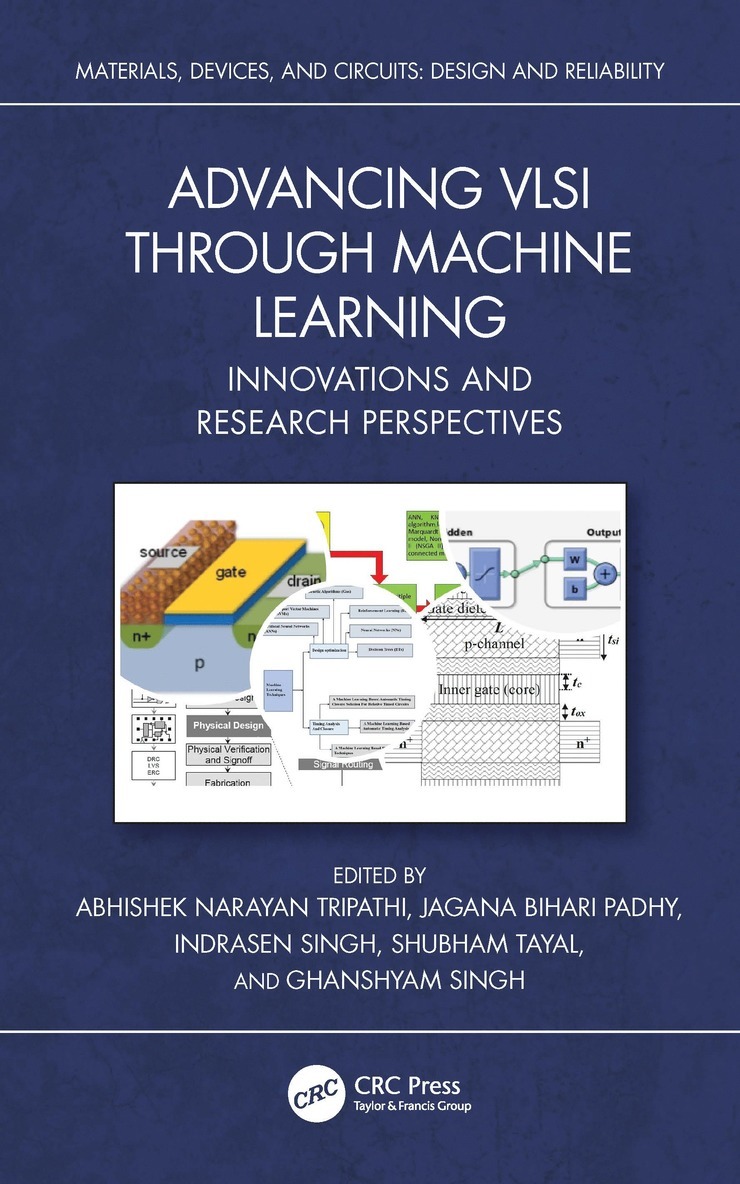
    Advancing VLSI through Machine Learning

    Innovations and Research Perspectives

    AvAbhishek Narayan Tripathi,Jagana Bihari Padhy

    Inbunden, Engelska, 2025

    Del i serien Materials, Devices, and Circuits

    2 046 kr

    Beställningsvara. Skickas inom 10-15 vardagar. Fri frakt över 249 kr.

    Beskrivning

    This book explores the synergy between very large-scale integration (VLSI) and machine learning (ML) and its applications across various domains. It investigates how ML techniques can enhance the design and testing of VLSI circuits, improve power efficiency, optimize layouts, and enable novel architectures.This book bridges the gap between VLSI and ML, showcasing the potential of this integration in creating innovative electronic systems, advancing computing capabilities, and paving the way for a new era of intelligent devices and technologies. Additionally, it covers how VLSI technologies can accelerate ML algorithms, enabling more efficient and powerful data processing and inference engines. It explores both hardware and software aspects, covering topics like hardware accelerators, custom hardware for specific ML tasks, and ML-driven optimization techniques for chip design and testing.This book will be helpful for academicians, researchers, postgraduate students, and those working in ML-driven VLSI.

    Produktinformation

    • Utgivningsdatum:2025-03-30
    • Mått:156 x 234 x 19 mm
    • Vikt:560 g
    • Format:Inbunden
    • Språk:Engelska
    • Serie:Materials, Devices, and Circuits
    • Antal sidor:254
    • Förlag:Taylor & Francis Ltd
    • ISBN:9781032774282

    Utforska kategorier

    • Energiteknik inom Naturvetenskap och teknik
    • Systemvetenskap och AI inom Data och IT
    • Programmeringsböcker inom Data och IT

    Mer om författaren

    Dr. Abhishek Narayan Tripathi is currently an Assistant Professor in the Department of Micro and Nanoelectronics, School of Electronics Engineering, Vellore Institute of Technology, Vellore, Tamil Nadu, India. He holds a Ph.D. in ECE with a specialization in VLSI Design and Embedded Technology from MANIT, Bhopal. His research work includes the development of methodologies for dynamic power and leakage power estimation in FPGA and ASIC‑based implementations, VLSI system design, AI, deep learning, and microprocessor architecture.Dr. Jagana Bihari Padhy is an Assistant Professor in the Department of Embedded Technology, School of Electronics Engineering, Vellore Institute of Technology, Vellore, Tamil Nadu, India. He holds a Ph.D. in ECE with a specialization in optical wireless system design from IIIT Bhubaneswar. His research work includes the development of optical system design both in wired and wireless methodologies for the next generation of communication 5G and beyond.Dr. Indrasen Singh is an Assistant Professor (Sr. Grade‑2) in the Department of Embedded Technology, School of Electronics Engineering, Vellore Institute of Technology, Vellore, Tamil Nadu, India. His research interests are in the areas of cooperative communication, stochastic geometry, modelling of wireless networks, heterogeneous networks, millimetre wave communications, device‑to‑device communication, and 5G/6G communication.Dr. Shubham Tayal is an Assistant Professor in the Department of Electronics and Communication Engineering, SR University, Warangal, India. He has more than 6 years of academic/research experience in teaching at the UG and PG levels. He received his Ph.D. in Microelectronics and VLSI Design from the National Institute of Technology, Kurukshetra; M.Tech. (VLSI Design) from YMCA University of Science and Technology, Faridabad; and B.Tech. (Electronics and Communication Engineering) from MDU, Rohtak. His research interests include simulation and modelling of multi‑gate semiconductor devices, device‑circuit co‑design in digital/analogue domain, ML, and Internet of Things.Prof. Ghanshyam Singh received a Ph.D. degree in Electronics Engineering from the Indian Institute of Technology, Banaras Hindu University, Varanasi, India, in 2000. At present, he is a full Professor with the Department of Electrical and Electronics Engineering, APK Campus, University of Johannesburg, South Africa. His research and teaching interests include RF/microwave engineering, millimetre/THz wave antennas and their applications in communication and imaging, next‑generation communication systems (OFDM and cognitive radio), and nanophotonics. He has more than 19 years of teaching and research experience in electromagnetic/microwave engineering, wireless communication, and nanophotonics.

    Innehållsförteckning

    • Chapter 1. Optimizing Circuit Synthesis: Integrating Neural Networks and Evolutionary Algorithms for Increased Design EfficiencyChapter 2. Study of Physical Processes Analysis and Phenomena of Insights of Trapping in the Performance Degradation in AlGaN/GaN HEMTsChapter 3. Framework for Design and Performance Evaluation of Memory using MemristorChapter 4. Innovative Design and Optimization of High-Power Amplifiers: A Comparative Study with GaN HEMT and CMOS TechnologiesChapter 5. Exploring FPGA Architecture Designs for Matrix Multiplication in Machine LearningChapter 6. Silicon Chip Design and TestingChapter 7. A Novel Deep Learning Approach for Early Brain Tumour DetectionChapter 8. TCAD Augmented Machine Learning for the Prediction of Device Behavior and Failure AnalysisChapter 9. Opportunities and Challenges for ML-Based FPGA Backend FlowChapter 10. Role of Machine Learning Applications in VLSI DesignChapter 11. Application of Artificial Intelligence/Machine Learning in VLSI DesignChapter 12. FinFET-Based 9T SRAM for Enhanced Performance in AI/ML ApplicationsChapter 13. Power Consumption and SNM Analysis of 6T and 7T SRAM using 90nm TechnologyChapter 14. Transforming Electronics: An Extensive Analysis of Hyper-FET Technological Developments and UtilisationChapter 15. VLSI Realization of Smart Systems using Blockchain and Fog Computing