• Fri frakt över 249 kr
  • •
  • Snabba leveranser
  • •
  • Billiga böcker
Kundservice

Du är på sajten för privatpersoner.

Företag, bibliotek eller offentlig verksamhet?

Du handlar på classic.bokus.com, där alla dina funktioner finns intakta.
Till classic.bokus.com
Bokus logotyp. Gå till startsidan.
  • Erbjudanden
  • Nyheter
  • Student
  • Topplistor
  • Barn & ungdom
  • Bokus Play
  • E-böcker
  • Pocketböcker
  • Spel & pussel

10% rabatt på allt med kod: NYSTART10 →

Sidfot

Mina sidor

    Hjälp

    • Kundservice
    • Vanliga frågor och svar
    • Frakt och leverans
    • Retur vid ångerrätt
    • Reklamera vara
    • Betalning
    • Köpvillkor
    • Allmänna villkor
    • Information om webbplatsens tillgänglighet

    Om Bokus

    • Om oss
    • Pressrum
    • För studenter
    • För företag
    • För bibliotek och offentlig verksamhet
    • För leverantörer
    • Hållbarhet

    Populärt

    • Aktuella erbjudanden
    • Presentkort
    • Studentlitteratur
    • Nya böcker
    • Topplistor
    • Signerade böcker
    • Engelska böcker

    Inspiration

    • Boktips
    • BookTok
    • Populära bokserier
    • Barnbokskaraktärer
    • Populära författare
    Logotyp för Bokus
    Följ oss på Facebook (extern länk)Följ oss på Instagram (extern länk)Följ oss på YouTube (extern länk)Följ oss på TikTok (extern länk)
    bokus @ CookiesAnpassa cookiesIntegritetspolicyKöpvillkor
    Till Citymail hemsida (extern länk)Till Budbee hemsida (extern länk)Till Postnord hemsida (extern länk)Till Schenker hemsida (extern länk)Till Early Bird hemsida (extern länk)Till Walleys hemsida (extern länk)
    1. Kultur
    2. Scenkonst och film
    3. Teater

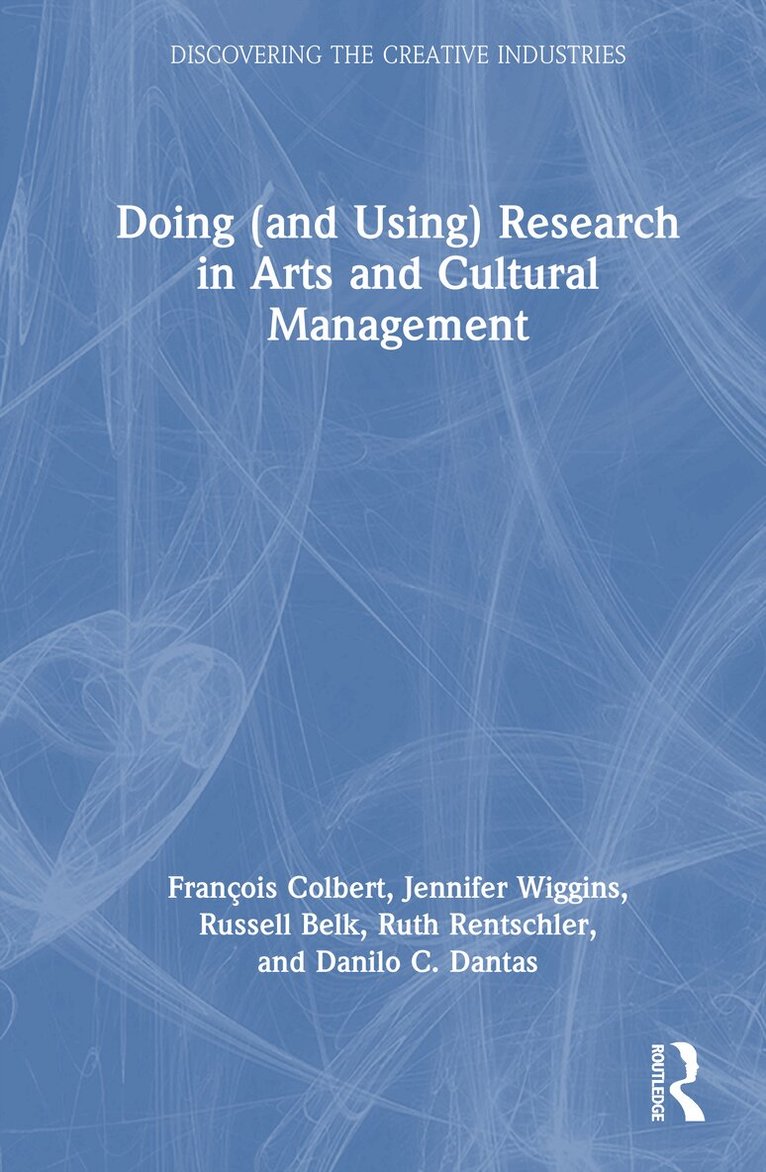
    Doing (and Using) Research in Arts and Cultural Management

    AvFrançois Colbert,Jennifer Wiggins

    Inbunden, Engelska, 2025

    Del i serien Discovering the Creative Industries

    2 117 kr

    Beställningsvara. Skickas inom 10-15 vardagar. Fri frakt över 249 kr.

    Fler format och utgåvor

    Häftad

    643 kr

    Beskrivning

    This book offers a rich, critical, and engaging exploration of cutting-edge methods for studying arts and cultural management in a digital age. The content will appeal to those who seek to study these topics by employing the latest data gathering and analytical methods. It is an informative resource for academics, including advanced masters’ and PhD candidates, as well as professional arts managers seeking to understand the changing landscape. This book is relevant to arts and cultural management, creative industries, cultural policy, festivals and events, heritage, museum studies, arts consumption and marketing, and cultural tourism. It will also appeal to consultants, evaluators, and fundraisers who do research on a regular basis. The chapters engage with both traditional and contemporary research topics, including providing examples of high-quality research from national, regional, and local settings in various parts of the world. The co-authors are five diverse scholars who are experienced not only in standard qualitative and quantitative methods but also emerging techniques such as netnography and digital analysis. This book provides real-world, empirical, and theoretical insights on how to navigate the complexities of research methods in a creative context.

    Produktinformation

    • Utgivningsdatum:2025-12-19
    • Mått:156 x 234 x 16 mm
    • Vikt:540 g
    • Format:Inbunden
    • Språk:Engelska
    • Serie:Discovering the Creative Industries
    • Antal sidor:186
    • Förlag:Taylor & Francis Ltd
    • ISBN:9781032784526

    Utforska kategorier

    • Teater inom Kultur
    • Referensverk och tvärvetenskap inom Samhälle och politik
    • Evenemang och organisation inom Sport, fritid och hobby

    Mer om författaren

    Russell Belk is York University Distinguished Research Professor and Kraft Foods Canada Chair in Marketing at Schulich School of Business, York University. His research involves the extended self, the arts, collecting, gift-giving, sharing, digital consumption, and materialism. He is primarily qualitative and often conceptual, visual, and cultural. He has over 800 publications; in 2012 a 10-volume subset was published in Sage’s Legends in Consumer Behavior series. In 2023 he received an honorary doctorate with festschrift from Université de Reims. He co-initiated the Consumer Behavior Odyssey, the ACR Film Festival, and the Consumer Culture Theory Conference.François Colbert has been active in the field of arts and culture for over 50 years, particularly in the performing arts, museum, and film sectors. He has given numerous training and professional development seminars in arts management, with a focus on the field of marketing management in a cultural context. He is professor of marketing and holder of the Carmelle and Rémi Marcoux Chair in Arts Management at HEC Montréal. He founded the AIMAC Conference and the International Journal of Arts Management. He is the codirector of the Master of Management in International Arts Management and author of the book Marketing Culture and the Arts published in 16 languages.Danilo C. Dantas is Professor of Marketing at HEC Montréal, Canada, where he serves as the pedagogical director of the Professional Master’s and Graduate Diploma in Management of Cultural Organizations. His research focuses on the marketing of music, employing various research methods. His work has been published in the European Journal of Marketing, the Journal of Interactive Marketing, the International Journal of Arts Management, and the Journal of Public Policy & Marketing, among others. He is also the co-chair of AIMAC, the International Association of Arts and Culture Management.Ruth Rentschler OAM is Professor of Arts and Cultural Leadership, UniSA Business, Adelaide, Australia. Is an Honorary Visiting Adjunct Professor at John Moore’s Business School University, Liverpool, and is a Guest Professor Peking University and Supervising Professor Flinders University.Her research entails creative topics focusing on inclusion and diversity. Ruth’s work is often qualitative, with particular interest in unique longitudinal secondary data sets, the self and others, and more recently film and the digital world. She has designed and taught research methods at PhD level in numerous universities around the world. Ruth has received national and international awards for her contributions to arts and cultural management and higher education. She is widely published, including her most recent book, Routledge Companion to Governance in the Arts World (Rentschler, Reid & Donelli, Routledge, Eds., 2025).Jennifer Wiggins is Professor of Marketing and Entrepreneurship at Kent State University, Ohio, USA, and Co-Editor in Chief of the International Journal of Arts Management. Her research on consumer willingness to donate, willingness to pay for arts experiences, and willingness to support new creative and social ventures has been published in top journals in marketing, entrepreneurship, and arts management. Her methodological expertise is in experimental design and measurement. She has mentored over two dozen doctoral students and teaches philosophy of science, theory development, and research methods at the doctoral level.

    Recensioner i media

    "As data continue to drive decision making, funding, and policy cultural managers need resources like this book to aid them in learning, doing, and using research." Constance DeVereaux, State University of New York at Buffalo, USA"Written by five experienced arts management professors this comprehensive and digestible book about research methods and publication practices in arts and cultural management, specifically, is a much-needed practical resource for undergraduate and graduate students as well as their professors and mentors. The authors provide clear definitions, detailed research design descriptions and examples that will inspire fellow researchers and professional managers working in an increasingly complex and complicated arts and cultural economy." Diane Claussen, DePaul University, USA

    Innehållsförteckning

    • PrefaceChapter 1 Foundations of arts and cultural researchWhat is research?Academic researchInformation search from the manager's point of viewQualitative ResearchQuantitative researchThe importance of writing clearlyHow to use this BookReferencesChapter 2: Research Questions and Research DesignsIntroductionStep 1: Identify Your Potential ContributionStep 2: Clarify Your Research GoalStep 3: Specify Your Research QuestionStep 4: Select Your Research DesignConclusionReferencesChapter 3: Doing ethics in arts and cultural management researchIntroductionEthical dilemmasTypes of ethical dilemmasTypes of ethical breachesA research ethics frameworkSteps in the research ethics processGaining RespectBuilding TrustBeing responsible and accountableIndividual CommunityInstitutionalConclusionReferencesChapter 4 What, Why and How: Writing a Literature ReviewIntroductionWhat is a literature ReviewSteps in a Literature Review1. Define the boundaries/gaps of your subject.2. Define the constructs or concepts you are going to use.3. Explain your contribution to knowledge.4. Address Your AudienceTypes of Literature ReviewThematic literature reviewSystematic Literature reviewAnnotated bibliographic analysisNetnographyMeta-analysisSpectroscopyConclusionReferencesChapter 5: Survey ResearchIntroductionStep 1: Selecting and Sampling ParticipantsStep 2: Measuring the VariablesStep 3: Designing and Distributing the Survey QuestionnaireStep 5: Analyzing and Presenting the DataConclusionReferencesChapter 6: Depth Interview ResearchIntroductionStep 1: Literature Review and Research QuestionStep 2: Locating Participants and Preparing for InterviewsStep 3: Conducting the InterviewStep 4: Transcribe, Code, AnalyzeStep 5: Write-up or Edit your FindingsConclusionReferencesChapter 7: Experimental ResearchIntroductionStep 1: Selecting the Type of ExperimentStep 2: Determining the Factorial DesignStep 3: Designing and Pretesting the ManipulationsStep 4: Designing and Distributing the QuestionnaireStep 5: Analyzing and Presenting the DataConclusionReferencesChapter 8: Case Studies IntroductionWhat is Case Study?When to Use Case Studies as a Research Method?3.0 Key stages in case study researchStep 1: Define a research questionStep 2: Determine the subject and set the boundariesStep 3: Craft and test the tools Step 4: Collect dataPrinciple 1: use multiple sources of evidencePrinciple 2: create a case study database Step 5: Analyze the dataConclusionReferencesChapter 9: Ethnography, Netnography, and ObservationIntroductionEthnographyNetnographyStep 1: Locate DataStep 2: Data AnalysisStep 3: Data InterpretationStep 4. Publishing your NetnographyObservationAutoethnographyMechanical ObservationNon-Participant and Unobtrusive ObservationConclusionReferencesChapter 10: Effective Writing and Presentations IntroductionStep 1: Preparing to Communicate Your ResearchStep 2: Framing the Phenomenon and Research QuestionStep 3: Writing a Literature Review and Theoretical FoundationStep 4: Writing Methods Sections and FindingsStep 5: Writing Discussion and Conclusion SectionsWriting for a Managerial AudienceConclusionReferencesConclusion