• Fri frakt över 249 kr
  • •
  • Snabba leveranser
  • •
  • Billiga böcker
Kundservice

Du är på sajten för privatpersoner.

Företag, bibliotek eller offentlig verksamhet?

Du handlar på classic.bokus.com, där alla dina funktioner finns intakta.
Till classic.bokus.com
Bokus logotyp. Gå till startsidan.
  • Erbjudanden
  • Nyheter
  • Student
  • Topplistor
  • Barn & ungdom
  • Bokus Play
  • E-böcker
  • Pocketböcker
  • Spel & pussel

Upp till 20% på populära nyheter →

Sidfot

Mina sidor

    Hjälp

    • Kundservice
    • Vanliga frågor och svar
    • Frakt och leverans
    • Retur vid ångerrätt
    • Reklamera vara
    • Betalning
    • Köpvillkor
    • Allmänna villkor
    • Information om webbplatsens tillgänglighet

    Om Bokus

    • Om oss
    • Pressrum
    • För studenter
    • För företag
    • För bibliotek och offentlig verksamhet
    • För leverantörer
    • Hållbarhet

    Populärt

    • Aktuella erbjudanden
    • Presentkort
    • Studentlitteratur
    • Nya böcker
    • Topplistor
    • Signerade böcker
    • Engelska böcker

    Inspiration

    • Boktips
    • BookTok
    • Populära bokserier
    • Barnbokskaraktärer
    • Populära författare

    Mina sidor

      Hjälp

      • Kundservice
      • Vanliga frågor och svar
      • Frakt och leverans
      • Retur vid ångerrätt
      • Reklamera vara
      • Betalning
      • Köpvillkor
      • Allmänna villkor
      • Information om webbplatsens tillgänglighet

      Om Bokus

      • Om oss
      • Pressrum
      • För studenter
      • För företag
      • För bibliotek och offentlig verksamhet
      • För leverantörer
      • Hållbarhet

      Populärt

      • Aktuella erbjudanden
      • Presentkort
      • Studentlitteratur
      • Nya böcker
      • Topplistor
      • Signerade böcker
      • Engelska böcker

      Inspiration

      • Boktips
      • BookTok
      • Populära bokserier
      • Barnbokskaraktärer
      • Populära författare
      Logotyp för Bokus
      Följ oss på Facebook (extern länk)Följ oss på Instagram (extern länk)Följ oss på YouTube (extern länk)Följ oss på TikTok (extern länk)
      bokus @ CookiesIntegritetspolicyKöpvillkor
      Till Citymail hemsida (extern länk)Till Budbee hemsida (extern länk)Till Postnord hemsida (extern länk)Till Schenker hemsida (extern länk)Till Early Bird hemsida (extern länk)Till Walleys hemsida (extern länk)
      1. Naturvetenskap och teknik
      2. Geovetenskap
      3. Miljövetenskap och miljöpolitik

      Delivering a Climate Neutral Europe

      AvJos Delbeke

      Inbunden, Engelska, 2024

      2 085 kr

      Beställningsvara. Skickas inom 10-15 vardagar. Fri frakt över 249 kr.

      Beskrivning

      Delivering a Climate Neutral Europe summarises the achievements of 25 years of EU Climate Policy, with the emphasis on what has been achieved under the Green Deal. It also highlights climate issues on the table of policy makers in the next European policy cycle 2024–2029.Curated by Jos Delbeke, one of the foremost experts in this field, the chapters are all written by responsible officials of the EU Commission services, who were deeply involved in the negotiations related to the legislation they prepared. They explain how ambitious targets were prepared for 2030 and 2050 in view of implementing the commitments taken in 2015 under the Paris Agreement and present the overall architecture of the policy to counter the idea that an avalanche of legislative action is being developed without much structure. In particular, this book examines the carbon pricing tool that Europe implemented under the EU Emissions Trading System (EU ETS), the differentiated targets Member States have to deliver and climate-relevant EU legislation in the fields of energy, transport, industry, finance and agriculture and forestry. The authors also discuss the upcoming headwinds in the form of a growing scepticism in public opinion, and the impact of the wars in the close neighbourhood of the European continent.Written as a follow-up to previous publications EU Climate Policy Explained and Towards a Climate-Neutral Europe, this new volume will be a vital resource for students, scholars and policy makers alike who are researching and working in the areas of climate change, environmental governance and EU policy more broadly.

      Produktinformation

      • Utgivningsdatum:2024-05-17
      • Mått:138 x 216 x 20 mm
      • Vikt:460 g
      • Format:Inbunden
      • Språk:Engelska
      • Antal sidor:268
      • Förlag:Taylor & Francis Ltd
      • ISBN:9781032797601

      Utforska kategorier

      • Miljövetenskap och miljöpolitik inom Naturvetenskap och teknik
      • Politik och statsskick inom Samhälle och politik

      Mer om författaren

      Jos Delbeke holds the first EIB Chair on Climate Policy and International Carbon Markets and was previously Director-General of the European Commission’s DG for Climate Action (2010–2018). Delbeke was involved in setting the EU’s climate and energy targets for 2020 and 2030 and in developing EU legislation on the Emissions Trading System (ETS), cars and fuels, air quality, emissions from big industrial installations and chemicals (REACH). He developed Europe’s International Climate Change strategy and was the European Commission’s chief negotiator at the UNFCCC Conference of the Parties, playing a key role in the EU’s implementation of the Kyoto Protocol and in negotiations on the Paris Agreement.

      Innehållsförteckning

      • Part 1: Climate action in the EU and the world Chapter 1: EU Climate Policy after 25 years: looking back, looking ahead Introduction 1.1 Climate change is happening 1.2 EU greenhouse gas emissions reduced by 32.5% between 1990 and 2022 1.3 Building further on the cornerstones of EU climate policy 1.3.1 The politics: a vision endorsed at the highest political level 1.3.2 The economics: putting an explicit price on carbon 1.3.3 The technicalities: designing policies based on solid preparation 1.4 Anchoring climate into a strengthened geopolitical EU strategy 1.4.1 The climate transition as part of an EU geopolitical industrial strategy 1.4.2 Investing in social and regional cohesion 1.4.3 Investing in removals 1.4.4 Raising much more sustainable finance 1.4.5 Addressing adaptation Chapter 2: The Paris Agreement Introduction 2.1The UN Framework Convention on Climate Change and the Kyoto Protocol 2.2 From the failure of Copenhagen (2009) to the success of the Paris Agreement (2015) 2.3Essential features of the Paris Agreement 2.3.1 Applicable to all Parties 2.3.2 Ambitious collective goals 2.3.3 Dynamic five-year ambition cycles 2.3.4 Transparency and accountability 2.3.5 Increasing resilience to and responding to the adverse effects of climate change 2.3.6 Fostering cooperation and financial flows 2.4Are global emissions peaking? 2.5 The international dimension of the European Green Deal 2.5.1 Sharing lessons on the climate and energy transition 2.5.2 Trade-related climate measures 2.5.3 Mobilising sustainable finance Conclusion Part 2: The EU Emissions Trading System Chapter 3: The EU Emissions Trading System Introduction 3.1 How does the EU Emissions Trading System work? 3.2 Price and emissions development 3.3 The creation of the Market Stability Reserve 3.4 A strengthening of the emissions cap 2024–2030 3.5 The creation of ETS2 for road transport, buildings, and smaller industry 3.5.1 Defining the ETS2 cap trajectory 3.5.2 The Market Stability Reserve for ETS2 3.5.3 Gradual implementation and safeguards for a smooth start 3.6 The growing importance of ETS revenues 3.6.1 Raising revenue through auctioning allowances 3.6.2 EU Solidarity and the use of auctioning revenue 3.6.3 The Social Climate Fund Conclusion Chapter 4: Addressing Carbon Leakage under the EU ET Introduction 4.1 The problem of carbon leakage 4.2The EU approach to free allocation 4.2.1 Benchmarks4.2.2 Carbon leakage list 4.2.3 Seizing the benefit of technological progress 4.2.4 The correction factor 4.2.5 The State Aid provisions and the New Entrants Reserve 4.3 The creation of a Carbon Border Adjustment Mechanism (CBAM) 4.3.1 The CBAM Design 4.3.2 Defining CBAM Liability 4.3.3 Reduction for a carbon price paid 4.3.4 Monitoring the introduction of CBAM 4.3.5 CBAM as an impetus for more intensivepolicy cooperation Conclusion Chapter 5: The international dimension of EU ETS Introduction 5.1 International cooperation on carbon markets 5.2 Experience with international credits 5.3 Aviation emissions 5.3.1 The international governance of aviation emissions 5.3.2 The EU ETS includes aviation within Europe 5.3.3 The 2023 EU ETS Review 5.3.4 Sustainable aviation fuels 5.3.5 Development of CORSIA within ICAO 5.4 Maritime emissions 5.4.1 The international governance of shipping emissions 5.4.2 Extension of EU ETS to maritime emissions 5.4.3 Developments in the IMO Conclusion Part 3: Climate action by Member States and economic sectors Chapter 6: The Effort Sharing Regulation Introduction 6.1 Emissions from the Effort Sharing sectors 6.2 Effort Sharing 2013-2020 6.2.1 Setting differentiated targets 6.2.2 Developing more elements of re-distribution 6.2.3 Experience to date 6.2.4 Flexible provisions 6.3 Differentiation and flexibilities allowed for 2021-2030 6.3.1 Continuation of the differentiated target approach 6.3.2 More differentiation among Member States 6.3.3 Towards the convergence among Member States by 2030 6.3.4 Starting point and trajectoriesm 6.3.5 Flexibility with the Emissions Trading System 6.3.6 Flexibility to Land Use Change and Forestry sectors 6.3.7 Flexibility linked to earlier over-achievement 6.3.8 The 2030 targets as adopted 6.4 An energy and climate governance system 6.4.1 Integrated energy and climate governance and the Climate Law 6.4.2 National climate and energy plans Conclusion Chapter 7: Climate related regulations in the field of energy, transport, F-gases and Methane Introduction 7.1 Renewable energy 7.1.1 A binding EU-wide target 7.1.2 Biomass 7.2 Electricity and gas market integration and climate policy 7.2.1 The challenge of integrating renewable energy 7.2.2 The combined effects of electricity market reform and carbon pricing 7.2.3 Strengthened role for consumers 7.3 Energy efficiency 7.3.1 Energy dependence, the import bill and barriers to energy efficiency 7.3.2 The EU’s bottom-up approach and the Energy Efficiency Directive 7.3.3 Regulating the energy use and labelling of products and devices 7.3.4 Addressing the energy efficiency of buildings 7.4 Emissions from road transport7.4.1 Biofuels and renewable energy in the transport sector 7.4.2 Regulating zero CO2 emissions from cars and vans by 2035 7.4.3 Emissions from Heavy-Duty Vehicles (HDV), such as lorries and buses 7.5 Phasing down the use of fluorinated gases 7.5.1 Addressing the hole in the ozone layer internationally 7.5.2 EU legislation implementing the Montreal Protocol and the Kigali Amendment 7.6 The EU Methane Strategy Conclusion Chapter 8: Removals and emissions from agriculture and forestry Introduction 8.1 The role of the land use sector in mitigating and removing greenhouse gas emissions 8.2 The LULUCF carbon sink in the EU 8.2.1 Evolution of LULUCF: From Kyoto Protocol to ambitious EU targets 8.2.2 Building further on the 2018 LULUCF Regulation 8.3 Scaling up carbon removals and ensuring credibility 8.4 An enabling environment for climate action in forestry and agriculture Conclusion Chapter 9: Accelerating the Greening of EU Industry Introduction 9.1 The new policy context 9.2The Innovation Fund 9.3The Battery Alliance 9.4The role of state aid: the Temporary Crisis and Transition Framework (TCTF) 9.5 The Hydrogen Bank and EU level auctioning under the Innovation Fund 9.6Towards a European Net Zero Industry 9.6.1 Net‑Zero Industry Act (NZIA) 228 9.6.2 Critical Raw Materials Act 229 9.6.3 Strategic Technologies for Europe Platform (STEP) 230 Conclusion, Chapter 10: The Greening of EU Finance, Introduction 10.1 The EU Sustainable Finance Strategy 10.1.1 The EU Taxonomy10.1.2 Disclosure rules 10.1.3 Benchmarks and green bonds 10.1.4 The EU and the international approach to Sustainable Finance 10.2 Mainstreaming climate into the EU budget 10.2.1 The climate mainstreaming target 10.2.2 The specific programme targets 10.3 The EIB becomes the EU’s Climate bank Conclusion, Index
      Hoppa över listan

      Du kanske också är intresserad av

      Peter Vis, Jos Delbeke - EU Climate Policy Explained, E-bok

      EU Climate Policy Explained

      Peter Vis, Jos Delbeke

      E-bok
      2015

      738 kr

      Jos Delbeke, Peter Vis - EU Climate Policy Explained, Häftad

      EU Climate Policy Explained

      Jos Delbeke, Peter Vis

      Häftad, 2015

      582 kr

      Jos Delbeke - Delivering a Climate Neutral Europe, Häftad

      Delivering a Climate Neutral Europe

      Jos Delbeke

      Häftad, 2024

      462 kr

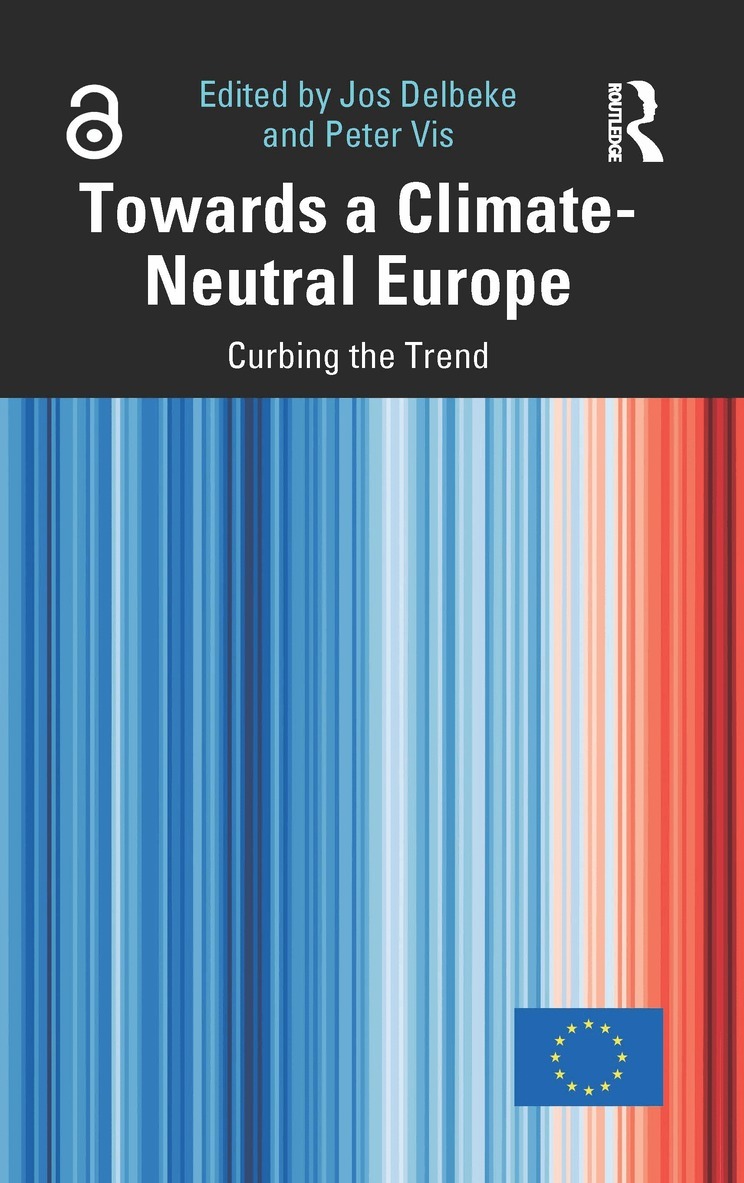
      Jos Delbeke, Peter Vis - Towards a Climate-Neutral Europe, Häftad

      Towards a Climate-Neutral Europe

      Jos Delbeke, Peter Vis

      Häftad, 2019

      628 kr

      Jos Delbeke, Peter Vis - Towards a Climate-Neutral Europe, Inbunden

      Towards a Climate-Neutral Europe

      Jos Delbeke, Peter Vis

      Inbunden, 2019

      2 434 kr

      Jos Delbeke, Peter Vis - EU Climate Policy Explained, Inbunden

      EU Climate Policy Explained

      Jos Delbeke, Peter Vis

      Inbunden, 2015

      2 258 kr

      Peter Vis, Jos Delbeke - EU Climate Policy Explained, E-bok

      EU Climate Policy Explained

      Peter Vis, Jos Delbeke

      E-bok
      2015

      740 kr

      Måns Petter Zelmerlöw - När allt faller, Inbunden
      • -12%

      När allt faller

      Måns Petter Zelmerlöw

      Inbunden, 2026

      229 kr259 kr

      Peter Englund - Om att misslyckas, Inbunden
      • -17%

      Om att misslyckas

      Peter Englund

      Inbunden, 2026

      4,0 utav 5 stjärnor. Totalt antal röster:(9)

      199 kr239 kr

      Roland Paulsen - Avbegåvad : en essäberättelse om arv och miljö, Inbunden
      • -15%

      Avbegåvad : en essäberättelse om arv och miljö

      Roland Paulsen

      Inbunden, 2026

      225 kr265 kr