• Fri frakt över 249 kr
  • •
  • Snabba leveranser
  • •
  • Billiga böcker
Kundservice

Du är på sajten för privatpersoner.

Företag, bibliotek eller offentlig verksamhet?

Du handlar på classic.bokus.com, där alla dina funktioner finns intakta.
Till classic.bokus.com
Bokus logotyp. Gå till startsidan.
  • Erbjudanden
  • Nyheter
  • Student
  • Topplistor
  • Barn & ungdom
  • Bokus Play
  • E-böcker
  • Pocketböcker
  • Spel & pussel

10% rabatt på allt med kod: NYSTART10 →

Sidfot

Mina sidor

    Hjälp

    • Kundservice
    • Vanliga frågor och svar
    • Frakt och leverans
    • Retur vid ångerrätt
    • Reklamera vara
    • Betalning
    • Köpvillkor
    • Allmänna villkor
    • Information om webbplatsens tillgänglighet

    Om Bokus

    • Om oss
    • Pressrum
    • För studenter
    • För företag
    • För bibliotek och offentlig verksamhet
    • För leverantörer
    • Hållbarhet

    Populärt

    • Aktuella erbjudanden
    • Presentkort
    • Studentlitteratur
    • Nya böcker
    • Topplistor
    • Signerade böcker
    • Engelska böcker

    Inspiration

    • Boktips
    • BookTok
    • Populära bokserier
    • Barnbokskaraktärer
    • Populära författare
    Logotyp för Bokus
    Följ oss på Facebook (extern länk)Följ oss på Instagram (extern länk)Följ oss på YouTube (extern länk)Följ oss på TikTok (extern länk)
    bokus @ CookiesAnpassa cookiesIntegritetspolicyKöpvillkor
    Till Citymail hemsida (extern länk)Till Budbee hemsida (extern länk)Till Postnord hemsida (extern länk)Till Schenker hemsida (extern länk)Till Early Bird hemsida (extern länk)Till Walleys hemsida (extern länk)
    1. Samhälle och politik
    2. Samhälle och kultur
    3. Kultur och medier
    4. Referensverk och tvärvetenskap

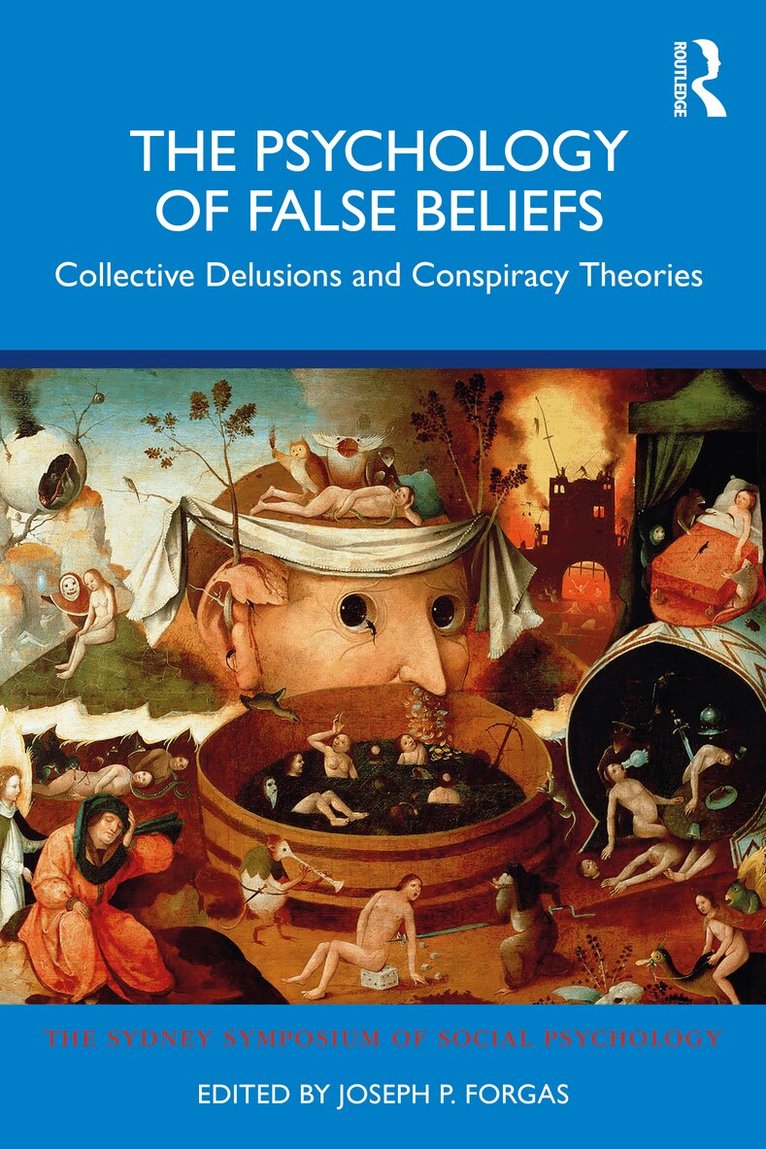
    Psychology of False Beliefs

    Collective Delusions and Conspiracy Theories

    AvJoseph P. Forgas

    Häftad, Engelska, 2025

    Del i serien Sydney Symposium of Social Psychology

    765 kr

    Beställningsvara. Skickas inom 10-15 vardagar. Fri frakt över 249 kr.

    Beskrivning

    This exciting book outlines the fascinating social psychology of false beliefs and tribal delusions, examining the common human tendency to create and maintain collectively shared belief systems that have no foundation in reality. Bringing together leading international researchers, contributors explore how evolutionary, biological, cognitive, and social variables shape the creation and maintenance of widely shared but obviously false belief systems. The authors review how psychological processes promote the formation and maintenance of fallacious beliefs and discuss the philosophical and epistemological criteria we can use to classify some beliefs as false, and others as true.The chapters draw on many core areas of contemporary social life where false beliefs are of topical interest, highlighting the applied implications of this line of research. Topics include political polarisation, false narratives about group differences, pandemic conspiracy theories, fallacious theories in academia and the role of the media and the internet in creating distorted narratives.This book is engagingly written and will be of great interest to students and researchers in social psychology and the social sciences, as well as anyone seeking to understand one of the most intriguing issues that shape human social life.

    Produktinformation

    • Utgivningsdatum:2025-04-29
    • Mått:156 x 234 x 21 mm
    • Vikt:540 g
    • Format:Häftad
    • Språk:Engelska
    • Serie:Sydney Symposium of Social Psychology
    • Antal sidor:326
    • Förlag:Taylor & Francis Ltd
    • ISBN:9781032834122

    Utforska kategorier

    • Referensverk och tvärvetenskap inom Samhälle och politik
    • Socialpsykologi och gruppsykologi inom Psykologi och pedagogik
    • Grupper och gruppteori inom Naturvetenskap och teknik

    Mer om författaren

    Joseph P. Forgas is Scientia Professor of Psychology at the University of New South Wales, Australia. He received his D.Phil. and D.Sc. from the University of Oxford and his research focuses on affective influences on social cognition and behaviour. He published over 30 books and 300 papers and for his work he received the Order of Australia, the Distinguished Scientific Contribution Award, the Alexander von Humboldt Research Prize and a Rockefeller Fellowship as well as a number of academic fellowships and honours.

    Innehållsförteckning

    • Part 1. The Nature and Origins of False BeliefsChapter 1. Forgas, Joseph P. (University of New South Wales, Sydney). From false beliefs to collective delusions: The psychology of human credulity.Chapter 2. Goel, Vinod (York University) False beliefs and the tethered mindChapter 3. Cooper, Joel & Packman, James (Princeton University) The care and feeding off false beliefs: A cognitive dissonance analysisChapter 4. Albarracin, Dolores & Javier Granados Samayoa (University of Pennsylvania) Beyond Confrontation: Bypassing and Motivational Interventions to Curb the Impact of False BeliefsChapter 5. Crano, William D. (Claremont College) The Birth, Development, and Transformation of False Beliefs.Part 2. False beliefs as consensual delusionsChapter 6. Krueger, Joachim (Brown university) and Gruening, David J. (University of Heidelberg) The false belief in free will.Chapter 7. Dunbar, Robin (University of Oxford) Religion and the susceptibility to false beliefChapter 8. French, Chris (Goldsmith's, London). The psychology of paranormal beliefsChapter 9. Sutton, Robbie, Hopkins-Doyle, Aife, Petterson, Aino, Zibell, Hannah, Chalmers, Jocelyn and Leach, Stefan (University of Kent) The false and widespread belief that feminists are misandrists.Part 3. False beliefs in academiaChapter 10. Jussim, Lee, Yanovsky, Sonia, Honeycutt, Nathan and Finkelstein, Danit (Rutgers University) Academic misinformation and false beliefs.Chapter 11. Forgas, Joseph P. (University of New South Wales) Tribal delusions in academia: Three elephants carried by a turtleChapter 12. Fiedler, K. (University of Heidelberg) On the illusion of correct beliefs and the suspicion that correct beliefs may not existChapter 13. Dunning, Dave (University of Michigan) False beliefs among experts and the cognitively ablePart 4. False beliefs and conspiracy theoriesChapter 14. van Prooijen, Jan-Willem (Vrije Universiteit Amsterdam) Pandemic conspiracy theories: Implications for health and polarisationChapter 15. Stanovich, Keith (University of Toronto) and Toplak, Maggie (York University) Reconceptualising the rationality of conspirational thinkingChapter 16. Douglas, Karen, Ricky Green, Daniel Toribio-Flórez, Lea Kamitz, Cassidy Rowden, Mikey Biddlestone, and Dylan De Gourville (University of Kent) Conspiracy beliefs and interpersonal relationshipsChapter 17. Ritov, Ilana & Bruck, Amy (Hebrew University of Jerusalem) False beliefs about an antagonistic group