• Fri frakt över 249 kr
  • •
  • Snabba leveranser
  • •
  • Billiga böcker
Kundservice

Du är på sajten för privatpersoner.

Företag, bibliotek eller offentlig verksamhet?

Du handlar på classic.bokus.com, där alla dina funktioner finns intakta.
Till classic.bokus.com
Bokus logotyp. Gå till startsidan.
  • Erbjudanden
  • Nyheter
  • Student
  • Topplistor
  • Barn & ungdom
  • Bokus Play
  • E-böcker
  • Pocketböcker
  • Spel & pussel

10% rabatt på allt med kod: NYSTART10 →

Sidfot

Mina sidor

    Hjälp

    • Kundservice
    • Vanliga frågor och svar
    • Frakt och leverans
    • Retur vid ångerrätt
    • Reklamera vara
    • Betalning
    • Köpvillkor
    • Allmänna villkor
    • Information om webbplatsens tillgänglighet

    Om Bokus

    • Om oss
    • Pressrum
    • För studenter
    • För företag
    • För bibliotek och offentlig verksamhet
    • För leverantörer
    • Hållbarhet

    Populärt

    • Aktuella erbjudanden
    • Presentkort
    • Studentlitteratur
    • Nya böcker
    • Topplistor
    • Signerade böcker
    • Engelska böcker

    Inspiration

    • Boktips
    • BookTok
    • Populära bokserier
    • Barnbokskaraktärer
    • Populära författare
    Logotyp för Bokus
    Följ oss på Facebook (extern länk)Följ oss på Instagram (extern länk)Följ oss på YouTube (extern länk)Följ oss på TikTok (extern länk)
    bokus @ CookiesAnpassa cookiesIntegritetspolicyKöpvillkor
    Till Citymail hemsida (extern länk)Till Budbee hemsida (extern länk)Till Postnord hemsida (extern länk)Till Schenker hemsida (extern länk)Till Early Bird hemsida (extern länk)Till Walleys hemsida (extern länk)
    1. Ekonomi och Ledarskap
    2. Ledarskapsböcker
    3. Projektledning

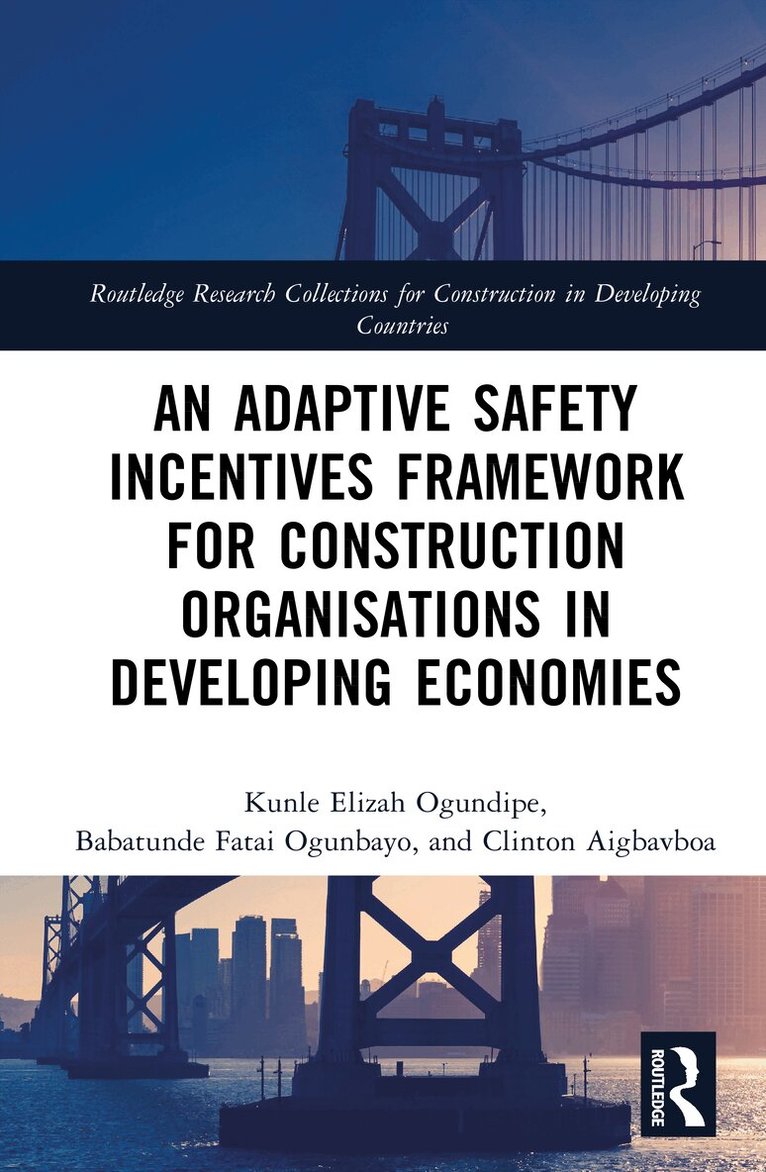
    Adaptive Safety Incentives Framework for Construction Organisations in Developing Economies

    AvKunle Ogundipe,Babatunde Fatai Ogunbayo

    Inbunden, Engelska, 2025

    Del i serien Routledge Research Collections for Construction in Developing Countries

    2 421 kr

    Beställningsvara. Skickas inom 10-15 vardagar. Fri frakt över 249 kr.

    Beskrivning

    The central aim of this book is to focus on safety incentives in a construction context and conceptualise an adaptive safety incentive framework for construction firms in the global south. This book is a collection of knowledge on safety incentives and their impact on improving workplace safety, motivating workers' safety practices, and improving organisations' performance goals in the construction industry. With primary research conducted in Nigeria, and secondary comparisons with Ghana, South Africa, China, Malaysia, and Hong Kong, the conceptualised framework provides insights into the multifaceted factors influencing safety incentives in the construction sector. By explaining the behavioural approach to creating reward systems that minimise unintended consequences and maximise happiness, health, wealth, and success, this book takes a pragmatic approach to developing safety incentives and provides significant practical insights. This book identifies the gaps in safety incentives studies by critically reviewing related models, theories, and conceptual models to provide significant recommendations that support the implementation of safety incentives in the construction industry in the global south. Guiding readers on templates for developing safety incentives, this book will interest professionals in building construction, project management, quantity surveying, civil engineering, human resource management studies, and occupational safety and health (OSH) and owners of construction organisations, as well as researchers in all these fields.

    Produktinformation

    • Utgivningsdatum:2025-11-24
    • Mått:156 x 234 x 27 mm
    • Vikt:920 g
    • Format:Inbunden
    • Språk:Engelska
    • Serie:Routledge Research Collections for Construction in Developing Countries
    • Antal sidor:388
    • Förlag:Taylor & Francis Ltd
    • ISBN:9781041019312

    Utforska kategorier

    • Projektledning inom Ekonomi och Ledarskap
    • Arbetsmarknaden inom Ekonomi och Ledarskap
    • Byggnadsteknik inom Naturvetenskap och teknik

    Mer om författaren

    Kunle Elizah Ogundipe is a seasoned construction manager and researcher. He earned his PhD in Construction Management from the University of Johannesburg in 2024, focusing on incentives‑driven approach to construction health and safety practices. He is a post‑doctoral researcher at the cidb Centre of Excellence & Sustainable Human Settlement and Construction Research Centre, University of Johannesburg, Johannesburg, South Africa.Babatunde Fatai Ogunbayo obtained his PhD in Construction Management from the University of Johannesburg in 2022, focusing on maintenance management and services. He is an Associate Professor in the Department of Civil Engineering, College of Engineering and Technology, William V.S. Tubman University, Harper, Maryland County, Republic of Liberia.Clinton Aigbavboa is a Professor in the Department of Construction Management and Quantity Surveying, University of Johannesburg, South Africa. He is currently the Director of the Construction Industry Development Board Centre of Excellence and the Sustainable Human Settlement and Construction Research Centre at the University of Johannesburg.

    Innehållsförteckning

    • PrefacePart I Safety Incentives Underpinning Principles1. Introduction and General Background 2. General Overview of Safety Incentives in the Construction Industry 3. Policy and Performance Measurement for Safety IncentivesPart II Safety Incentives in Developing Countries4. Safety Incentives Overview in Developing Countries: An African Experience in Ghana and South Africa 5. Safety Incentives Overview in the Nigerian Construction IndustryPart III Safety Incentives Fundamental Theories and Models6. Theories, Models, And Concepts in Safety Incentives Studies 7. Underpinning Safety Incentives Research TheoriesPart IV Conceptualising Safety Incentives8. Gaps In Safety Incentives Research 9. Conceptual Framework Underpinning Safety Incentives 10. Validation Of the Adaptive Safety Incentive Framework Constructs Part V Conclusion11. Conclusion and Recommendation