• Fri frakt över 249 kr
  • •
  • Snabba leveranser
  • •
  • Billiga böcker
Kundservice

Du är på sajten för privatpersoner.

Företag, bibliotek eller offentlig verksamhet?

Du handlar på classic.bokus.com, där alla dina funktioner finns intakta.
Till classic.bokus.com
Bokus logotyp. Gå till startsidan.
  • Erbjudanden
  • Nyheter
  • Student
  • Topplistor
  • Barn & ungdom
  • Bokus Play
  • E-böcker
  • Pocketböcker
  • Spel & pussel

10% rabatt på allt med kod: NYSTART10 →

Sidfot

Mina sidor

    Hjälp

    • Kundservice
    • Vanliga frågor och svar
    • Frakt och leverans
    • Retur vid ångerrätt
    • Reklamera vara
    • Betalning
    • Köpvillkor
    • Allmänna villkor
    • Information om webbplatsens tillgänglighet

    Om Bokus

    • Om oss
    • Pressrum
    • För studenter
    • För företag
    • För bibliotek och offentlig verksamhet
    • För leverantörer
    • Hållbarhet

    Populärt

    • Aktuella erbjudanden
    • Presentkort
    • Studentlitteratur
    • Nya böcker
    • Topplistor
    • Signerade böcker
    • Engelska böcker

    Inspiration

    • Boktips
    • BookTok
    • Populära bokserier
    • Barnbokskaraktärer
    • Populära författare
    Logotyp för Bokus
    Följ oss på Facebook (extern länk)Följ oss på Instagram (extern länk)Följ oss på YouTube (extern länk)Följ oss på TikTok (extern länk)
    bokus @ CookiesAnpassa cookiesIntegritetspolicyKöpvillkor
    Till Citymail hemsida (extern länk)Till Budbee hemsida (extern länk)Till Postnord hemsida (extern länk)Till Schenker hemsida (extern länk)Till Early Bird hemsida (extern länk)Till Walleys hemsida (extern länk)
    1. Ekonomi och Ledarskap
    2. Nationalekonomi
    3. Makroekonomi

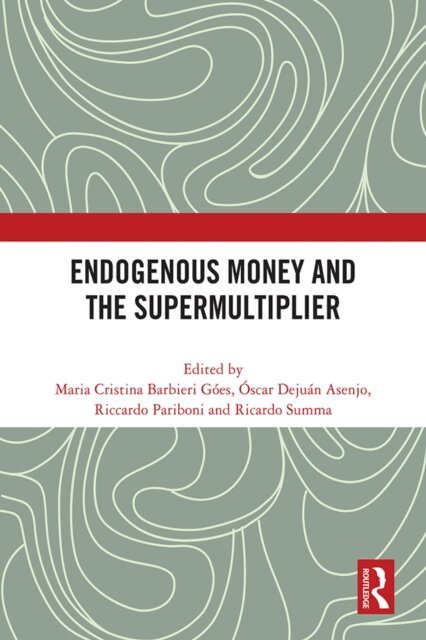
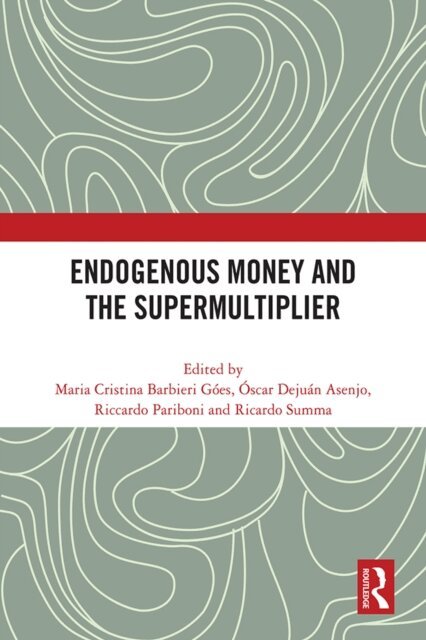
    Endogenous Money and the Supermultiplier

    AvMaria Cristina Barbieri Góes,Óscar Dejuán Asenjo

    Inbunden, Engelska, 2025

    2 493 kr

    Beställningsvara. Skickas inom 10-15 vardagar. Fri frakt över 249 kr.

    Beskrivning

    This book explores the Supermultiplier model which has rapidly evolved into a key analytical framework, embraced and debated by post-Keynesian economists across various schools of thought. At its core, the model extends Keynesian principles to the long run, asserting that economic growth and productive capacity are fundamentally shaped by effective demand. Central to this framework is the concept of autonomous demand—components of aggregate demand such as government spending, exports, and residential investment and credit-financed consumption that operate independently of income flows, driving growth and capital accumulation.This book ventures into the relatively uncharted territory of how these autonomous demand components are financed. It highlights the indispensable role of endogenous money creation—credit expansion, state money, and external sector financing—in sustaining demand-led growth. Drawing from recent contributions, the book integrates credit and debt dynamics into the Supermultiplier model, offering insights into the financial underpinnings of autonomous demand.A vital resource for understanding modern monetary economies, this book bridges theoretical advancements and practical policy implications, making it essential reading for economists, policymakers, and those intrigued by the intersection of demand, finance, and growth.The chapters in this book were originally published in Review of Political Economy.

    Produktinformation

    • Utgivningsdatum:2025-06-19
    • Mått:174 x 246 x 19 mm
    • Vikt:643 g
    • Format:Inbunden
    • Språk:Engelska
    • Antal sidor:252
    • Förlag:Taylor & Francis Ltd
    • ISBN:9781041053781

    Utforska kategorier

    • Makroekonomi inom Ekonomi och Ledarskap
    • Nationalekonomi inom Ekonomi och Ledarskap
    • Mikroekonomi inom Ekonomi och Ledarskap

    Mer om författaren

    Maria Cristina Barbieri Góes is Assistant Professor at the LINK Campus University, Rome, Italy, and the co-editor of the Review of Political Economy. Her research activity is focused on post-Keynesian economics, growth theory, fiscal and monetary policies, and income distribution. Her scientific contributions were published in various journals.Óscar Dejuán Asenjo is Full Professor of Economics at the University of Castilla–La Mancha (FCEE of Albacete, Spain). His research has been focused on: growth and crisis, unemployment, Sraffian economics, post-Keynesian economics, input-output analysis, and the Supermultiplier model.Riccardo Pariboni is Associate Professor at the University of Siena, Italy. After three years as a postdoctoral fellow at the Department of Economics of Roma Tre University, Italy, he was appointed Visiting Professor at the Freie Universität in Berlin, Germany. Then, he joined the Max Planck Institute for the Study of Societies (Cologne) as a postdoctoral fellow. His research interests are growth theory, income distribution, and post-Keynesian economics, but he has also worked on environmental issues and labour market dynamics.Ricardo Summa is Associate Professor at the Federal University of Rio de Janeiro, Brazil, and co-editor of the Review of Keynesian Economics. His research interests are growth theory, conflict inflation and income distribution, endogenous money in open economies, and macroeconomic policies.

    Innehållsförteckning

    • Introduction: The Supermultiplier and Endogenous Money 1. Finance, Financial Adjustments and Alternative Closures in Neo-Kaleckian Models: The Paradoxes of Thrift and Costs in the Long-Run 2. The Monetary Theory of Production and the Supermultiplier: What Determines Savings? 3. Fiscal Supermultiplier and Endogenous Money in the United States: The COVID-19 Pandemic vs. the Global Financial Crisis 4. Supermultiplier Models, Demand Stagnation, and Monetary Policy: Inevitable March to the Lower Bound for Interest Rates? 5. The Supermultiplier-Cum-Finance. An Application to the Credit-Led Boom before the 2008 Crash 6. Pensions as an Engine of Growth. An Approach to the Spanish Case, Based on the Sraffian Supermultiplier 7. Components of Autonomous Demand Growth and Financial Feedbacks: Implications for Growth Drivers and Growth Regime Analysis 8. Debt-credit Flows and Stocks in a Supermultiplier Model with Two Autonomous Demand Components: Consequences for Growth 9. Limits to Fiscal and Monetary Policy in Small Open Economies 10. Impacts of US Interest Rates on Growth, Income Distribution, and Macroeconomic Policy Space in Developing Countries: A SFC Supermultiplier Model