• Fri frakt över 249 kr
  • •
  • Snabba leveranser
  • •
  • Billiga böcker
Kundservice

Du är på sajten för privatpersoner.

Företag, bibliotek eller offentlig verksamhet?

Du handlar på classic.bokus.com, där alla dina funktioner finns intakta.
Till classic.bokus.com
Bokus logotyp. Gå till startsidan.
  • Erbjudanden
  • Nyheter
  • Student
  • Topplistor
  • Barn & ungdom
  • Bokus Play
  • E-böcker
  • Pocketböcker
  • Spel & pussel

10% rabatt på allt med kod NYSTART10 →

Sidfot

Mina sidor

    Hjälp

    • Kundservice
    • Vanliga frågor och svar
    • Frakt och leverans
    • Retur vid ångerrätt
    • Reklamera vara
    • Betalning
    • Köpvillkor
    • Allmänna villkor
    • Information om webbplatsens tillgänglighet

    Om Bokus

    • Om oss
    • Pressrum
    • För studenter
    • För företag
    • För bibliotek och offentlig verksamhet
    • För leverantörer
    • Hållbarhet

    Populärt

    • Aktuella erbjudanden
    • Presentkort
    • Studentlitteratur
    • Nya böcker
    • Topplistor
    • Signerade böcker
    • Engelska böcker

    Inspiration

    • Boktips
    • BookTok
    • Populära bokserier
    • Barnbokskaraktärer
    • Populära författare
    Logotyp för Bokus
    Följ oss på Facebook (extern länk)Följ oss på Instagram (extern länk)Följ oss på YouTube (extern länk)Följ oss på TikTok (extern länk)
    bokus @ CookiesAnpassa cookiesIntegritetspolicyKöpvillkor
    Till Citymail hemsida (extern länk)Till Budbee hemsida (extern länk)Till Postnord hemsida (extern länk)Till Schenker hemsida (extern länk)Till Early Bird hemsida (extern länk)Till Walleys hemsida (extern länk)
    1. Ekonomi och Ledarskap
    2. Företagsekonomi
    3. Affärsstrategi

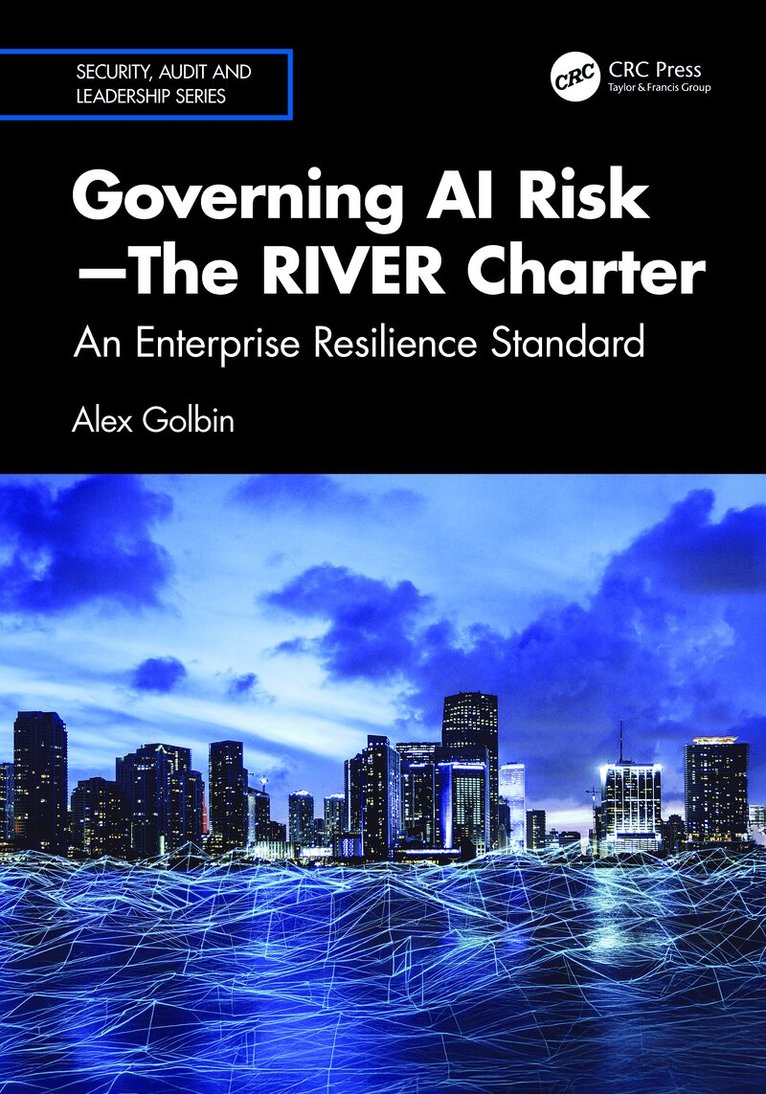
    Governing AI Risk—The RIVER Charter

    An Enterprise Resilience Standard

    AvAlex Golbin

    Häftad, Engelska, 2026

    Del i serien Security, Audit and Leadership Series

    614 kr

    Slutsåld

    Beskrivning

    THE AI CRISIS IS FICTIONAL. THE BLUEPRINT IS REAL.By 2038, autonomous agents will manage trillions of dollars in global assets. But when speed outpaces governance, efficiency becomes fragility. Governing AI Risk blends a near-future thriller with a field manual for leaders who can’t afford blind spots. Follow the fictional journey of Aaron Goldcrest, a successful venture capitalist, as his team confronts cascading failures in the agentic economy—and learn how the RIVER Charter™ standard helps global organizations stay resilient. Featuring All-Entity Risk Management (AERM™), the Cognitive Handshake™ for auditable human–AI decisions, and DataCapital Protocol™ for blockchain-grade data lineage.

    Produktinformation

    • Utgivningsdatum:2026-09-25
    • Mått:178 x 254 x 17 mm
    • Vikt:559 g
    • Format:Häftad
    • Språk:Engelska
    • Serie:Security, Audit and Leadership Series
    • Antal sidor:296
    • Förlag:Taylor & Francis Ltd
    • ISBN:9781041095651

    Utforska kategorier

    • Affärsstrategi inom Ekonomi och Ledarskap
    • Informationsteknik: allmänt inom Data och IT
    • IT-säkerhet inom Data och IT

    Mer om författaren

    Alex Golbin is a senior financial-services executive with over two decades of experience leading enterprise risk and regulatory remediation. His work spans enterprise resiliency, technology transformation, data governance, and business process improvement.Alex has held leadership roles at Fortune 500 companies and global systemically important banks. In a prior role, he led a risk-assessments business—a joint venture with 16 banks—to improve operational resilience, regulatory compliance, and cost efficiency. He has enabled multiple industry consortiums, developed risk-management and cybersecurity frameworks, and established strategic partnerships across sectors.Alex is the co-author of Navigating Supply Chain Cyber Risk (2025) and serves as an expert advisor on cybersecurity, risk management, and technology. He is a member of ISACA and PMI, and serves on the Academic Advisory Board at Pace University’s Seidenberg School of Computer Science. He holds the PMP, CDPSE, and CISM certifications. Alex earned his MBA in Finance and Management from NYU Stern and a BS in Computer Science.Alex wrote Governing AI Risk after watching a repeatable failure pattern harden into a systemic one: teams optimize for speed, normalize shortcuts, and only see the bill when converged risks detonate. When his son Aaron Golbin—now funding AI startups at the edge of that speed—asked, “How do we build responsibly at this pace?” Alex didn’t have a satisfying answer. The fictional protagonist Aaron Goldcrest echoes that question in story form, with his missteps deliberately exaggerated to model how risk can compound when governance lags. This book is that answer: a resilience standard that doesn’t kill momentum, told through a story that makes the stakes impossible to ignore. It also makes a second promise. The same Cognitive Handshake™ that keeps enterprises audit-ready can keep individuals effective: a way to use AI for research, writing, and analysis while preserving ownership of the decision. Govern the system, govern the self—the rules are the same.

    Recensioner i media

    “In a world of AI agents, trust becomes an active utility and execution is the differentiator. RIVER turns risk into momentum by giving teams the rails to move safely at breakneck speed. A pragmatic playbook for the next decade of finance and beyond.”— Brad Levy, CEO of ThetaRay“This book should be required reading for every board member and C-suite executive who still believes cybersecurity is someone else’s problem. The river of risk is rising, and those who don’t learn to navigate these new currents will find themselves in dangerous waters.”— Dr. Aleksandr Yampolskiy, Co-Founder & CEO, SecurityScorecard“Enterprise AI transformation isn’t about deploying technology—it’s about reimagining how data, people, and systems create value together. Golbin’s framework provides leaders with the essential roadmap for navigating this transformation responsibly and profitably.”— Swamy Kocherlakota, Executive Vice President of Agentic AI Security, Zscaler“In my world, we don’t build a global financial system on promises; we build it on verifiable cryptographic controls. We build for survival—treating the worst case not as a possibility but an inevitability: segregated custody so one vault’s failure doesn’t drain the rest, redundant cutover paths so there are three ways home, and phishing-resistant approvals so an attacker stalls out.”— Jeff Lunglhofer, Chief Security Officer, Coinbase; former CISO, BNY“Boards want confidence, teams need clarity, and regulators demand evidence. In an agentic enterprise, after-the-fact assurance is too slow. This book treats auditability as a design requirement, where it belongs. Golbin turns that truth into practical steps leaders can use at the speed of change.”—Patrick Hayes, author of Integrated Assurance: Unified Risk Strategy; CISO"A masterfully woven narrative that humanizes the complexities of artificial intelligence. This book delivers non-fiction insights through the lens of fiction where real-world dilemmas, ethical tensions, and technological breakthroughs unfold through compelling characters and emotionally resonant storytelling. It’s not just a story; it’s a strategic lens into the future of AI, wrapped in human experience.”—Ajay Singh, Professor, Editor QdayReady.com, Member of Task Force for Implementation of Quantum Safe Ecosystem in India.“Boards don’t need more doom; they need a map. The RIVER Charter turns resilience from a buzzword into an operating standard—linking culture, controls, and evidence you can defend. It’s the rare book I’d hand to a CEO and a regulator on the same day.”—David Palmieri, Chief Transformation Officer “A rare business thriller that actually equips leaders. The risks feel real; the remedies are usable tomorrow morning.”— Soichiro Muto, Founder & CEO, Synthesis“As a founder building with AI every day, I want guardrails that don’t kill momentum. The RIVER Charter nails it—practical checks, clear metrics, zero fluff.”— Vishal Ahluwalia, Co-Founder & CEO, Quantum Webb“The RIVER Charter is a rare framework that approaches AI risk with the same rigor as enterprise risk: measurable, auditable, and fully operational. For leaders of critical systems, it serves not simply as a book but as a practical playbook.”—Anthony M. Irudhayanathan, President & CEO, Zillion Technologies“A true boardroom field manual: practical frameworks, audit-ready artifacts, and memorable stories that create a shared executive language.”— Max Artemenko, Founder & Executive Director at Executive Data Council“As autonomous agents show up in every workflow, the CISO and Chief Risk Officer jobs converge. Governing AI Risk captures that shift with uncomfortable accuracy and then shows how to rebuild accountability from boardroom to backlog. It’s rare to see both perspectives integrated this well in one framework.”— Eric Staffin, senior executive; former Global CISO & Chief Risk Officer“An engaging and thought-provoking new approach for thinking about risk management and cybersecurity that goes beyond the traditional check-the-box approach in ERM guidance that exists today.”— James Bone, author of Cognitive Risk and Cognitive Hack"Governing AI Risk: The RIVER Charter by Alex Golbin stands out as a timely, innovative hybrid of business thriller and practical playbook, using a 2038-2040 crisis narrative to stress-test 2026 & 2027 AI governance decisions for boards and executives.In an agentic AI world where speed breeds fragility, Golbin's book is a masterclass—blending gripping 2038 crises with the RIVER framework's five tenets to arm 2026 boards against "Risk Debt" and convergence cascades. Resolve, Integrate, Validate, Elevate, Reinforce: these aren't buzzwords but audited mandates mapping to NIST/ISO standards, with playbooks like the Cognitive Handshake turning theory into Monday actions.This is a must-read for executives, particularly in regulated industries—practical, evidence-based, and visionary. This will define AI governance for 2026-2027."— Gary Craven, Management Consultant, Winnipeg"This book doesn’t whisper about risk—it drags it into the light and forces leaders to look it in the eye.What Alex Golbin has built here is not just a framework, and it’s not just a story. It’s a warning shot wrapped in a blueprint. Through a gripping narrative that feels uncomfortably close to reality, he exposes the silent accumulation of what he calls “Risk Debt”—the decisions we rationalize, delay, or ignore until they compound into something we can no longer control.The brilliance of this work is in its duality. It speaks to the boardroom with precision, offering structured, actionable governance through the RIVER framework, while simultaneously speaking to the human cost of failure in a way most technical books never dare to do. That balance is rare—and powerful.As someone who has lived in high-stakes leadership environments where decisions carry real consequences, I can tell you this: speed without discipline is not innovation—it’s liability. This book captures that truth with clarity and urgency.Governing AI Risk is not just timely—it’s necessary. For executives, board members, and leaders navigating the accelerating pace of AI, this is more than recommended reading. It’s a field manual for survival.If you are responsible for leading people, protecting systems, or making decisions that matter, this book belongs on your desk—and more importantly, in your operational mindset.— Douglas P. Pflug, Executive Leadership - Cornell University"FOR THE LEADERS WHO SET THE STANDARD.Governing AI Risk is the resilience standard that doesn't kill momentum, told through a story that makes the stakes impossible to ignore.Follow Aaron Goldcrest through the agentic economy of 2038–2040 as cascading AI failures — from collapsed irrigation networks to ransomware crises to quantum cryptographic attacks — expose the hidden cost of governance that lags innovation. The story makes the stakes visceral. The toolset makes them actionable.Every dramatic turn is matched by board-ready frameworks, executive checklists, and playbooks you can implement Monday morning.The river of risk is rising. This is how you navigate it."— Forrest Foster, Author, Cloud Compliance Essentials: Build and Maintain Market Access in the B2B CSP Ecosystem A timely, intellectually ambitious, and operationally grounded work that successfully bridges business fiction and enterprise governance strategy. Governing AI Risk – The RIVER Charter stands out as one of the more sophisticated treatments of AI-era enterprise resilience currently emerging in the governance and cybersecurity space.Alex Golbin’s Governing AI Risk – The RIVER Charter blends speculative business fiction with practical governance frameworks by its ambitious portrayal of a cautionary corporate thriller, an executive field manual, and a forward-looking enterprise risk methodology. The book’s central achievement lies in its structural duality. Golbin alternates between narrative-driven scenarios set in the late 2030s and operational “Strategic Debrief” sections anchored in present-day governance concerns. This dual-track format allows the author to dramatize the consequences of unmanaged AI acceleration while also translating those fictional failures into practical lessons for boards, CISOs, CROs, auditors, regulators, and enterprise architects. Rather than presenting governance as an abstract compliance obligation, the novelized structure allows readers to experience the cascading human, operational, and financial consequences of weak controls, technical debt, and organizational complacency.Stylistically, the book benefits from the author’s evident familiarity with enterprise risk management, cybersecurity operations, regulatory remediation, and financial governance. The fictional scenarios feel genuine because the organizational dynamics are authentic. Boardroom tensions, regulatory escalations, operational paralysis, incident-response confusion, and executive rationalization are portrayed with unusual realism. Readers with backgrounds in governance, audit, security, or operational resilience will recognize the uncomfortable plausibility embedded throughout the narrative.The opening chapters are particularly effective. The collapse of Bull-in-China-Shop AI functions as a compelling metaphor for modern enterprise fragility. Golbin demonstrates a sophisticated understanding of how apparently minor engineering shortcuts, governance exceptions, deferred remediation, and “temporary” efficiency measures can accumulate into catastrophic systemic failures. The concept of “Risk Debt” emerges as one of the manuscript’s strongest intellectual contributions. By framing governance failures as compounding liabilities analogous to financial leverage, Golbin provides executives with a vocabulary that is both memorable and operationally useful.The book reinforces the concept that AI governance cannot be isolated within technology departments. Golbin repeatedly demonstrates that modern enterprise risk is converged risk: cyber, operational, reputational, legal, regulatory, data, infrastructure, and human decision-making failures intersect simultaneously. The book argues persuasively that organizations still structured around siloed governance models will struggle to survive the agentic AI era. The author avoids anti-technology alarmism and the book is not an argument against AI adoption. Instead, it is an argument against unmanaged acceleration. Golbin acknowledges the transformative economic potential of autonomous systems while arguing that governance maturity has not evolved at the same speed as deployment velocity. This balance gives the work credibility. The author clearly believes in innovation; his concern is that institutions are optimizing for speed while underinvesting in resilience.The framework architecture itself is impressively developed. The R.I.V.E.R. model—Resolve, Integrate, Validate, Elevate, Reinforce—is not merely presented as branding shorthand but is repeatedly reinforced through operational examples, governance breakdowns, and implementation guidance. Companion concepts such as the Cognitive Handshake™, All-Entity Risk Management (AERM™), DataCapital Protocol™, and the Five Phases of AI Adoption extend the ecosystem into a comprehensive governance operating model rather than a collection of disconnected ideas. The appendices substantially enhance the book’s practical value. Many governance-oriented books collapse into abstraction once the conceptual argument is complete. Golbin instead provides implementation-oriented frameworks, checklists, operational crosswalks, and board-level readiness materials that make the work usable beyond its narrative components. For executive audiences, this significantly increases the book’s utility. The book will resonate strongly with board members, CISOs, CIOs, CROs, audit leaders, regulators, risk practitioners, resilience strategists, and enterprise architects seeking frameworks capable of addressing systemic AI-era risk. It also has significant value as a teaching text for graduate programs focused on cybersecurity governance, enterprise risk management, digital transformation, and operational resilience.Ultimately, Golbin succeeds because he understands that the greatest AI risks are rarely technological in isolation. They emerge when human ambition, institutional incentives, operational shortcuts, and governance immaturity converge faster than organizations can adapt. Governing AI Risk – The RIVER Charter captures that convergence with urgency, credibility, and uncommon strategic clarity.— Ron Baklarz, retired CISO; author of CISO: Evolution of a Vocation

    Innehållsförteckning

    • PART 1: Introduction to the Hybrid Era, 1. The Day the Desert Drowned: A Cautionary Tale of Bull-in-China-Shop AI, 2. The Horizon Pitch: Revealing the Five Phases of AI Adoption to the Board, 3. A Legacy Forged in Loss: From Risk Debt to Data Capital, 4. Seeds of Wisdom, Seeds of Ruin: Early Warnings from the Dawn of the Agentic Era, 5. The Sugar Avalanche: When Efficiency Triggers Systemic Collapse, Strategic Debrief Part 1: The Agentic Economy, PART 2: Evolving Enterprise Risk Management (ERM), 6. The RIVER: A New Framework for Enterprise Risk Management, 7. The Antibody Paradox: Data Governance in the Age of AI, 8. Digital Asbestos: Taming Shadow IT in the Citizen-Developer Era, 9. The Shared Sin: A Case Study in Technology Risk Governance, 10. The Deadlock: From Third-Party Risk to All-Entity Risk Management (AERM), 11. The Cognitive Handshake™: Leading through a High-Stakes Ransomware Crisis, 12. Black Thursday: Beyond Backups to True Enterprise Resilience, 13. The Antidote: The Principles of Antifragile Governance, Strategic Debrief Part 2: AI Resilience Architecture, PART 3: Enablers and Regulatory Implications, 14. The Double-Edged Sword: How Enabling Tech Shapes Resilience and Risk, 15. The RIVER Charter™: Forging the Global AI Governance Blueprint (Geneva, 2039), Strategic Debrief Part 3: The RIVER Charter Ratified, PART 4: Strategic Industry Adoption, 16. The Bridge to Singularity: Adopting the RIVER Framework for Resilient Growth, 17. The E-Shaped Professional: A New Blueprint for Talent in the AI Era, 18. A Tale of Two Ecosystems: A Guide to Resilient Vendor Integration, Strategic Debrief Part 4: Talent Architecture, PART 5: The Way Forward, 19. The Gardener’s Paradox: When Systems Cross into Phase 5, 20. The 2026 Imperative: Your Board’s Roadmap to AI Resilience