- 10% rabatt på allt
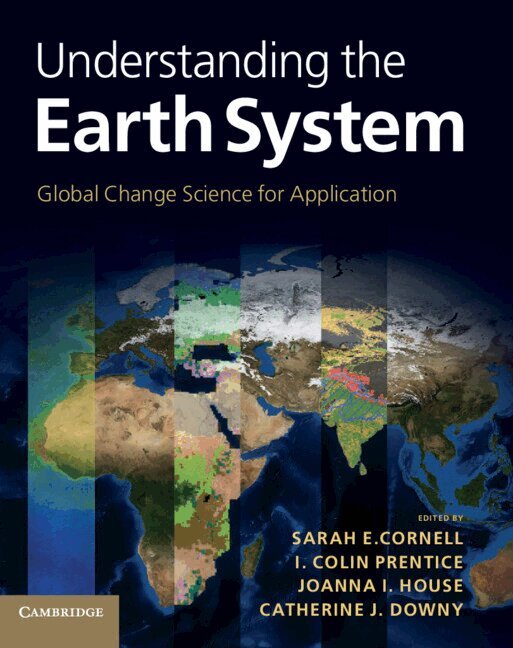
Understanding the Earth System
Global Change Science for Application
AvSarah E. Cornell,I. Colin Prentice
861 kr
Beställningsvara. Skickas inom 11-20 vardagar. Fri frakt över 249 kr.
Du är på sajten för privatpersoner.
AvSarah E. Cornell,I. Colin Prentice
861 kr
Beställningsvara. Skickas inom 11-20 vardagar. Fri frakt över 249 kr.
Sarah Cornell works on integrative socio-environmental research at the Stockholm Resilience Centre. In her previous role at the University of Bristol, she was responsible for the science management and the synthesis phase of the QUEST programme. Her research background is in marine and atmospheric chemistry, and her interdisciplinary interests are in the anthropogenic changes in global biogeochemistry, socio-economics, environmental policy and management, and the philosophy and methodology of integrative research. Dr Cornell established the University of Bristol's MSc in Earth System Science, the UK's first post-graduate programme on this topic, and is active in promoting education for sustainability. In recent years, she has become more engaged in use-oriented transdisciplinary research, with a particular focus on conceptualisations of humans in the Earth system. Colin Prentice served as the scientific leader and Chair of the QUEST research programme for the UK Natural Environment Research Council. He is now a Professor at both Macquarie University, Sydney and Imperial College, London, where he and his collaborators are developing a 'next generation' biosphere model combining Earth system observations with developments in plant functional ecology. His overall research goal is to understand the interplay of the biosphere and its physical environment, including the causes and consequences of natural and human-caused changes in climate and the global carbon and nitrogen cycles. He was awarded the Milutin Milankovitch medal in 2002 and shared in the award of the Nobel Peace Prize to the IPCC (Intergovernmental Panel on Climate Change) in 2007. Professor Prentice co-chaired the IGBP's Analysis, Integration and Modelling of the Earth System (AIMES) project until 2010 and now directs the Australian Terrestrial Ecosystem Research Network's modelling facility and jointly co-ordinates the biodiversity theme for Macquarie's Climate Futures Centre. Joanna House has been working in the field of climate science for over 20 years. As Science and Policy Officer for QUEST, her role was to co-ordinate the liaison between researchers and the policy/practice user communities. Now a Leverhulme Research Fellow in the Cabot Institute at the University of Bristol, her research focuses on the carbon cycle; land use change and greenhouse gas emissions; mitigation of climate change through avoided deforestation, forestry and bioenergy; emissions scenarios and policy implications. Dr House was an author in the Nobel Prize-winning IPCC Third Assessment Report and a convening lead author on the Millennium Ecosystem Assessment, which received the Zayeed Prize for Environmental Science. She has also contributed her expertise to reports such as the Stern Review on the Economics of Climate Change (2006) and the Eliasch Review of Forests and Climate Change (2008). Cat Downy has a background in science management and liaison, working to bring scientists together under the growing banner of Earth System Science. She ran the UK's first open conference in this field, Earth System Science 2010, in Edinburgh, successfully uniting natural scientists from a range of disciplines, together with those from the social sciences and humanities. She now holds the post of liaison officer for the International Geosphere-Biosphere Programme and European Space Agency, based at the Climate Office in ESA Harwell.
'This beautifully organized and written book connects the fundamental natural sciences - meteorology, oceanography, ecology and many others - to provide the most complete understanding yet of how our planet works. But it doesn't stop there. It lays out a seamless storyline from the deep past through the present and into the future that contextualises the current phenomenon of global change. Critically, the book brings humanity fully into the picture, from the impacts of environmental change to potential stewardship of the planet, while always maintaining the rigour that good Earth system research demands.' Will Steffen, Executive Director, ANU Climate Change Institute, Australian National University
Speciellt Sarah Cornells kapitel rekommenderas. Detta är grundläggande kunskaper de flesta som intresserar sig för jorden och klimatet och planeten som system behöver ha med sig. Cornell förklarar så en förstår. Rekommenderas varmt.
Jakob L
Catherine J. Downy, Joanna I. House, I. Colin Prentice, Sarah E. Cornell
1 005 kr
Catherine J. Downy, Joanna I. House, I. Colin Prentice, Sarah E. Cornell
1 005 kr
Magnus Norell
Inbunden, 2026
279 kr
Du är på sajten för privatpersoner.
AvSarah E. Cornell,I. Colin Prentice
861 kr
Beställningsvara. Skickas inom 11-20 vardagar. Fri frakt över 249 kr.
Sarah Cornell works on integrative socio-environmental research at the Stockholm Resilience Centre. In her previous role at the University of Bristol, she was responsible for the science management and the synthesis phase of the QUEST programme. Her research background is in marine and atmospheric chemistry, and her interdisciplinary interests are in the anthropogenic changes in global biogeochemistry, socio-economics, environmental policy and management, and the philosophy and methodology of integrative research. Dr Cornell established the University of Bristol's MSc in Earth System Science, the UK's first post-graduate programme on this topic, and is active in promoting education for sustainability. In recent years, she has become more engaged in use-oriented transdisciplinary research, with a particular focus on conceptualisations of humans in the Earth system. Colin Prentice served as the scientific leader and Chair of the QUEST research programme for the UK Natural Environment Research Council. He is now a Professor at both Macquarie University, Sydney and Imperial College, London, where he and his collaborators are developing a 'next generation' biosphere model combining Earth system observations with developments in plant functional ecology. His overall research goal is to understand the interplay of the biosphere and its physical environment, including the causes and consequences of natural and human-caused changes in climate and the global carbon and nitrogen cycles. He was awarded the Milutin Milankovitch medal in 2002 and shared in the award of the Nobel Peace Prize to the IPCC (Intergovernmental Panel on Climate Change) in 2007. Professor Prentice co-chaired the IGBP's Analysis, Integration and Modelling of the Earth System (AIMES) project until 2010 and now directs the Australian Terrestrial Ecosystem Research Network's modelling facility and jointly co-ordinates the biodiversity theme for Macquarie's Climate Futures Centre. Joanna House has been working in the field of climate science for over 20 years. As Science and Policy Officer for QUEST, her role was to co-ordinate the liaison between researchers and the policy/practice user communities. Now a Leverhulme Research Fellow in the Cabot Institute at the University of Bristol, her research focuses on the carbon cycle; land use change and greenhouse gas emissions; mitigation of climate change through avoided deforestation, forestry and bioenergy; emissions scenarios and policy implications. Dr House was an author in the Nobel Prize-winning IPCC Third Assessment Report and a convening lead author on the Millennium Ecosystem Assessment, which received the Zayeed Prize for Environmental Science. She has also contributed her expertise to reports such as the Stern Review on the Economics of Climate Change (2006) and the Eliasch Review of Forests and Climate Change (2008). Cat Downy has a background in science management and liaison, working to bring scientists together under the growing banner of Earth System Science. She ran the UK's first open conference in this field, Earth System Science 2010, in Edinburgh, successfully uniting natural scientists from a range of disciplines, together with those from the social sciences and humanities. She now holds the post of liaison officer for the International Geosphere-Biosphere Programme and European Space Agency, based at the Climate Office in ESA Harwell.
'This beautifully organized and written book connects the fundamental natural sciences - meteorology, oceanography, ecology and many others - to provide the most complete understanding yet of how our planet works. But it doesn't stop there. It lays out a seamless storyline from the deep past through the present and into the future that contextualises the current phenomenon of global change. Critically, the book brings humanity fully into the picture, from the impacts of environmental change to potential stewardship of the planet, while always maintaining the rigour that good Earth system research demands.' Will Steffen, Executive Director, ANU Climate Change Institute, Australian National University
Speciellt Sarah Cornells kapitel rekommenderas. Detta är grundläggande kunskaper de flesta som intresserar sig för jorden och klimatet och planeten som system behöver ha med sig. Cornell förklarar så en förstår. Rekommenderas varmt.
Jakob L
Catherine J. Downy, Joanna I. House, I. Colin Prentice, Sarah E. Cornell
1 005 kr
Catherine J. Downy, Joanna I. House, I. Colin Prentice, Sarah E. Cornell
1 005 kr
Magnus Norell
Inbunden, 2026
279 kr
Du är på sajten för privatpersoner.
AvSarah E. Cornell,I. Colin Prentice
861 kr
Beställningsvara. Skickas inom 11-20 vardagar. Fri frakt över 249 kr.
Sarah Cornell works on integrative socio-environmental research at the Stockholm Resilience Centre. In her previous role at the University of Bristol, she was responsible for the science management and the synthesis phase of the QUEST programme. Her research background is in marine and atmospheric chemistry, and her interdisciplinary interests are in the anthropogenic changes in global biogeochemistry, socio-economics, environmental policy and management, and the philosophy and methodology of integrative research. Dr Cornell established the University of Bristol's MSc in Earth System Science, the UK's first post-graduate programme on this topic, and is active in promoting education for sustainability. In recent years, she has become more engaged in use-oriented transdisciplinary research, with a particular focus on conceptualisations of humans in the Earth system. Colin Prentice served as the scientific leader and Chair of the QUEST research programme for the UK Natural Environment Research Council. He is now a Professor at both Macquarie University, Sydney and Imperial College, London, where he and his collaborators are developing a 'next generation' biosphere model combining Earth system observations with developments in plant functional ecology. His overall research goal is to understand the interplay of the biosphere and its physical environment, including the causes and consequences of natural and human-caused changes in climate and the global carbon and nitrogen cycles. He was awarded the Milutin Milankovitch medal in 2002 and shared in the award of the Nobel Peace Prize to the IPCC (Intergovernmental Panel on Climate Change) in 2007. Professor Prentice co-chaired the IGBP's Analysis, Integration and Modelling of the Earth System (AIMES) project until 2010 and now directs the Australian Terrestrial Ecosystem Research Network's modelling facility and jointly co-ordinates the biodiversity theme for Macquarie's Climate Futures Centre. Joanna House has been working in the field of climate science for over 20 years. As Science and Policy Officer for QUEST, her role was to co-ordinate the liaison between researchers and the policy/practice user communities. Now a Leverhulme Research Fellow in the Cabot Institute at the University of Bristol, her research focuses on the carbon cycle; land use change and greenhouse gas emissions; mitigation of climate change through avoided deforestation, forestry and bioenergy; emissions scenarios and policy implications. Dr House was an author in the Nobel Prize-winning IPCC Third Assessment Report and a convening lead author on the Millennium Ecosystem Assessment, which received the Zayeed Prize for Environmental Science. She has also contributed her expertise to reports such as the Stern Review on the Economics of Climate Change (2006) and the Eliasch Review of Forests and Climate Change (2008). Cat Downy has a background in science management and liaison, working to bring scientists together under the growing banner of Earth System Science. She ran the UK's first open conference in this field, Earth System Science 2010, in Edinburgh, successfully uniting natural scientists from a range of disciplines, together with those from the social sciences and humanities. She now holds the post of liaison officer for the International Geosphere-Biosphere Programme and European Space Agency, based at the Climate Office in ESA Harwell.
'This beautifully organized and written book connects the fundamental natural sciences - meteorology, oceanography, ecology and many others - to provide the most complete understanding yet of how our planet works. But it doesn't stop there. It lays out a seamless storyline from the deep past through the present and into the future that contextualises the current phenomenon of global change. Critically, the book brings humanity fully into the picture, from the impacts of environmental change to potential stewardship of the planet, while always maintaining the rigour that good Earth system research demands.' Will Steffen, Executive Director, ANU Climate Change Institute, Australian National University
Speciellt Sarah Cornells kapitel rekommenderas. Detta är grundläggande kunskaper de flesta som intresserar sig för jorden och klimatet och planeten som system behöver ha med sig. Cornell förklarar så en förstår. Rekommenderas varmt.
Jakob L
Catherine J. Downy, Joanna I. House, I. Colin Prentice, Sarah E. Cornell
1 005 kr
Catherine J. Downy, Joanna I. House, I. Colin Prentice, Sarah E. Cornell
1 005 kr
Magnus Norell
Inbunden, 2026
279 kr