• Fri frakt över 249 kr
  • •
  • Snabba leveranser
  • •
  • Billiga böcker
Kundservice

Du är på sajten för privatpersoner.

Företag, bibliotek eller offentlig verksamhet?

Du handlar på classic.bokus.com, där alla dina funktioner finns intakta.
Till classic.bokus.com
Bokus logotyp. Gå till startsidan.
  • Erbjudanden
  • Nyheter
  • Student
  • Topplistor
  • Barn & ungdom
  • Bokus Play
  • E-böcker
  • Pocketböcker
  • Spel & pussel

10% rabatt på allt med kod: NYSTART10 →

Sidfot

Mina sidor

    Hjälp

    • Kundservice
    • Vanliga frågor och svar
    • Frakt och leverans
    • Retur vid ångerrätt
    • Reklamera vara
    • Betalning
    • Köpvillkor
    • Allmänna villkor
    • Information om webbplatsens tillgänglighet

    Om Bokus

    • Om oss
    • Pressrum
    • För studenter
    • För företag
    • För bibliotek och offentlig verksamhet
    • För leverantörer
    • Hållbarhet

    Populärt

    • Aktuella erbjudanden
    • Presentkort
    • Studentlitteratur
    • Nya böcker
    • Topplistor
    • Signerade böcker
    • Engelska böcker

    Inspiration

    • Boktips
    • BookTok
    • Populära bokserier
    • Barnbokskaraktärer
    • Populära författare
    Logotyp för Bokus
    Följ oss på Facebook (extern länk)Följ oss på Instagram (extern länk)Följ oss på YouTube (extern länk)Följ oss på TikTok (extern länk)
    bokus @ CookiesAnpassa cookiesIntegritetspolicyKöpvillkor
    Till Citymail hemsida (extern länk)Till Budbee hemsida (extern länk)Till Postnord hemsida (extern länk)Till Schenker hemsida (extern länk)Till Early Bird hemsida (extern länk)Till Walleys hemsida (extern länk)
    1. Samhälle och politik
    2. Politik och statsskick
    3. Statsvetenskap och politisk teori

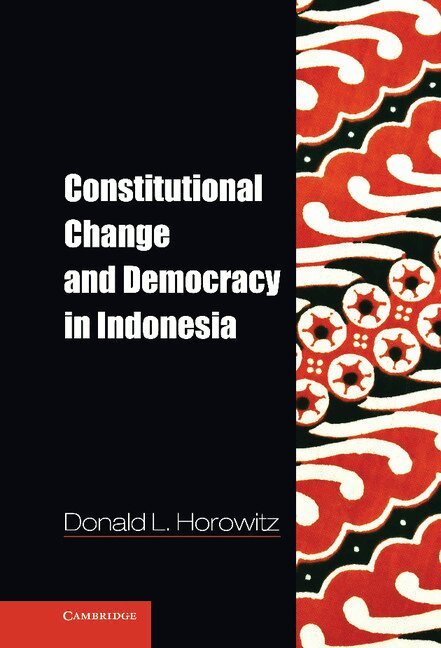
    Constitutional Change and Democracy in Indonesia

    AvDonald L. Horowitz

    Inbunden, Engelska, 2013

    Del i serien Problems of International Politics

    1 067 kr

    Beställningsvara. Skickas inom 10-15 vardagar. Fri frakt över 249 kr.

    Fler format och utgåvor

    Häftad

    379 kr

    Beskrivning

    How did democracy became entrenched in the world's largest Muslim-majority country? After the fall of its authoritarian regime in 1998, Indonesia pursued an unusual course of democratization. It was insider-dominated and gradualist and it involved free elections before a lengthy process of constitutional reform. At the end of the process, Indonesia's amended constitution was essentially a new and thoroughly democratic document. By proceeding as they did, the Indonesians averted the conflict that would have arisen between adherents of the old constitution and proponents of radical, immediate reform. Donald L. Horowitz documents the decisions that gave rise to this distinctive constitutional process. He then traces the effects of the new institutions on Indonesian politics and discusses their shortcomings and their achievements in steering Indonesia away from the dangers of polarization and violence. He also examines the Indonesian story in the context of comparative experience with constitutional design and intergroup conflict.

    Produktinformation

    • Utgivningsdatum:2013-03-25
    • Mått:152 x 229 x 24 mm
    • Vikt:680 g
    • Format:Inbunden
    • Språk:Engelska
    • Serie:Problems of International Politics
    • Antal sidor:346
    • Förlag:Cambridge University Press
    • ISBN:9781107027275

    Utforska kategorier

    • Statsvetenskap och politisk teori inom Samhälle och politik

    Mer om författaren

    Donald L. Horowitz is the James B. Duke Professor of Law and Political Science at Duke University. He is the author of The Courts and Social Policy (1977), winner of the Louis Brownlow Award of the National Academy of Public Administration; The Jurocracy (1977), a book about government lawyers; Coup Theories and Officers' Motives: Sri Lanka in Comparative Perspective (1980); Ethnic Groups in Conflict (1985, 2000); A Democratic South Africa? Constitutional Engineering in a Divided Society (1991), winner of the Ralph Bunche Award of the American Political Science Association; and The Deadly Ethnic Riot (2001). Horowitz has been a visiting professor at the University of Chicago Law School and the Central European University as well as a visiting fellow at Wolfson College, Cambridge, at the Law Faculty of the University of Canterbury in New Zealand and at Universiti Kebangsaan Malaysia. In 2001, he was Centennial Professor at the London School of Economics and in 2001–2002, he was a Carnegie Scholar. In 2009, he was presented with the Distinguished Scholar Award of the Ethnicity, Nationalism and Migration Section of the International Studies Association. Horowitz is currently writing a book about constitutional design, particularly for divided societies, a subject on which he has advised in a number of countries. In 2010–11, he was a fellow of the Woodrow Wilson Center. In 2011–12, he was a Jennings Randolph Senior Fellow at the US Institute of Peace and in 2013, he will be a fellow of the American Academy in Berlin. Elected to the American Academy of Arts and Sciences in 1993, he served as president of the American Society for Political and Legal Philosophy from 2007 to 2010. In 2011, Horowitz was awarded an honorary doctoral degree by the Vrije Universiteit Brussel, the Flemish-speaking Free University of Brussels.

    Recensioner i media

    'The country's remarkable steps toward democracy have inspired a recent proliferation of original works, and this is one of the best … Its politics long ignored, the world's fourth-largest country is now firmly on the academic scene, and in Horowitz's hands adding new insights about the process of democratic transitions. Recommended. Upper-division undergraduate, graduate, research and professional collections.' E. V. Schneier, Choice

    Innehållsförteckning

    • 1. A distinctive path; 2. Democratization before renovation; 3. Creeping reform: reconfiguring the political infrastructure; 4. A game of inches; 5. Anomalies, ironies, regularities, and surprises; 6. The shape of the new system; 7. Low-quality democracy and its discontents; 8. Causes, consequence, and the consequences of consequences.