• Fri frakt över 249 kr
  • •
  • Snabba leveranser
  • •
  • Billiga böcker
Kundservice

Du är på sajten för privatpersoner.

Företag, bibliotek eller offentlig verksamhet?

Du handlar på classic.bokus.com, där alla dina funktioner finns intakta.
Till classic.bokus.com
Bokus logotyp. Gå till startsidan.
  • Erbjudanden
  • Nyheter
  • Student
  • Topplistor
  • Barn & ungdom
  • Bokus Play
  • E-böcker
  • Pocketböcker
  • Spel & pussel

10% rabatt på allt med kod: NYSTART10 →

Sidfot

Mina sidor

    Hjälp

    • Kundservice
    • Vanliga frågor och svar
    • Frakt och leverans
    • Retur vid ångerrätt
    • Reklamera vara
    • Betalning
    • Köpvillkor
    • Allmänna villkor
    • Information om webbplatsens tillgänglighet

    Om Bokus

    • Om oss
    • Pressrum
    • För studenter
    • För företag
    • För bibliotek och offentlig verksamhet
    • För leverantörer
    • Hållbarhet

    Populärt

    • Aktuella erbjudanden
    • Presentkort
    • Studentlitteratur
    • Nya böcker
    • Topplistor
    • Signerade böcker
    • Engelska böcker

    Inspiration

    • Boktips
    • BookTok
    • Populära bokserier
    • Barnbokskaraktärer
    • Populära författare
    Logotyp för Bokus
    Följ oss på Facebook (extern länk)Följ oss på Instagram (extern länk)Följ oss på YouTube (extern länk)Följ oss på TikTok (extern länk)
    bokus @ CookiesAnpassa cookiesIntegritetspolicyKöpvillkor
    Till Citymail hemsida (extern länk)Till Budbee hemsida (extern länk)Till Postnord hemsida (extern länk)Till Schenker hemsida (extern länk)Till Early Bird hemsida (extern länk)Till Walleys hemsida (extern länk)
    1. Filosofi och religion
    2. Filosofi
    3. Filosofiska discipliner

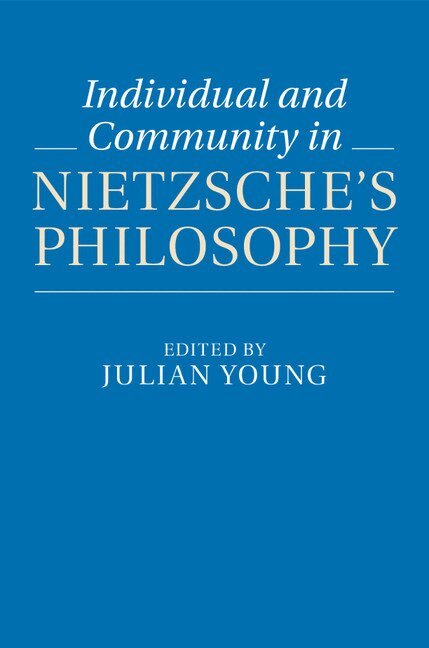
    Individual and Community in Nietzsche's Philosophy

    AvJulian Young

    Inbunden, Engelska, 2014

    1 335 kr

    Beställningsvara. Skickas inom 10-15 vardagar. Fri frakt över 249 kr.

    Beskrivning

    According to Bertrand Russell, Nietzsche's only value is the flourishing of the exceptional individual. The well-being of ordinary people is, in itself, without value. Yet there are passages in Nietzsche that appear to regard the flourishing of the community as a whole alongside, perhaps even above, that of the exceptional individual. The ten essays that comprise this volume wrestle with the tension between individual and community in Nietzsche's writings. Some defend a reading close to Russell's. Others suggest that Nietzsche's highest value is the flourishing of the community as a whole and that exceptional individuals find their highest value only in promoting that flourishing. In viewing Nietzsche from the perspective of community, the essays also cast new light on other aspects of his philosophy, for instance, his ideal of scientific research and his philosophy of language.

    Produktinformation

    • Utgivningsdatum:2014-08-21
    • Mått:152 x 229 x 16 mm
    • Vikt:510 g
    • Format:Inbunden
    • Språk:Engelska
    • Antal sidor:262
    • Förlag:Cambridge University Press
    • ISBN:9781107049857

    Utforska kategorier

    • Filosofiska discipliner inom Filosofi och religion

    Mer om författaren

    Julian Young is Kenan Professor of Humanities and Professor of Philosophy at Wake Forest University. He is the author of more than fifty articles and eleven books, including Friedrich Nietzsche: A Philosophical Biography (Cambridge, 2010), The Philosophy of Tragedy: From Plato to Žižek (Cambridge, 2013), and The Death of God and the Meaning of Life, 2nd edition (2014).

    Innehållsförteckning

    • 1. Nietzsche: the long view Julian Young; 2. 'The time is coming when one will have to relearn about politics' Hans Sluga; 3. The culture of myth and the myth of culture Ken Gemes and Chris Sykes; 4. Festivals of recognition: Nietzsche's idealized communities Kathleen Higgins; 5. Nietzsche's scientific community: elective affinities Jessica Berry; 6. The good of community Maudemarie Clark and Monique Wonderly; 7. The self versus society: Nietzsche's advocacy of egoism Ivan Soll; 8. Nietzsche and the collective individual Christine Swanton; 9. 'We Hyperboreans': toward a Nietzschean topography Jeff Malpas; 10. Nietzsche, language, and community John Richardson.