• Fri frakt över 249 kr
  • •
  • Snabba leveranser
  • •
  • Billiga böcker
Kundservice

Du är på sajten för privatpersoner.

Företag, bibliotek eller offentlig verksamhet?

Du handlar på classic.bokus.com, där alla dina funktioner finns intakta.
Till classic.bokus.com
Bokus logotyp. Gå till startsidan.
  • Erbjudanden
  • Nyheter
  • Student
  • Topplistor
  • Barn & ungdom
  • Bokus Play
  • E-böcker
  • Pocketböcker
  • Spel & pussel

10% studentrabatt med kod TERM26

Sidfot

Mina sidor

    Hjälp

    • Kundservice
    • Vanliga frågor och svar
    • Frakt och leverans
    • Retur vid ångerrätt
    • Reklamera vara
    • Betalning
    • Köpvillkor
    • Allmänna villkor
    • Information om webbplatsens tillgänglighet

    Om Bokus

    • Om oss
    • Pressrum
    • För studenter
    • För företag
    • För bibliotek och offentlig verksamhet
    • För leverantörer
    • Hållbarhet

    Populärt

    • Aktuella erbjudanden
    • Presentkort
    • Studentlitteratur
    • Nya böcker
    • Topplistor
    • Signerade böcker
    • Engelska böcker

    Inspiration

    • Boktips
    • BookTok
    • Populära bokserier
    • Barnbokskaraktärer
    • Populära författare
    Logotyp för Bokus
    Följ oss på Facebook (extern länk)Följ oss på Instagram (extern länk)Följ oss på YouTube (extern länk)Följ oss på TikTok (extern länk)
    bokus @ CookiesAnpassa cookiesIntegritetspolicyKöpvillkor
    Till Citymail hemsida (extern länk)Till Budbee hemsida (extern länk)Till Postnord hemsida (extern länk)Till Schenker hemsida (extern länk)Till Early Bird hemsida (extern länk)Till Walleys hemsida (extern länk)
    1. Ekonomi och Ledarskap
    2. Nationalekonomi
    3. Ekonomisk politik

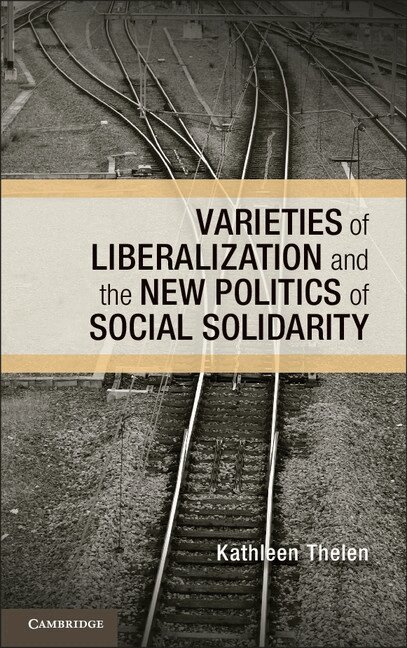
    Varieties of Liberalization and the New Politics of Social Solidarity

    AvKathleen Thelen

    Inbunden, Engelska, 2014

    Del i serien Cambridge Studies in Comparative Politics

    1 140 kr

    Beställningsvara. Skickas inom 10-15 vardagar. Fri frakt över 249 kr.

    Fler format och utgåvor

    Häftad

    337 kr

    E-bok

    408 kr

    E-bok

    408 kr

    Beskrivning

    This book examines contemporary changes in labor market institutions in the United States, Germany, Denmark, Sweden, and the Netherlands, focusing on developments in industrial relations, vocational education and training, and labor market policy. It finds that there are in fact distinct varieties of liberalization associated with very different distributive outcomes. Most scholarship equates liberal capitalism with inequality and coordinated capitalism with higher levels of social solidarity. However, this study explains why the institutions of coordinated capitalism and egalitarian capitalism coincided and complemented one another in the 'Golden Era' of postwar development in the 1950s and 1960s, and why they no longer do so. Contrary to the conventional wisdom, this study reveals that the successful defense of the institutions traditionally associated with coordinated capitalism has often been a recipe for increased inequality due to declining coverage and dualization. Conversely, it argues that some forms of labor market liberalization are perfectly compatible with continued high levels of social solidarity and indeed may be necessary to sustain it.

    Produktinformation

    • Utgivningsdatum:2014-03-31
    • Mått:152 x 229 x 19 mm
    • Vikt:500 g
    • Format:Inbunden
    • Språk:Engelska
    • Serie:Cambridge Studies in Comparative Politics
    • Antal sidor:282
    • Förlag:Cambridge University Press
    • ISBN:9781107053168
    • Utmärkelser:Best Book Award, European Politics and Society Section, American Political Science Association 2015

    Utforska kategorier

    • Ekonomisk politik inom Ekonomi och Ledarskap

    Mer om författaren

    Kathleen Thelen is Ford Professor of Political Science at Massachusetts Institute of Technology and a Permanent External Scientific Member of the Max Planck Institute for the Study of Societies in Cologne, Germany. She is the author, among other books, of How Institutions Evolve: The Political Economy of Skills in Germany, Britain, the United States and Japan (Cambridge, 2004), winner of the Woodrow Wilson Foundation Award, and winner of the Mattei Dogan Award of the Society for Comparative Research. She also writes extensively on historical institutionalism and theories of institutional change, including, most recently, Explaining Institutional Change: Ambiguity, Agency and Power (Cambridge, 2010, co-edited with James Mahoney) and Beyond Continuity: Institutional Change in Advanced Political Economies (2005, co-edited with Wolfgang Streeck). Thelen has held appointments as a research fellow or visiting professor at the Wissenschaftszentrum Berlin für Sozialpolitik, the University of Gothenburg (Sweden), Nuffield College (Oxford), Sciences Po (Paris), and the Copenhagen Business School, among others. She has served as Chair of the Council for European Studies (2002-6) and as President of the Society for the Advancement of Socio-Economics (2008-9). Currently, she is President of the APSA organized section for Comparative Politics. In 2009 Thelen was elected to the Berlin-Brandenburg Academy of Sciences and Humanities in Berlin.

    Recensioner i media

    "As union membership and the manufacturing sector have shrunk, the institutions built around them have become the locus of political conflict over inequality and inclusion in the world’s rich countries. Kathleen Thelen elegantly argues that the course of these struggles hinges on the extent to which unions have succeeded in organizing broad parts of the population, and to which states themselves have the capacity and political will to intervene in conflicts over redistribution. Returning the political coalitions identified by Esping-Andersen to the heart of institutionalist political economy, Thelen’s book is a trenchant statement of the ongoing struggles that lie behind the apparent stability in models of capitalism." Pepper D. Culpepper, European University Institute

    Innehållsförteckning

    • 1. Varieties of liberalization and the new politics of social solidarity; 2. Industrial relations institutions; 3. Vocational education and training; 4. Labor market policy; 5. Coalitional realignments and institutional change; 6. The future of egalitarian capitalism, in light of its past.