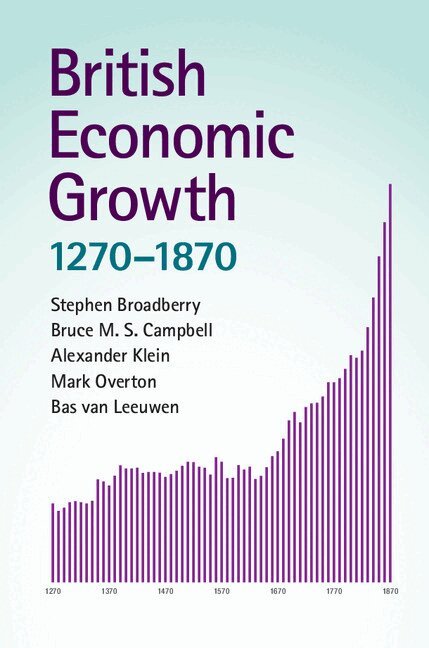
British Economic Growth, 1270-1870
AvStephen Broadberry,Bruce M. S. Campbell
1 723 kr
Beställningsvara. Skickas inom 5-8 vardagar. Fri frakt över 249 kr.
Du är på sajten för privatpersoner.
AvStephen Broadberry,Bruce M. S. Campbell
1 723 kr
Beställningsvara. Skickas inom 5-8 vardagar. Fri frakt över 249 kr.
Stephen Broadberry is Professor of Economic History at the London School of Economics and Political Science, Research Theme Leader at CAGE and Director of the Economic History Programme at CEPR. He has also taught at the Universities of Warwick, Oxford and Cardiff and held visiting positions at the University of British Columbia, the University of California, Berkeley, Humboldt University, Berlin, Universitat Pompeu Fabra, Barcelona, Hitotsubashi University, Tokyo and the University of Southern Denmark. His research interests include the development of the world economy from 1000 AD to the present; historical national accounts for Britain since 1086; the Great Divergence of productivity and living standards between Europe and Asia; sectoral aspects of comparative growth and productivity performance during the nineteenth and twentieth centuries; productivity in services; wars and economic performance. He is currently Editor of the Economic History Review, and has previously been Editor of the European Review of Economic History. He has been President of the European Historical Economics Society and is currently a Trustee of the Economic History Association and the Asian Historical Economics Society, and an Executive Committee Member of the Economic History Society. His books include The British Economy between the Wars: A Macroeconomic Survey (1986); The Productivity Race: British Manufacturing in International Perspective, 1850-1990 (Cambridge, 1997); Market Services and the Productivity Race, 1850-2000: British Performance in International Perspective (Cambridge, 2006) and the 2-volume Cambridge Economic History of Europe, edited with Kevin O'Rourke (Cambridge, 2010). Bruce Campbell is Emeritus Professor of Medieval Economic History at Queen's University, Belfast. He belongs to the Academia Europaea, Academy of Social Sciences, British Academy, Royal Historical Society and Royal Irish Academy, and is a former fellow of the Wissenschaftskolleg zu Berlin. A graduate of the Universities of Liverpool and Cambridge, his teaching at Queen's from 1973 to 2010 embraced the economic and environmental history of Britain and Ireland over the last millennium. He is the author of English Seigniorial Agriculture 1250-1450 (2000), co-author of A Medieval Capital and Its Grain Supply: Agrarian Production and Its Distribution in the London Region c.1300 (1993), and England on the Eve of the Black Death: An Atlas of Lay Lordship, Land, and Wealth, 1300-49 (2006), and author of three collections of essays: The Medieval Antecedents of English Agricultural Progress (2007), Field Systems and Farming Systems in Late Medieval England (2008), and Land and People in Late Medieval England (2009). His research harnesses the wealth of detailed statistical information contained in England's extensive medieval archives to shed systematic light on the country's economic development when it was still comparatively poor, under-developed and prone to subsistence crises and famine. He is currently completing the manuscript of his 2013 Ellen McArthur Lectures for publication by Cambridge. Alexander Klein is an Assistant Professor at the School of Economics, University of Kent. He taught at the University of Warwick, Centre for Economic Research and Graduate Education in Prague, and the London School of Economics. He also held a position at the Jagiellonian University in Krakow, and is a Research Associate of CAGE, University of Warwick. His research interests include long-run economic growth; divergence of living standards between Western and Eastern Europe; the second serfdom in Eastern Europe; economic geography; agglomeration economics; long-run comparative labour productivity of European countries; and historical national accounts. He has published in the Economic History Review, Explorations in Economic History, the Journal of Economic Geography, Scandinavian Economic History Review, and Research in Economic History. Mark Overton is Professor of Economic and Social History at the University of Exeter. Before moving to Exeter he taught in the Geography Departments of the Universities of Cambridge and Newcastle, and held a Visiting Fellowship at All Souls College, Oxford. His research interests are in the agrarian history of England from the middle ages to the present day and in the economy and society in early modern England. He is currently President of the British Agricultural History Society and has been a member of the Executive Committee of the Economic History Society. He was also Vice-Chair of the Training and Skills Committee of the Economic and Social Research Council. His books include Agricultural Revolution in England: The Transformation of the Agrarian Economy 1500-1850 (Cambridge, 1996); Farming to Halves: The Hidden History of Sharefarming in England from Medieval to Modern Times (2008); and Production and Consumption in English Households, 1600-1750 (2004). He also co-edited Land, Labour and Livestock: Historical Studies in European Agricultural Productivity (1991) with Bruce Campbell. Bas van Leeuwen is a Postdoctoral Researcher in Economic History at Utrecht University, The Netherlands. He has held similar positions at Warwick University and Vrije Universiteit, Amsterdam. His main field of interest includes quantitative economic development in Europe and Asia between c.500 BC and the present. He has also been part of the, now finalized, project on historical national accounts of The Netherlands. Currently he is participating in the historical national accounts of China as well as being the editor of the Quantitative History of China series which will make historical data on China available to the wider audience.
'This book continues the path-breaking tradition initiated by Phyllis Deane and W. A. Cole [in] British Economic Growth, 1688-1959: Trends and Structure (1962). I can only congratulate Cambridge University Press for maintaining it and encouraging the publication of such a landmark in British and international economic history. My hope is that is will set the standards for research in other countries' economic history.' Leandro Prados de la Escosura, Universidad Carlos III
Bas van Leeuwen, Mark Overton, Alexander Klein, Bruce M. S. Campbell, Stephen Broadberry
559 kr
Stephen Broadberry, Kevin H. O'Rourke
Häftad, 2010
639 kr
Stephen Broadberry, Kevin H. O'Rourke
Häftad, 2010
639 kr
Stephen Broadberry, Kevin H. O'Rourke, Stephen Broadberry, Kevin H. O'Rourke
Inbunden, 2010
1 641 kr
Stephen Broadberry, Kevin H. O'Rourke, Stephen Broadberry, Kevin H. O'Rourke
Inbunden, 2010
1 641 kr
Stephen Broadberry, Bruce M. S. Campbell, Alexander Klein, Mark Overton, Bas van Leeuwen
Häftad, 2015
574 kr
Bas van Leeuwen, Mark Overton, Alexander Klein, Bruce M. S. Campbell, Stephen Broadberry
559 kr
Bas van Leeuwen, Mark Overton, Alexander Klein, Bruce M. S. Campbell, Stephen Broadberry
559 kr
Alexander Klein
Häftad, 2008
352 kr
Du är på sajten för privatpersoner.
AvStephen Broadberry,Bruce M. S. Campbell
1 723 kr
Beställningsvara. Skickas inom 5-8 vardagar. Fri frakt över 249 kr.
Stephen Broadberry is Professor of Economic History at the London School of Economics and Political Science, Research Theme Leader at CAGE and Director of the Economic History Programme at CEPR. He has also taught at the Universities of Warwick, Oxford and Cardiff and held visiting positions at the University of British Columbia, the University of California, Berkeley, Humboldt University, Berlin, Universitat Pompeu Fabra, Barcelona, Hitotsubashi University, Tokyo and the University of Southern Denmark. His research interests include the development of the world economy from 1000 AD to the present; historical national accounts for Britain since 1086; the Great Divergence of productivity and living standards between Europe and Asia; sectoral aspects of comparative growth and productivity performance during the nineteenth and twentieth centuries; productivity in services; wars and economic performance. He is currently Editor of the Economic History Review, and has previously been Editor of the European Review of Economic History. He has been President of the European Historical Economics Society and is currently a Trustee of the Economic History Association and the Asian Historical Economics Society, and an Executive Committee Member of the Economic History Society. His books include The British Economy between the Wars: A Macroeconomic Survey (1986); The Productivity Race: British Manufacturing in International Perspective, 1850-1990 (Cambridge, 1997); Market Services and the Productivity Race, 1850-2000: British Performance in International Perspective (Cambridge, 2006) and the 2-volume Cambridge Economic History of Europe, edited with Kevin O'Rourke (Cambridge, 2010). Bruce Campbell is Emeritus Professor of Medieval Economic History at Queen's University, Belfast. He belongs to the Academia Europaea, Academy of Social Sciences, British Academy, Royal Historical Society and Royal Irish Academy, and is a former fellow of the Wissenschaftskolleg zu Berlin. A graduate of the Universities of Liverpool and Cambridge, his teaching at Queen's from 1973 to 2010 embraced the economic and environmental history of Britain and Ireland over the last millennium. He is the author of English Seigniorial Agriculture 1250-1450 (2000), co-author of A Medieval Capital and Its Grain Supply: Agrarian Production and Its Distribution in the London Region c.1300 (1993), and England on the Eve of the Black Death: An Atlas of Lay Lordship, Land, and Wealth, 1300-49 (2006), and author of three collections of essays: The Medieval Antecedents of English Agricultural Progress (2007), Field Systems and Farming Systems in Late Medieval England (2008), and Land and People in Late Medieval England (2009). His research harnesses the wealth of detailed statistical information contained in England's extensive medieval archives to shed systematic light on the country's economic development when it was still comparatively poor, under-developed and prone to subsistence crises and famine. He is currently completing the manuscript of his 2013 Ellen McArthur Lectures for publication by Cambridge. Alexander Klein is an Assistant Professor at the School of Economics, University of Kent. He taught at the University of Warwick, Centre for Economic Research and Graduate Education in Prague, and the London School of Economics. He also held a position at the Jagiellonian University in Krakow, and is a Research Associate of CAGE, University of Warwick. His research interests include long-run economic growth; divergence of living standards between Western and Eastern Europe; the second serfdom in Eastern Europe; economic geography; agglomeration economics; long-run comparative labour productivity of European countries; and historical national accounts. He has published in the Economic History Review, Explorations in Economic History, the Journal of Economic Geography, Scandinavian Economic History Review, and Research in Economic History. Mark Overton is Professor of Economic and Social History at the University of Exeter. Before moving to Exeter he taught in the Geography Departments of the Universities of Cambridge and Newcastle, and held a Visiting Fellowship at All Souls College, Oxford. His research interests are in the agrarian history of England from the middle ages to the present day and in the economy and society in early modern England. He is currently President of the British Agricultural History Society and has been a member of the Executive Committee of the Economic History Society. He was also Vice-Chair of the Training and Skills Committee of the Economic and Social Research Council. His books include Agricultural Revolution in England: The Transformation of the Agrarian Economy 1500-1850 (Cambridge, 1996); Farming to Halves: The Hidden History of Sharefarming in England from Medieval to Modern Times (2008); and Production and Consumption in English Households, 1600-1750 (2004). He also co-edited Land, Labour and Livestock: Historical Studies in European Agricultural Productivity (1991) with Bruce Campbell. Bas van Leeuwen is a Postdoctoral Researcher in Economic History at Utrecht University, The Netherlands. He has held similar positions at Warwick University and Vrije Universiteit, Amsterdam. His main field of interest includes quantitative economic development in Europe and Asia between c.500 BC and the present. He has also been part of the, now finalized, project on historical national accounts of The Netherlands. Currently he is participating in the historical national accounts of China as well as being the editor of the Quantitative History of China series which will make historical data on China available to the wider audience.
'This book continues the path-breaking tradition initiated by Phyllis Deane and W. A. Cole [in] British Economic Growth, 1688-1959: Trends and Structure (1962). I can only congratulate Cambridge University Press for maintaining it and encouraging the publication of such a landmark in British and international economic history. My hope is that is will set the standards for research in other countries' economic history.' Leandro Prados de la Escosura, Universidad Carlos III
Bas van Leeuwen, Mark Overton, Alexander Klein, Bruce M. S. Campbell, Stephen Broadberry
559 kr
Stephen Broadberry, Kevin H. O'Rourke
Häftad, 2010
639 kr
Stephen Broadberry, Kevin H. O'Rourke
Häftad, 2010
639 kr
Stephen Broadberry, Kevin H. O'Rourke, Stephen Broadberry, Kevin H. O'Rourke
Inbunden, 2010
1 641 kr
Stephen Broadberry, Kevin H. O'Rourke, Stephen Broadberry, Kevin H. O'Rourke
Inbunden, 2010
1 641 kr
Stephen Broadberry, Bruce M. S. Campbell, Alexander Klein, Mark Overton, Bas van Leeuwen
Häftad, 2015
574 kr
Bas van Leeuwen, Mark Overton, Alexander Klein, Bruce M. S. Campbell, Stephen Broadberry
559 kr
Bas van Leeuwen, Mark Overton, Alexander Klein, Bruce M. S. Campbell, Stephen Broadberry
559 kr
Alexander Klein
Häftad, 2008
352 kr