• Fri frakt över 249 kr
  • •
  • Snabba leveranser
  • •
  • Billiga böcker
Kundservice

Du är på sajten för privatpersoner.

Företag, bibliotek eller offentlig verksamhet?

Du handlar på classic.bokus.com, där alla dina funktioner finns intakta.
Till classic.bokus.com
Bokus logotyp. Gå till startsidan.
  • Erbjudanden
  • Nyheter
  • Student
  • Topplistor
  • Barn & ungdom
  • Bokus Play
  • E-böcker
  • Pocketböcker
  • Spel & pussel

10% rabatt på allt med kod NYSTART10 →

Sidfot

Mina sidor

    Hjälp

    • Kundservice
    • Vanliga frågor och svar
    • Frakt och leverans
    • Retur vid ångerrätt
    • Reklamera vara
    • Betalning
    • Köpvillkor
    • Allmänna villkor
    • Information om webbplatsens tillgänglighet

    Om Bokus

    • Om oss
    • Pressrum
    • För studenter
    • För företag
    • För bibliotek och offentlig verksamhet
    • För leverantörer
    • Hållbarhet

    Populärt

    • Aktuella erbjudanden
    • Presentkort
    • Studentlitteratur
    • Nya böcker
    • Topplistor
    • Signerade böcker
    • Engelska böcker

    Inspiration

    • Boktips
    • BookTok
    • Populära bokserier
    • Barnbokskaraktärer
    • Populära författare
    Logotyp för Bokus
    Följ oss på Facebook (extern länk)Följ oss på Instagram (extern länk)Följ oss på YouTube (extern länk)Följ oss på TikTok (extern länk)
    bokus @ CookiesAnpassa cookiesIntegritetspolicyKöpvillkor
    Till Citymail hemsida (extern länk)Till Budbee hemsida (extern länk)Till Postnord hemsida (extern länk)Till Schenker hemsida (extern länk)Till Early Bird hemsida (extern länk)Till Walleys hemsida (extern länk)
    1. Psykologi och pedagogik
    2. Psykologi
    3. Kognitiv psykologi

    Frequency in Language

    Memory, Attention and Learning

    AvDagmar Divjak

    Inbunden, Engelska, 2019

    1 428 kr

    Beställningsvara. Skickas inom 10-15 vardagar. Fri frakt över 249 kr.

    Fler format och utgåvor

    Häftad

    372 kr

    Beskrivning

    Cognitive linguists are bound by the cognitive commitment, which is the commitment to providing a characterization of the general principles governing all aspects of human language, in a way that is informed by, and accords with, what is known about the brain and mind from other disciplines. But what do we know about aspects of cognition that are relevant for theories of language? Which insights can help us build cognitive reality into our descriptive practice and move linguistic theorizing forward? This unique study integrates research findings from across the cognitive sciences to generate insights that challenge the way in which frequency has been interpreted in usage-based linguistics. It answers the fundamental questions of why frequency of experience has the effect it has on language development, structure and representation, and what role psychological and neurological explorations of core cognitive processes can play in developing a cognitively more accurate theoretical account of language.

    Produktinformation

    • Utgivningsdatum:2019-10-10
    • Mått:156 x 235 x 19 mm
    • Vikt:660 g
    • Format:Inbunden
    • Språk:Engelska
    • Antal sidor:340
    • Förlag:Cambridge University Press
    • ISBN:9781107085756

    Utforska kategorier

    • Kognitiv psykologi inom Psykologi och pedagogik

    Mer om författaren

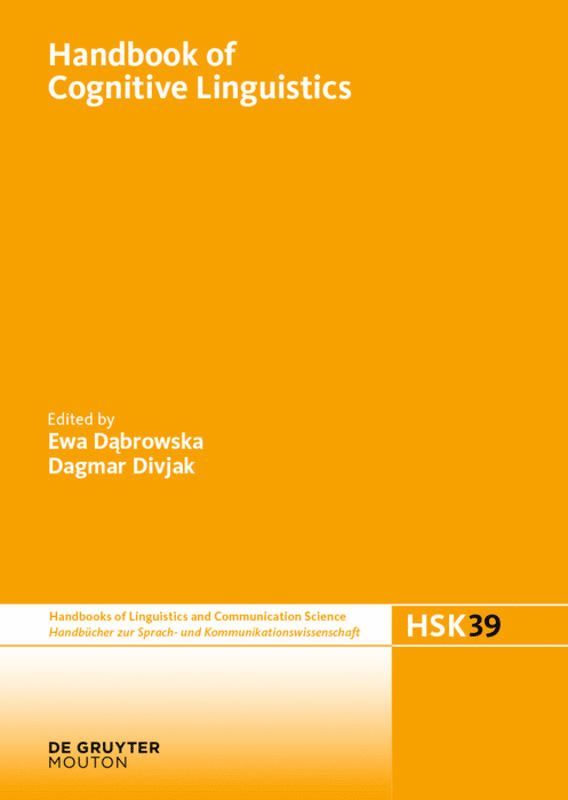
    Dagmar Divjak is a Professorial Research Fellow at the University of Birmingham where she holds a Chair in Cognitive Linguistics and Language Cognition. She is Editor-in-Chief of the journal Cognitive Linguistics and co-editor of Handbook of Cognitive Linguistics (2015, with Ewa Dąbrowska) and author of Structuring the Lexicon (2010).

    Recensioner i media

    'This book is a compendium of concepts, theories and practices at the intersection of cognitive linguistics, corpus linguistics, quantitative linguistics, computational linguistics, psycholinguistics, neurolinguistics, and the like … students and teachers of cognitive linguistics, corpus linguistics, quantitative linguistics, computational linguistics, psycholinguistics, and neurolinguistics should read.' Mayowa Akinlotan, LINGUIST List

    Innehållsförteckning

    • Introduction: 1. Frequency of experience; 2. A cognitive perspective on language; 3. What this book is not about; 4. What this book is about; Part I: 5. Counting occurrences: how frequency made its way into the study of language; 5.1. The frequency wars: the role of frequency in nativist and nurturist frameworks; 5.2. Lexical statistics and word (frequency) lists; 5.3. Word lists in psycholinguistics: the discovery of the (word) frequency effect; 5.4. Word frequency distributions and the beginning of quantitative linguistics; 5.5. Summary and outlook; 6. Measuring exposure: frequency as s linguistic game-changer; 6.1 Frequency and usage-based theories of language; 6.2. Frequency measures that have played an important role in the development of usage-based theories of language; 6.3. Summary and outlook; 7. More than frequencies: towards a probabilistic view on language; 7.1. Constructing a grammar from the ground up; 7.2. probabilistic grammar; 7.3. Probabilities link linguistics to information theory; 7.4. Summary and outlook; Part II: 8. Committing experiences to memory; 8.1. What is memory?; 8.2. The physiology or neurobiology of memory; 8.3. Memory systems, memory processes and neural mechanisms of memory storage; 8.4. Behavioural diagnostics of memory for language; 8.5. Summary and outlook; 9. Entrenching linguistic structures; 9.1. Entrenchment in the mind, or in society?; 9.2. Three types of entrenchment; 9.3. How are repeated experiences recorded?; 9.4. Frequently asked questions; 9.5. Summary and outlook; Part III: 10. The brain's attention-orienting mechanisms; 10.1. Grasping the phenomenon: what is attention and what does it do?; 10.2. Ways of deploying attention; 10.3. Attention and memory: encoding and retrieving information; 10.4. Summary and outlook; 11. Salience: capturing attention in and through language; 11.1. Capturing attention in language: linguistics versus psychology; 11.2. Attention and salience; 11.3. Conclusions and outlook; Part IV: 12. Predicting: using past experience to guide future action; 12.1. Predicting from stored memories; 12.2. Memoryless prediction: Bayesian predictive coding frameworks; 12.3. What does predictive processing mean for language cognition? 12.4. Conclusions and outlook; 13. Learning: navigating frequency, recency, context and contingency; 13.1. Background: learning theory; 13.2 Applications to linguistics; 13.3. Conclusions: the place of frequency in a learning theoretic approach to language; 14. Conclusions; 14.1. Why do frequencies of occurrence play an important role in usage-based linguistics?; 14.2 How can frequency be used to explain the construction of a grammar from the ground up?; 14.3. Memory, attention and learning in the emergence of grammar; 14.4. Looking forward: what lessons can we learn?; 14.5. By way of conclusion.