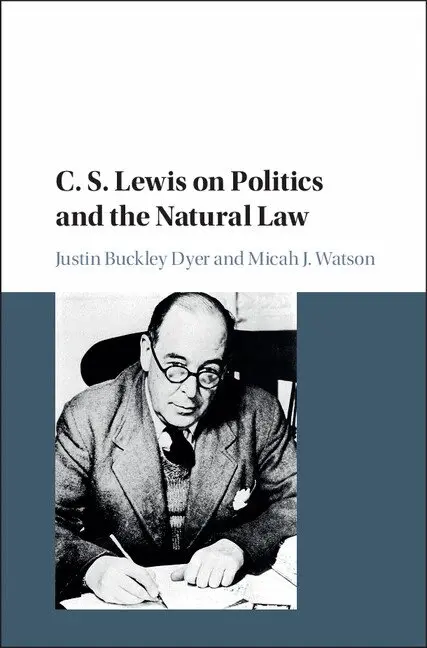
Inbunden, Engelska, 2016
C. S. Lewis on Politics and the Natural Law
Av Justin Buckley Dyer, Micah J. Watson
892 kr
Beställningsvara. Skickas inom 5-8 vardagar. Fri frakt över 249 kr.
Beskrivning
Produktinformation
- Utgivningsdatum: 2016-08-08
- Mått: 154 x 240 x 15 mm
- Vikt: 370 g
- Format: Inbunden
- Språk: Engelska
- Antal sidor: 174
- Förlag: Cambridge University Press
- ISBN: 9781107108240
Utforska kategorier
Mer om författaren
Justin Buckley Dyer is Associate Professor of Political Science and Director of the Kinder Institute on Constitutional Democracy at the University of Missouri, Columbia. He is the author of Natural Law and the Antislavery Constitutional Tradition (Cambridge, 2012) and Slavery, Abortion, and the Politics of Constitutional Meaning (Cambridge, 2013), and the editor of American Soul: The Contested Legacy of the Declaration of Independence (2012). He earned a PhD in government at the University of Texas, Austin and a BA and MPA at the University of Oklahoma. Micah J. Watson is 2015-16 William Spoelhof Teacher-Scholar Chair and Associate Professor of Political Science at Calvin College, Michigan. He is the co-editor of Natural Law and Evangelical Political Thought (2012), and has contributed chapters to this book as well as John Rawls and Christian Social Engagement (2015), and Reason, Revelation, and the Civic Order (2014). In 2010-11 he was the William E. Simon Fellow in Religion and Public Life at Princeton University, New Jersey. He earned his PhD in politics at Princeton University, New Jersey, and his MA in Church-State Studies at Baylor University, Texas.
Recensioner i media
'… Justin Buckley Dyer and Micah J. Watson, associate professors at the University of Missouri and Calvin College, show in their groundbreaking new book, C. S. Lewis on Politics and the Natural Law, Lewis's understanding of truth and human nature, of what constitutes the good life and the good society, had significant political implications … Professors Dyer and Watson write that Lewis had 'a very limited view of government's role and warrant,' was skeptical of its capacity to inculcate virtue and worried about its paternalistic tendencies. The duty of government was to restrain wrongdoing. Because he believed in the fallen nature of humanity, Lewis was concerned by the concentration of political power.' Peter Wehner, The New York Times
Betyg & recensioner
0 recensioner
Inga recensioner tillgängliga.