• Fri frakt över 249 kr
  • •
  • Snabba leveranser
  • •
  • Billiga böcker
Kundservice

Du är på sajten för privatpersoner.

Företag, bibliotek eller offentlig verksamhet?

Du handlar på classic.bokus.com, där alla dina funktioner finns intakta.
Till classic.bokus.com
Bokus logotyp. Gå till startsidan.
  • Erbjudanden
  • Nyheter
  • Student
  • Topplistor
  • Barn & ungdom
  • Bokus Play
  • E-böcker
  • Pocketböcker
  • Spel & pussel

10% studentrabatt med kod TERM26

Sidfot

Mina sidor

    Hjälp

    • Kundservice
    • Vanliga frågor och svar
    • Frakt och leverans
    • Retur vid ångerrätt
    • Reklamera vara
    • Betalning
    • Köpvillkor
    • Allmänna villkor
    • Information om webbplatsens tillgänglighet

    Om Bokus

    • Om oss
    • Pressrum
    • För studenter
    • För företag
    • För bibliotek och offentlig verksamhet
    • För leverantörer
    • Hållbarhet

    Populärt

    • Aktuella erbjudanden
    • Presentkort
    • Studentlitteratur
    • Nya böcker
    • Topplistor
    • Signerade böcker
    • Engelska böcker

    Inspiration

    • Boktips
    • BookTok
    • Populära bokserier
    • Barnbokskaraktärer
    • Populära författare
    Logotyp för Bokus
    Följ oss på Facebook (extern länk)Följ oss på Instagram (extern länk)Följ oss på YouTube (extern länk)Följ oss på TikTok (extern länk)
    bokus @ CookiesAnpassa cookiesIntegritetspolicyKöpvillkor
    Till Citymail hemsida (extern länk)Till Budbee hemsida (extern länk)Till Postnord hemsida (extern länk)Till Schenker hemsida (extern länk)Till Early Bird hemsida (extern länk)Till Walleys hemsida (extern länk)
    1. Juridik
    2. Särskilda rättsområden
    3. Författningsrätt och förvaltningsrätt
    4. Mänskliga och medborgerliga rättigheter

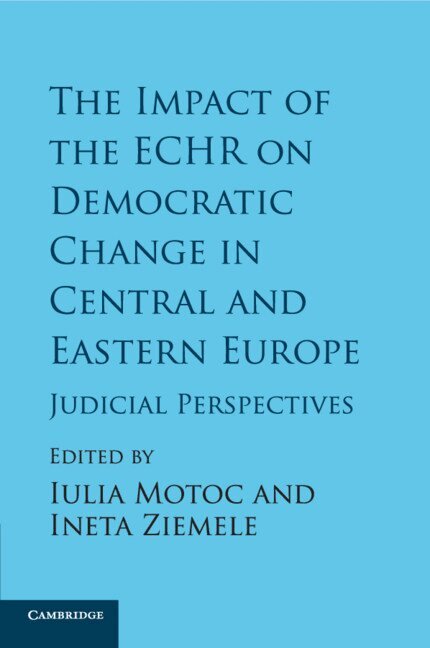
    The Impact of the ECHR on Democratic Change in Central and Eastern Europe

    Judicial Perspectives

    AvIulia Motoc,Ineta Ziemele

    Inbunden, Engelska, 2016

    1 672 kr

    Beställningsvara. Skickas inom 10-15 vardagar. Fri frakt över 249 kr.

    Beskrivning

    High hopes were placed in the ability of the European Convention and the Court of Human Rights to help realise fundamental freedoms and civil and political rights in the post-communist countries. This book explores the effects of the Strasbourg human rights system on the domestic law, politics and reality of the new member states. With contributions by past and present judges of the European Court of Human Rights and assorted constitutional courts, this book provides an insider view of the relationship between Central and Eastern European states and the ECHR, and examines the fundamental role played by the ECHR in the process of democratisation, particularly the areas of the right to liberty, the right to propriety, freedom of expression, and minorities' rights.

    Produktinformation

    • Utgivningsdatum:2016-08-18
    • Mått:158 x 235 x 33 mm
    • Vikt:920 g
    • Format:Inbunden
    • Språk:Engelska
    • Antal sidor:558
    • Förlag:Cambridge University Press
    • ISBN:9781107135024

    Utforska kategorier

    • Mänskliga och medborgerliga rättigheter inom Juridik

    Mer om författaren

    Iulia Motoc is a judge at the European Court of Human Rights and Professor of Law at the University of Bucharest, Romania. She has also served as a judge at the Constitutional Court of Romania and as the Vice-Chair of the UN Human Rights Committee. Ineta Ziemele is a judge of the Constitutional Court of Latvia and a professor at the Riga Graduate School of Law. She is a former judge and Section President at the European Court of Human Rights.

    Recensioner i media

    'I think this is a fascinating book, and one that will be widely read by legal practitioners and scholars across Europe and beyond. It will be particularly useful for students trying to come to terms with the many ways in which the ECHR influences and shapes widely different legal cultures and practices … The book shows the importance of the Council of Europe, and the ECHR, in facilitating this transformation and supporting States in meeting their obligation to respect human rights and fundamental freedoms.' Paul Johnson, ECHR Sexual Orientation Blog (www.echrso.blogspot.co.uk)

    Innehållsförteckning

    • Foreword Dean Spielmann; 1. Introduction Iulia Motoc; 2. Comments on the early years and conclusions Luzius Wildhaber; 3. Albania: Albania's long path towards European human rights standards Ledi Bianku; 4. Armenia: the supremacy of the European Convention on Human Rights: Armenia's path Alvina Gyulumyan and Davit Melkonyan; 5. Azerbaijan: the directions of influence of the case law of the European Court of Human Rights in Azerbaijan Khanlar Hajyev; 6. Bosnia and Herzegovina: impact of the case law of the European Court of Human Rights on post-conflict society of Bosnia and Herzegovina Faris Vehabovic; 7. Croatia: commitment to reform: assessing the impact of the ECtHR's Case Law on Reinforcing Democratization Efforts in Croatian Legal Order Ksenija Turkovic and Jasna Omejec; 8. Czech Republic: democratic tradition, legitimacy of confiscation, translation of the case law of the ECtHR in the light of the Convention in the Czech Republic Aleš Pejchal; 9. Estonia: impact of the European Court of Human Rights' (Case Law) on Democracy and Rule of Law: some reflections from the Estonian perspective Julia Laffranque; 10. Hungary: the Legal Order of Hungary and the European Convention on Human Rights Károly Bárd; 11. Latvia: consolidating democratic changes in Latvia: the various roles of the European Convention on Human Rights Mārtiņš Mits; 12. Lithuania: the European Convention on Human Rights in the Lithuanian legal system Danutė Jočienė; 13. Macedonia: the impact of the European Convention on Human Rights and the case law on the Republic of Macedonia Mirjana Lazarova-Trajkovska and Ilo Trajkovski; 14. Montenegro: the effect of the European Convention on Human Rights on the legal system of Montenegro Nebojša B. Vučinić; 15. Poland: human rights between international and constitutional law Lech Garlicki and Ireneusz Kondak; 16. Romania: Romania and the European Convention on Human Rights: a dialogue of judges Iulia Motoc and Crina Kaufmann; 17. Russia: European Convention on Human Rights in Russia: fifteen years after Anatoly I. Kovler; 18. Serbia: the emergence of the human rights protection in Serbia under the European Convention on Human Rights: the experience of the first ten years Dragoljub Popović and Tanasie Marinković; 19. Slovakia: how the Convention has helped Slovakia in its transition to a consolidated democracy Milan Blaško and Mihal Kučera; 20. Slovenia: just a glass bead game? Jan Zobec; 21. Ukraine: Ukraine on the way to democracy: role and achievements of the European Court of Human Rights Ganna Yudkivska; 22. Conclusions Ineta Ziemele.