• Fri frakt över 249 kr
  • •
  • Snabba leveranser
  • •
  • Billiga böcker
Kundservice

Du är på sajten för privatpersoner.

Företag, bibliotek eller offentlig verksamhet?

Du handlar på classic.bokus.com, där alla dina funktioner finns intakta.
Till classic.bokus.com
Bokus logotyp. Gå till startsidan.
  • Erbjudanden
  • Nyheter
  • Student
  • Topplistor
  • Barn & ungdom
  • Bokus Play
  • E-böcker
  • Pocketböcker
  • Spel & pussel

10% rabatt på allt med kod: NYSTART10 →

Sidfot

Mina sidor

    Hjälp

    • Kundservice
    • Vanliga frågor och svar
    • Frakt och leverans
    • Retur vid ångerrätt
    • Reklamera vara
    • Betalning
    • Köpvillkor
    • Allmänna villkor
    • Information om webbplatsens tillgänglighet

    Om Bokus

    • Om oss
    • Pressrum
    • För studenter
    • För företag
    • För bibliotek och offentlig verksamhet
    • För leverantörer
    • Hållbarhet

    Populärt

    • Aktuella erbjudanden
    • Presentkort
    • Studentlitteratur
    • Nya böcker
    • Topplistor
    • Signerade böcker
    • Engelska böcker

    Inspiration

    • Boktips
    • BookTok
    • Populära bokserier
    • Barnbokskaraktärer
    • Populära författare
    Logotyp för Bokus
    Följ oss på Facebook (extern länk)Följ oss på Instagram (extern länk)Följ oss på YouTube (extern länk)Följ oss på TikTok (extern länk)
    bokus @ CookiesAnpassa cookiesIntegritetspolicyKöpvillkor
    Till Citymail hemsida (extern länk)Till Budbee hemsida (extern länk)Till Postnord hemsida (extern länk)Till Schenker hemsida (extern länk)Till Early Bird hemsida (extern länk)Till Walleys hemsida (extern länk)
    1. Samhälle och politik
    2. Politik och statsskick
    3. Statsvetenskap och politisk teori

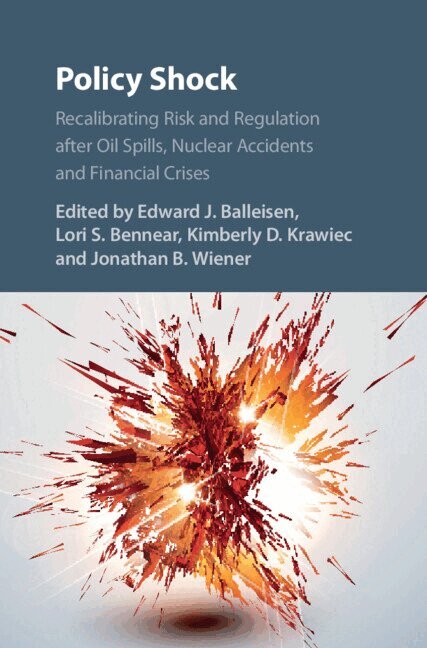
    Policy Shock

    Recalibrating Risk and Regulation after Oil Spills, Nuclear Accidents and Financial Crises

    AvEdward J. Balleisen,Lori S. Bennear

    Inbunden, Engelska, 2017

    1 818 kr

    Beställningsvara. Skickas inom 10-15 vardagar. Fri frakt över 249 kr.

    Beskrivning

    Policy Shock examines how policy-makers in industrialized democracies respond to major crises. After the immediate challenges of disaster management, crises often reveal new evidence or frame new normative perspectives that drive reforms designed to prevent future events of a similar magnitude. Such responses vary widely - from cosmetically masking inaction, to creating stronger incentive systems, requiring greater transparency, reorganizing government institutions and tightening regulatory standards. This book situates post-crisis regulatory policy-making through a set of conceptual essays written by leading scholars from economics, psychology and political science, which probe the latest thinking about risk analysis, risk perceptions, focusing events and narrative politics. It then presents ten historically-rich case studies that engage with crisis events in three policy domains: offshore oil, nuclear power and finance. It considers how governments can prepare to learn from crisis events - by creating standing expert investigative agencies to identify crisis causes and frame policy recommendations.

    Produktinformation

    • Utgivningsdatum:2017-11-02
    • Mått:160 x 235 x 37 mm
    • Vikt:960 g
    • Format:Inbunden
    • Språk:Engelska
    • Antal sidor:590
    • Förlag:Cambridge University Press
    • ISBN:9781107140219

    Utforska kategorier

    • Statsvetenskap och politisk teori inom Samhälle och politik

    Mer om författaren

    Edward J. Balleisen is Vice Provost for Interdisciplinary Studies and Associate Professor of History at Duke University, North Carolina. A historian of regulatory governance in the United States, his latest book is Fraud: An American History from Barnum to Madoff (2017). He received his Ph.D. from Yale University, Connecticut. Lori S. Bennear is an Associate Professor of Environmental Economics and Policy at Duke University, North Caroline where she is also the Co-Director of the Rethinking Regulation Program at the Kenan Institute for Ethics and the Faculty Lead in Energy Education at the Energy Initiative. Her research focuses on evaluating the effectiveness of flexible environmental policies including information disclosure regulations, management-based regulations, liability regimes and demand-side management programs. Her works spans environmental domains including toxics, drinking water and energy. She received her Ph.D. from Harvard University, Massachusetts. Kimberly D. Krawiec is the Kathrine Robinson Everett Professor of Law at Duke University, North Carolina where she teaches courses on corporate law and financial regulation. Her research centers on the regulation of financial markets, 'taboo' or contested markets and business organizations. Current work examines boards of directors, organ donation and allocation systems, and the administrative process surrounding the Volcker Rule, a provision of Dodd-Frank. She has served as a commentator for the Central European and Eurasian Law Initiative (CEELI) of the American Bar Association and on the faculty of the National Association of Securities Dealers Institute for Professional Development at the Wharton School of Business, University of Pennsylvania. Jonathan B. Wiener is the Perkins Professor of Law and Professor of Environmental Policy and Public Policy at Duke University, North Carolina. He co-directs the program on Rethinking Regulation at Duke. He is a University Fellow of Resources for the Future (RFF). He served as President of the Society for Risk Analysis (SRA) in 2008, and co-chair of the World Congress on Risk in 2012. His books include Risk vs Risk (1995), Reconstructing Climate Policy (2003) and The Reality of Precaution: Comparing Risk Regulation in the United States and Europe (2011). Previously he served at the US Department of Justice, the White House Office of Science and Technology Policy (OSTP) and the White House Council of Economic Advisers (CEA). He helped negotiate the Framework Convention on Climate Change (FCCC) between 1990 and 1992, and helped draft Executive Order 12866 on regulatory review (1993). He clerked for federal judges Stephen G. Breyer (1988-89) and Jack B. Weinstein (1987-88). He received his J.D. (1987) and A.B. (1984, economics) from Harvard University, Massachusetts.

    Innehållsförteckning

    • 1. Introduction Edward J. Balleisen, Lori S. Bennear, Kimberly D. Krawiec and Jonathan B. Wiener; Part I. The Conceptual Terrain of Crises and Risk Perceptions: 2. Economic analysis, risk regulation and the dynamics of policy regret Lori S. Bennear; 3. Revised risk assessments and the insurance industry Carolyn Kousky; 4. Understanding public risk perception and responses to changes in perceived risk Elke U. Weber; 5. Focusing events, risk and regulation Thomas A. Birkland and Megan K. Warnement; 6. The story of risk: how narratives shape risk communication, perception and policy Frederick W. Mayer; Part II. Case Studies on Offshore Oil Spills: 7. From Santa Barbara to the Exxon-Valdez: policy learning and the emergence of a new regime for managing oil spill risk Marc Allen Eisner; 8. The Nordic model of offshore oil regulation: managing crises through a proactive regulator Ole Andreas Engen and Preben H. Lindøe; 9. Reform in real time: evaluating reorganization as a response to the Gulf oil spill Christopher Carrigan; Part III. Case Studies on Nuclear Accidents: 10. Recalibrating risks of nuclear power: reactions to Three-Mile Island, Chernobyl and Fukushima Elisabeth Paté-Cornell; 11. Nuclear accidents and policy responses in Europe: comparing the cases of France and Germany Kristian Krieger, Ortwin Renn, M. Brooke Rogers and Ragnar Löfstedt; 12. Public attitudes and institutional changes in Japan following nuclear accidents Atsuo Kishimoto; Part IV. Case Studies of Financial Crises: 13. Regulatory responses to the financial crises of the Great Depression: Britain, France and the United States Youssef Cassis; 14. Financial decommodification: risk and the politics of valuation in US banks Bruce G. Carruthers; 15. Euro are risk (mis)management Barry Eichengreen; 16. The regulatory responses to the global financial crisis: some uncomfortable questions Stijn Claessens and Laura Kodres; Part V. Conclusions: 17. Institutional mechanisms for investigating the regulatory implications of a major crisis: the commission of inquiry and the safety board Edward J. Balleisen, Lori Bennear, David Cheang, Jonathon Free, Megan Hayes, Emily Pechar and A. Catherine Preston; 18. Recalibrating risk: crises, learning and regulatory change Edward Balleisen, Lori Bennear, Kimberly Krawiec and Jonathan Wiener.