• Fri frakt över 249 kr
  • •
  • Snabba leveranser
  • •
  • Billiga böcker
Kundservice

Du är på sajten för privatpersoner.

Företag, bibliotek eller offentlig verksamhet?

Du handlar på classic.bokus.com, där alla dina funktioner finns intakta.
Till classic.bokus.com
Bokus logotyp. Gå till startsidan.
  • Erbjudanden
  • Nyheter
  • Student
  • Topplistor
  • Barn & ungdom
  • Bokus Play
  • E-böcker
  • Pocketböcker
  • Spel & pussel

10% rabatt på allt med kod: NYSTART10 →

Sidfot

Mina sidor

    Hjälp

    • Kundservice
    • Vanliga frågor och svar
    • Frakt och leverans
    • Retur vid ångerrätt
    • Reklamera vara
    • Betalning
    • Köpvillkor
    • Allmänna villkor
    • Information om webbplatsens tillgänglighet

    Om Bokus

    • Om oss
    • Pressrum
    • För studenter
    • För företag
    • För bibliotek och offentlig verksamhet
    • För leverantörer
    • Hållbarhet

    Populärt

    • Aktuella erbjudanden
    • Presentkort
    • Studentlitteratur
    • Nya böcker
    • Topplistor
    • Signerade böcker
    • Engelska böcker

    Inspiration

    • Boktips
    • BookTok
    • Populära bokserier
    • Barnbokskaraktärer
    • Populära författare
    Logotyp för Bokus
    Följ oss på Facebook (extern länk)Följ oss på Instagram (extern länk)Följ oss på YouTube (extern länk)Följ oss på TikTok (extern länk)
    bokus @ CookiesAnpassa cookiesIntegritetspolicyKöpvillkor
    Till Citymail hemsida (extern länk)Till Budbee hemsida (extern länk)Till Postnord hemsida (extern länk)Till Schenker hemsida (extern länk)Till Early Bird hemsida (extern länk)Till Walleys hemsida (extern länk)
    1. Naturvetenskap och teknik
    2. Matematik och naturvetenskap
    3. Naturvetenskap:allmänt
    4. Naturvetenskapens filosofi

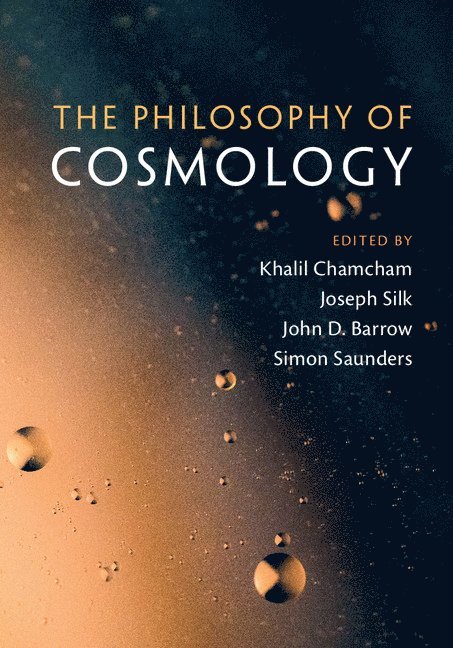
    The Philosophy of Cosmology

    AvKhalil Chamcham,Joseph Silk

    Inbunden, Engelska, 2017

    879 kr

    Beställningsvara. Skickas inom 10-15 vardagar. Fri frakt över 249 kr.

    Beskrivning

    Following a long-term international collaboration between leaders in cosmology and the philosophy of science, this volume addresses foundational questions at the limit of science across these disciplines, questions raised by observational and theoretical progress in modern cosmology. Space missions have mapped the Universe up to its early instants, opening up questions on what came before the Big Bang, the nature of space and time, and the quantum origin of the Universe. As the foundational volume of an emerging academic discipline, experts from relevant fields lay out the fundamental problems of contemporary cosmology and explore the routes toward finding possible solutions. Written for graduates and researchers in physics and philosophy, particular efforts are made to inform academics from other fields, as well as the educated public, who wish to understand our modern vision of the Universe, related philosophical questions, and the significant impacts on scientific methodology.

    Produktinformation

    • Utgivningsdatum:2017-04-13
    • Mått:178 x 253 x 27 mm
    • Vikt:1 190 g
    • Format:Inbunden
    • Språk:Engelska
    • Antal sidor:526
    • Förlag:Cambridge University Press
    • ISBN:9781107145399

    Utforska kategorier

    • Naturvetenskapens filosofi inom Naturvetenskap och teknik

    Mer om författaren

    Khalil Chamcham is a researcher at the University of Oxford. He acted as the executive director of the UK collaboration on the 'Philosophy of Cosmology' programme. His main research interests are in the chemical evolution of galaxies, nucleosynthesis, dark matter, and the concept of time. He has co-authored four books and co-edited ten, including From Quantum Fluctuations to Cosmological Structures (with David Valls-Gabaud, Martin A. Hendry and Paolo Molaro, 1997). Joseph Silk FRS is Homewood Professor at The Johns Hopkins University, Research Scientist at the Institut d'Astrophysique de Paris, CNRS and Sorbonne Universities, and Senior Fellow at the Beecroft Institute for Particle Astrophysics at the University of Oxford. He has written seven popular books on cosmology, including The Big Bang, 3rd edition (2001), On the Shores of the Unknown: A Short History of the Universe (Cambridge, 2005), and The Infinite Cosmos: Questions from the Frontiers of Cosmology (2006). His research areas include dark matter, the formation of the galaxies, and the big bang theory. He has received numerous awards and prestigious international fellowships. John D. Barrow FRS is Professor of Mathematical Sciences at the University of Cambridge and Director of the Millennium Mathematics Project to improve the appreciation of mathematics amongst the general public, teachers, and school students. The recipient of many distinguished prizes, his research interests are in cosmology, gravitation, and the interface between particle physics and astronomy. He is also a prolific author, the most recent of his twenty-two books being 100 Essential Things You Didn't Know You Didn't Know about Maths and the Arts (2014) and The Book of Universes (2011). Simon Saunders is Professor of Philosophy of Physics at the University of Oxford and a Tutorial Fellow of Merton College, Oxford. He is the lead editor of Many Worlds? Everett, Quantum Theory, and Reality (with Jonathan Barrett, Adrian Kent and David Wallace, 2010) and the author of more than sixty articles in philosophy of physics, with special emphasis on the foundations of quantum mechanics, quantum field theory, and symmetries. He also works on structuralism in philosophy of science and metaphysics, focusing on the logic of identity. He is president-elect of the British Society for the Philosophy of Science.

    Recensioner i media

    'The editors of this volume boldly announce that this collection of essays by an international group of philosophers and physicists 'marks a beginning' of 'a body of philosophical literature engaged with contemporary cosmology …' Currently, cosmology is at the pinnacle of innovation; its rapid development requires engagement from physicists and philosophers of physics on foundational issues. What is speculative or meta-cosmology today, soon becomes the cosmology of tomorrow as theory struggles to keep up with discovery. Thus, the book begins with a section entitled 'Issues in the Philosophy of Cosmology' and proceeds to delve further into more specialized topics in cosmological structures, gravity, quantum foundations, and 'methodological and philosophical issues'. It should be noted that the quality of the volume's essays varies, as well as the level of technical difficulty; some chapters are remarkably lucid while others are comprehensible only to specialists.' L. B. McHenry, Choice

    Innehållsförteckning

    • Part I. Issues in the Philosophy of Cosmology: 1. The domain of cosmology and the testing of cosmological theories George F. R. Ellis; 2. Black holes, cosmology and the passage of time: three problems at the limits of science Bernard Carr; 3. Moving boundaries? – comments on the relationship between philosophy and cosmology Claus Beisbart; 4. On the question why there exists something rather than nothing Roderich Tumulka; Part II. Structures in the Universe and the Structure of Modern Cosmology: 5. Some generalities about generality John D. Barrow; 6. Emergent structures of effective field theories Jean-Philippe Uzan; 7. Cosmological structure formation Joel R. Primack; 8. Formation of galaxies Joseph Silk; Part III. Foundations of Cosmology: Gravity and the Quantum: 9. The observer strikes back James Hartle and Thomas Hertog; 10. Testing inflation Chris Smeenk; 11. Why Boltzmann brains do not fluctuate into existence from the de Sitter vacuum Kimberly K. Boddy, Sean M. Carroll and Jason Pollack; 12. Holographic inflation revised Tom Banks; 13. Progress and gravity: overcoming divisions between general relativity and particle physics and between physics and HPS J. Brian Pitts; Part IV. Quantum Foundations and Quantum Gravity: 14. Is time's arrow perspectival? Carlo Rovelli; 15. Relational quantum cosmology Francesca Vidotto; 16. Cosmological ontology and epistemology Don N. Page; 17. Quantum origin of cosmological structure and dynamical reduction theories Daniel Sudarsky; 18. Towards a novel approach to semi-classical gravity Ward Struyve; Part V. Methodological and Philosophical Issues: 19. Limits of time in cosmology Svend E. Rugh and Henrik Zinkernagel; 20. Self-locating priors and cosmological measures Cian Dorr and Frank Arntzenius; 21. On probability and cosmology: inference beyond data? Martin Sahlén; 22. Testing the multiverse: Bayes, fine-tuning and typicality Luke A. Barnes; 23. A new perspective on Einstein's philosophy of cosmology Cormac O'Raifeartaigh; 24. The nature of the past hypothesis David Wallace; 25. Big and small David Albert.

    Betyg & recensioner

    4/5