• Fri frakt över 249 kr
  • •
  • Snabba leveranser
  • •
  • Billiga böcker
Kundservice

Du är på sajten för privatpersoner.

Företag, bibliotek eller offentlig verksamhet?

Du handlar på classic.bokus.com, där alla dina funktioner finns intakta.
Till classic.bokus.com
Bokus logotyp. Gå till startsidan.
  • Erbjudanden
  • Nyheter
  • Student
  • Topplistor
  • Barn & ungdom
  • Bokus Play
  • E-böcker
  • Pocketböcker
  • Spel & pussel

10% rabatt på allt med kod: NYSTART10 →

Sidfot

Mina sidor

    Hjälp

    • Kundservice
    • Vanliga frågor och svar
    • Frakt och leverans
    • Retur vid ångerrätt
    • Reklamera vara
    • Betalning
    • Köpvillkor
    • Allmänna villkor
    • Information om webbplatsens tillgänglighet

    Om Bokus

    • Om oss
    • Pressrum
    • För studenter
    • För företag
    • För bibliotek och offentlig verksamhet
    • För leverantörer
    • Hållbarhet

    Populärt

    • Aktuella erbjudanden
    • Presentkort
    • Studentlitteratur
    • Nya böcker
    • Topplistor
    • Signerade böcker
    • Engelska böcker

    Inspiration

    • Boktips
    • BookTok
    • Populära bokserier
    • Barnbokskaraktärer
    • Populära författare
    Logotyp för Bokus
    Följ oss på Facebook (extern länk)Följ oss på Instagram (extern länk)Följ oss på YouTube (extern länk)Följ oss på TikTok (extern länk)
    bokus @ CookiesAnpassa cookiesIntegritetspolicyKöpvillkor
    Till Citymail hemsida (extern länk)Till Budbee hemsida (extern länk)Till Postnord hemsida (extern länk)Till Schenker hemsida (extern länk)Till Early Bird hemsida (extern länk)Till Walleys hemsida (extern länk)
    1. Juridik
    2. Särskilda rättsområden
    3. Immaterialrätt

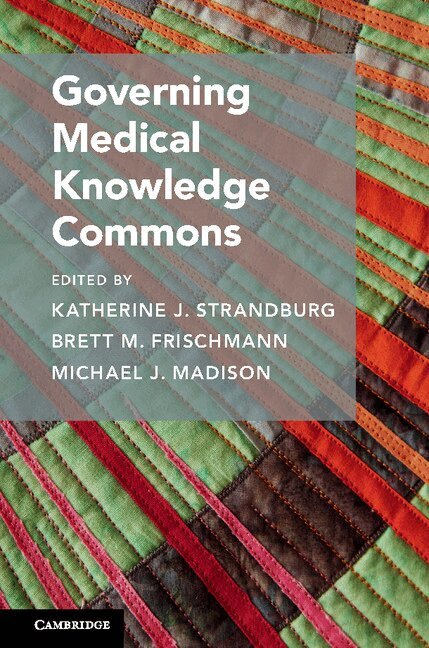
    Governing Medical Knowledge Commons

    AvKatherine J. Strandburg,Brett M. Frischmann

    Inbunden, Engelska, 2017

    Del i serien Cambridge Studies on Governing Knowledge Commons

    1 031 kr

    Beställningsvara. Skickas inom 10-15 vardagar. Fri frakt över 249 kr.

    Beskrivning

    Governing Medical Knowledge Commons makes three claims: first, evidence matters to innovation policymaking; second, evidence shows that self-governing knowledge commons support effective innovation without prioritizing traditional intellectual property rights; and third, knowledge commons can succeed in the critical fields of medicine and health. The editors' knowledge commons framework adapts Elinor Ostrom's groundbreaking research on natural resource commons to the distinctive attributes of knowledge and information, providing a systematic means for accumulating evidence about how knowledge commons succeed. The editors' previous volume, Governing Knowledge Commons, demonstrated the framework's power through case studies in a diverse range of areas. Governing Medical Knowledge Commons provides fifteen new case studies of knowledge commons in which researchers, medical professionals, and patients generate, improve, and share innovations, offering readers a practical introduction to the knowledge commons framework and a synthesis of conclusions and lessons. The book is also available as Open Access.

    Produktinformation

    • Utgivningsdatum:2017-10-19
    • Mått:158 x 237 x 30 mm
    • Vikt:780 g
    • Format:Inbunden
    • Språk:Engelska
    • Serie:Cambridge Studies on Governing Knowledge Commons
    • Antal sidor:440
    • Förlag:Cambridge University Press
    • ISBN:9781107146877

    Utforska kategorier

    • Immaterialrätt inom Juridik

    Mer om författaren

    Katherine J. Strandburg is the Alfred B. Engelberg Professor of Law at New York University School of Law, where she specializes in patent law, innovation policy, and information privacy law. Her research considers the implications of collaboration, social interactions, and technological change for law and policy in these areas, often from an interdisciplinary perspective. Professor Strandburg is an experienced litigator and has authored several amicus briefs to the Supreme Court and federal appellate courts dealing with patent and privacy law. Prior to her legal career, she was a physicist studying statistical mechanics and phase transitions at Argonne National Laboratory, having received her Ph.D. from Cornell University, New York and conducted postdoctoral research at Carnegie Mellon University, Pennsylvania. Brett M. Frischmann is the Charles Widger Endowed University Professor in Law, Business and Economics at Villanova University, Pennsylvania, where he teaches Internet law, intellectual property law, and related technology law courses. Frischmann holds an undergraduate degree in astrophysics and graduate degrees in engineering and law. His book Infrastructure: The Social Value of Shared Resources (2012) received the 2012 PROSE award and was reviewed in the Economist and Science. Frischmann is also coauthor of Cyberlaw: Problems of Policy and Jurisprudence in the Information Age (2010), a leading textbook on Internet law. Michael J. Madison is Professor of Law and Faculty Director of the Innovation Practice Institute at the University of Pittsburgh School of Law. His research and scholarship address intellectual property law and policy, as well as questions concerning the production and distribution of knowledge and innovation. He is the author of more than forty journal articles and book chapters, and the co-author of The Law of Intellectual Property (5th edition, 2017). He was elected to membership in the American Law Institute in 2016. He received his law degree from Stanford University, California and his undergraduate degree from Yale University, Connecticut.

    Recensioner i media

    'Governing Medical Knowledge Commons is a very interesting and useful book, and I am delighted to say so! Innovation development is increasingly becoming open and distributed over time. Whether and how the fruits of this openly revealed activity can be collected and efficiently utilized as a commons is a very important next question. Strandburg, Frischmann, and Madison greatly help further progress via this collection of very thoughtful studies on pioneering medical commons models and trials.' Eric von Hippel, T. Wilson Professor in Management, Sloan School of Management, Massachusetts Institute of Technology

    Innehållsförteckning

    • 1. The knowledge commons framework Brett Frischmann, Michael Madison and Katherine Strandburg; 2. Leviathan in the commons: biomedical data and the state Jorge Contreras; 3. Centralization, fragmentation, and replication in the genomic data commons Peter Lee; 4. Genomic data commons Barbara J. Evans; 5. Population biobanks' governance: a case study of knowledge commons Andrea Boggio; 6. The Sentinel Initiative as a knowledge commons Ryan Abbott; 7. Cancer: from a kingdom to a commons Michael Mattioli; 8. The greatest generational impact: the open neuroscience movement as an emerging knowledge commons Maja Larson and Margaret Chon; 9. Better to give than to receive: an uncommon commons in synthetic biology Andrew W. Torrance; 10. Governance of biomedical research commons to advance clinical translation: lessons from the mouse model community Tania Bubela, Rhiannon Adams, Shubha Chandrasekharan, Amrita Mishra and Songyan Liu; 11. Constructing interdisciplinary collaboration: the Oncofertility Consortium as an emerging knowledge commons Laura G. Pedraza-Fariña; 12. The application of user innovation and knowledge commons governance to mental health intervention Glenn Saxe and Mary Acri; 13. Challenges and opportunities in developing and sharing solutions by patients and caregivers: the story of a knowledge commons for the patient innovation project Pedro Oliveira, Leid Zejnilović and Helena Canhão; 14. Chronic disease, new thinking and outlaw innovation: patients on the edge in the knowledge commons Stephen Flowers; 15. The North American Mitochondrial Disease Consortium: a developing knowledge commons Katherine J. Strandburg and Brett M. Frischmann; 16. The Consortium of Eosinophilic Gastrointestinal Disease Researchers (CEGIR): an emerging knowledge commons Katherine J. Strandburg and Stefan Bechtold.