• Fri frakt över 249 kr
  • •
  • Snabba leveranser
  • •
  • Billiga böcker
Kundservice

Du är på sajten för privatpersoner.

Företag, bibliotek eller offentlig verksamhet?

Du handlar på classic.bokus.com, där alla dina funktioner finns intakta.
Till classic.bokus.com
Bokus logotyp. Gå till startsidan.
  • Erbjudanden
  • Nyheter
  • Student
  • Topplistor
  • Barn & ungdom
  • Bokus Play
  • E-böcker
  • Pocketböcker
  • Spel & pussel

10% rabatt på allt med kod NYSTART10 →

Sidfot

Mina sidor

    Hjälp

    • Kundservice
    • Vanliga frågor och svar
    • Frakt och leverans
    • Retur vid ångerrätt
    • Reklamera vara
    • Betalning
    • Köpvillkor
    • Allmänna villkor
    • Information om webbplatsens tillgänglighet

    Om Bokus

    • Om oss
    • Pressrum
    • För studenter
    • För företag
    • För bibliotek och offentlig verksamhet
    • För leverantörer
    • Hållbarhet

    Populärt

    • Aktuella erbjudanden
    • Presentkort
    • Studentlitteratur
    • Nya böcker
    • Topplistor
    • Signerade böcker
    • Engelska böcker

    Inspiration

    • Boktips
    • BookTok
    • Populära bokserier
    • Barnbokskaraktärer
    • Populära författare
    Logotyp för Bokus
    Följ oss på Facebook (extern länk)Följ oss på Instagram (extern länk)Följ oss på YouTube (extern länk)Följ oss på TikTok (extern länk)
    bokus @ CookiesAnpassa cookiesIntegritetspolicyKöpvillkor
    Till Citymail hemsida (extern länk)Till Budbee hemsida (extern länk)Till Postnord hemsida (extern länk)Till Schenker hemsida (extern länk)Till Early Bird hemsida (extern länk)Till Walleys hemsida (extern länk)
    1. Djur och Natur
    2. Djurböcker
    3. Vilda djur
    4. Fjärilar, insekter, spindlar

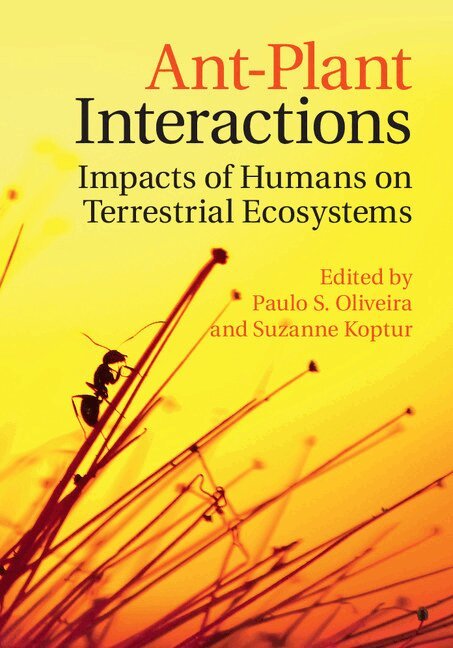
    Ant-Plant Interactions

    Impacts of Humans on Terrestrial Ecosystems

    AvPaulo S. Oliveira,Suzanne Koptur

    Inbunden, Engelska, 2017

    1 134 kr

    Beställningsvara. Skickas inom 10-15 vardagar. Fri frakt över 249 kr.

    Beskrivning

    Ants are probably the most dominant insect family on earth, and flowering plants have been the dominant plant group on land for more than 100 million years. In recent decades, human activities have degraded natural environments with unparalleled speed and scale, making it increasingly apparent that interspecific interactions vary not only under different ecological conditions and across habitats, but also according to anthropogenic global change. This is the first volume entirely devoted to the anthropogenic effects on the interactions between these two major components of terrestrial ecosystems. A first-rate team of contributors report their research from a variety of temperate and tropical ecosystems worldwide, including South, Central and North America, Africa, Japan, Polynesia, Indonesia and Australia. It provides an in-depth summary of the current understanding for researchers already acquainted with insect-plant interactions, yet is written at a level to offer a window into the ecology of ant-plant interactions for the mostly uninitiated international scientific community.

    Produktinformation

    • Utgivningsdatum:2017-08-17
    • Mått:181 x 253 x 25 mm
    • Vikt:1 060 g
    • Format:Inbunden
    • Språk:Engelska
    • Antal sidor:452
    • Förlag:Cambridge University Press
    • ISBN:9781107159754

    Utforska kategorier

    • Fjärilar, insekter, spindlar inom Djur och Natur
    • Insekter inom Naturvetenskap och teknik

    Mer om författaren

    Paulo S. Oliveira is Professor of Ecology at the Universidade Estadual de Campinas, São Paulo, Brazil. His research is on the natural history, ecology and behaviour of tropical ants. He is past President and Honorary Fellow of the Association for Tropical Biology and Conservation. He has co-authored and co-edited two books. Suzanne Koptur is Professor of Biological Sciences at Florida International University, teaching courses in ecology and botany to undergraduate and graduate students. She has published extensively on plant-animal interactions, especially anti-herbivore defence of plants and pollination ecology.

    Recensioner i media

    'Ant-Plant Interactions is the definitive and greatly needed treatise on a subject of importance to general terrestrial ecology and the study of Earth's dominant social insects.' Edward O. Wilson, Harvard University, Massachusetts

    Innehållsförteckning

    • Preface. Ants and plants: a prominent interaction in a changing world Paulo S. Oliveira and Suzanne Koptur; Part I. Landscape Mosaics, Habitat Fragmentation and Edge Effects: 1. Ant biodiversity and functional roles in fragmented forest and grassland ecosystems of the agricultural Midwest, North America Thomas O. Crist and Kaitlin U. Campbell; 2. Diversity and specificity of ant-plant interactions in canopy communities: insights from primary and secondary tropical forests in New Guinea Petr Klimes; 3. Living together in novel habitats: a review of land-use change impacts on mutualistic ant-plant symbioses in tropical forests Tom M. Fayle, Chua Wanji, Edgar C. Turner and Kalsum M. Yusah; 4. Ecology of leaf-cutting ants in human-modified landscapes Marcelo Tabarelli, Felipe F. S. Siqueira, Julia Backé, Rainer Wirth and Inara R. Leal; Part II. Ant-Seed Interactions and Man-Induced Disturbance: 5. Global change impacts on ant-mediated seed dispersal in Eastern North American forests Robert J. Warren II, Joshua R. King, Lacy Chick and Mark A. Bradford; 6. Effects of human disturbance and climate change on myrmecochory in Brazilian Caatinga Inara R. Leal, Laura C. Leal, Fernanda M. P. de Oliveira, Gabriela B. Arcoverde and Alan N. Andersen; 7. Anthropogenic disturbances affect the interactions between ants and fleshy fruits in two neotropical biodiversity hotspots Paulo S. Oliveira, Alexander V. Christianini, Ana G. D. Bieber and Marco A. Pizo; Part III. Ant-Plant Protection Systems under Variable Habitat Conditions: 8. Plasticity and efficacy of defense strategies against herbivory in ant-visited plants growing in variable abiotic conditions Akira Yamawo; 9. Interhabitat variation in the ecology of extrafloral nectar production and associated ant assemblages in Mexican landscapes Cecilia Díaz-Castelazo, Nathalia Chavarro-Rodríguez and Victor Rico-Gray; 10. Integrating ecological complexity into our understanding of ant-plant mutualism: ant-acacia interactions in African savannas Todd M. Palmer and Truman P. Young; 11. Ecological and evolutionary responses of protective ant-plant mutualisms to environmental changes Doyle McKey and Rumsaïs Blatrix; Part IV. Effect of Invasive Ants on Plants and their Mutualists: 12. Playing the system: the impacts of invasive ants and plants on facultative ant-plant interactions Suzanne Koptur, Ian M. Jones, Hong Liu and Cecilia Díaz-Castelazo; 13. Biological invasions and ant-flower networks on islands Nico Blüthgen, Christopher Kaiser-Bunbury and Robert R. Junker; 14. Mutualisms and the reciprocal benefits of comparing systems with native and introduced ants Joshua H. Ness and David A. Holway; 15. Invasion biology and ant-plant systems in Australia Lori Lach; Part V. Applied Ant Ecology: Agroecosystems, Ecosystem Engineering and Restoration: 16. Services and disservices of ant communities in tropical cacao and coffee agroforestry systems Yann Clough, Stacy Philpott and Teja Tscharntke; 17. Ant-plant-herbivore interactions in northern neotropical agroecosystems Inge Armbrecht and Ivette Perfecto; 18. Leaf-cutting ants in Patagonia: how human disturbances affect their role as ecosystem engineers on soil fertility, plant fitness and trophic cascades Alejandro G.Farji-Brener, Mariana Tadey and María N. Lescano; Part VI. Perspectives: 19. The study of interspecific interactions in habitats under anthropogenic disturbance: importance and applications Martin Heil and Marcia González-Teuber; 20. Why study ant-plant interactions? Andrew J. Beattie.