• Fri frakt över 249 kr
  • •
  • Snabba leveranser
  • •
  • Billiga böcker
Kundservice

Du är på sajten för privatpersoner.

Företag, bibliotek eller offentlig verksamhet?

Du handlar på classic.bokus.com, där alla dina funktioner finns intakta.
Till classic.bokus.com
Bokus logotyp. Gå till startsidan.
  • Erbjudanden
  • Nyheter
  • Student
  • Topplistor
  • Barn & ungdom
  • Bokus Play
  • E-böcker
  • Pocketböcker
  • Spel & pussel

Må bättre, för mindre! Upp till 50% rabatt på hälsoböcker

Sidfot

Mina sidor

    Hjälp

    • Kundservice
    • Vanliga frågor och svar
    • Frakt och leverans
    • Retur vid ångerrätt
    • Reklamera vara
    • Betalning
    • Köpvillkor
    • Allmänna villkor
    • Information om webbplatsens tillgänglighet

    Om Bokus

    • Om oss
    • Pressrum
    • För studenter
    • För företag
    • För bibliotek och offentlig verksamhet
    • För leverantörer
    • Hållbarhet

    Populärt

    • Aktuella erbjudanden
    • Presentkort
    • Studentlitteratur
    • Nya böcker
    • Topplistor
    • Signerade böcker
    • Engelska böcker

    Inspiration

    • Boktips
    • BookTok
    • Populära bokserier
    • Barnbokskaraktärer
    • Populära författare
    Logotyp för Bokus
    Följ oss på Facebook (extern länk)Följ oss på Instagram (extern länk)Följ oss på YouTube (extern länk)Följ oss på TikTok (extern länk)
    bokus @ CookiesAnpassa cookiesIntegritetspolicyKöpvillkor
    Till Citymail hemsida (extern länk)Till Budbee hemsida (extern länk)Till Postnord hemsida (extern länk)Till Schenker hemsida (extern länk)Till Early Bird hemsida (extern länk)Till Walleys hemsida (extern länk)
    1. Filosofi och religion
    2. Filosofi

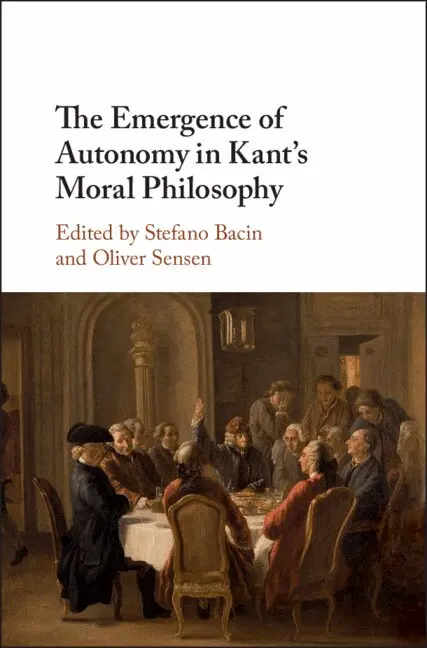
    The Emergence of Autonomy in Kant's Moral Philosophy

    AvStefano Bacin,Oliver Sensen

    Inbunden, Engelska, 2018

    1 335 kr

    Beställningsvara. Skickas inom 10-15 vardagar. Fri frakt över 249 kr.

    Beskrivning

    Autonomy is one of the central concepts of contemporary moral thought, and Kant is often credited with being the inventor of individual moral autonomy. But how and why did Kant develop this notion? The Emergence of Autonomy in Kant's Moral Philosophy is the first essay collection exclusively devoted to this topic. It traces the emergence of autonomy from Kant's earliest writings to the changes that he made to the concept in his mature works. The essays offer a close historical and philosophical analysis of what prompted Kant to develop his conception of autonomy, charting the historical background which prompted his search, and thoroughly analysing different stages of his writings in order to see which element of autonomy was introduced at which point. The resulting volume will be of interest to both scholars and students of Kantian moral philosophy, as well as to anyone interested in the subject of autonomy.

    Produktinformation

    • Utgivningsdatum:2018-10-25
    • Mått:156 x 235 x 16 mm
    • Vikt:460 g
    • Format:Inbunden
    • Språk:Engelska
    • Antal sidor:238
    • Förlag:Cambridge University Press
    • ISBN:9781107182851

    Utforska kategorier

    • Filosofi inom Filosofi och religion

    Mer om författaren

    Stefano Bacin is Senior Assistant Professor of History of Philosophy at the University of Milan. He is the author of Il senso dell'etica. Kant e la costruzione di una teoria morale (2006) and Fichte in Schulpforta (1774–1780) (2008) and is co-editor, with Marcus Willaschek, Georg Mohr and Jürgen Stolzenberg, of the Kant-Lexikon (2015). Oliver Sensen is Associate Professor and Director of Graduate Studies in Philosophy at Tulane University, Louisiana. He is the Vice President of the North American Kant Society, and the author of Human Dignity (Cambridge, forthcoming), Kant on Human Dignity (2011), as well as the editor of Kant on Moral Autonomy (Cambridge, 2012).

    Recensioner i media

    'For those interested in the details of how Kant came to develop his view of autonomy, and the various precursor views he developed and engaged with on the way there, this book is an excellent and welcome addition to the literature.' Notre Dame Philosophical

    Innehållsförteckning

    • Introduction Stefano Bacin and Oliver Sensen; 1. How is moral obligation possible? Kant's 'principle of autonomy' in historical context Heiner F. Klemme; 2. Anticipations of autonomy: freedom, obligation, and the concept of a world in Kant's writings of the Mid-1750s to Mid-1760s Susan Meld Shell; 3. Autonomy and moral rationalism: Kant's criticisms of 'rationalist' moral principles (1762–85) Stefano Bacin; 4. Autonomy and moral empiricism: Kant's criticism of sentimentalist moral principles (1762–85) Georg Mohr; 5. Elements of autonomy in Kant's Lectures on Ethics (1770–80) Oliver Sensen; 6. Emerging autonomy: dealing with the inadequacies of the 'canon' of the Critique of Pure Reason (1781) Jens Timmermann; 7. Autonomy and the legislation of laws in the Prolegomena (1783) Eric Watkins; 8. How can freedom be a law to itself? The concept of autonomy in the 'introduction' to the Naturrecht Feyerabend lecture notes (1784) Marcus Willaschek; 9. Moral autonomy as political analogy: self-legislation in Kant's Groundwork and the Feyerabend lectures on natural law (1784) Pauline Kleingeld; 10. What emerged: autonomy and heteronomy in the Groundwork and second Critique Andrews Reath; 11. Kant's threefold autonomy after the Groundwork: reason's own law-giving as our own cosmopolitan law-giving Pierre Keller.