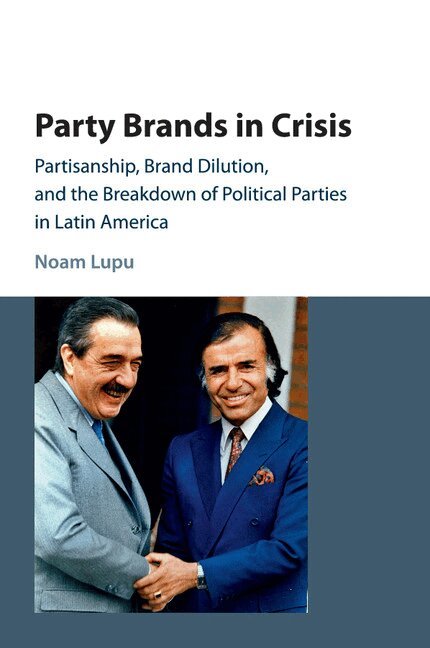
Häftad, Engelska, 2017
Party Brands in Crisis
Partisanship, Brand Dilution, and the Breakdown of Political Parties in Latin America
Av Noam Lupu
565 kr
Beställningsvara. Skickas inom 5-8 vardagar. Fri frakt över 249 kr.
Beskrivning
Produktinformation
- Utgivningsdatum: 2017-07-13
- Mått: 150 x 230 x 18 mm
- Vikt: 400 g
- Format: Häftad
- Språk: Engelska
- Antal sidor: 264
- Förlag: Cambridge University Press
- ISBN: 9781107423206
Utforska kategorier
Mer om författaren
Noam Lupu is Assistant Professor of Political Science and Trice Faculty Scholar at the University of Wisconsin, Madison. His research has appeared in the American Journal of Political Science, American Political Science Review, Comparative Political Studies, Political Behavior, and World Politics, among others. His dissertation, on which this book is based, won the Gabriel A. Almond Award and Juan Linz Prize. In 2014, he received the Emerging Scholar Award from the Political Organizations and Parties section of the American Political Science Association.
Recensioner i media
'Why do established parties sometimes dramatically collapse, often within a single electoral cycle? Lupu's persuasive answer is that such collapse occurs when parties switch positions, make unholy alliances with former adversaries, and converge on the policy positions of their opponents in order to attract floating voters and win the next election. When leaders thus 'dilute the party brand', parties hemorrhage partisans and are in turn left defenseless against the wrath of the electorate in hard times. Party Brands in Crisis challenges the way we think about partisanship and deserves to be read by students of political parties everywhere.' Frances Hagopian, Harvard University, Massachusetts
Betyg & recensioner
0 recensioner
Inga recensioner tillgängliga.