• Fri frakt över 249 kr
  • •
  • Snabba leveranser
  • •
  • Billiga böcker
Kundservice

Du är på sajten för privatpersoner.

Företag, bibliotek eller offentlig verksamhet?

Du handlar på classic.bokus.com, där alla dina funktioner finns intakta.
Till classic.bokus.com
Bokus logotyp. Gå till startsidan.
  • Erbjudanden
  • Nyheter
  • Student
  • Topplistor
  • Barn & ungdom
  • Bokus Play
  • E-böcker
  • Pocketböcker
  • Spel & pussel

10% rabatt på allt med kod: NYSTART10 →

Sidfot

Mina sidor

    Hjälp

    • Kundservice
    • Vanliga frågor och svar
    • Frakt och leverans
    • Retur vid ångerrätt
    • Reklamera vara
    • Betalning
    • Köpvillkor
    • Allmänna villkor
    • Information om webbplatsens tillgänglighet

    Om Bokus

    • Om oss
    • Pressrum
    • För studenter
    • För företag
    • För bibliotek och offentlig verksamhet
    • För leverantörer
    • Hållbarhet

    Populärt

    • Aktuella erbjudanden
    • Presentkort
    • Studentlitteratur
    • Nya böcker
    • Topplistor
    • Signerade böcker
    • Engelska böcker

    Inspiration

    • Boktips
    • BookTok
    • Populära bokserier
    • Barnbokskaraktärer
    • Populära författare
    Logotyp för Bokus
    Följ oss på Facebook (extern länk)Följ oss på Instagram (extern länk)Följ oss på YouTube (extern länk)Följ oss på TikTok (extern länk)
    bokus @ CookiesAnpassa cookiesIntegritetspolicyKöpvillkor
    Till Citymail hemsida (extern länk)Till Budbee hemsida (extern länk)Till Postnord hemsida (extern länk)Till Schenker hemsida (extern länk)Till Early Bird hemsida (extern länk)Till Walleys hemsida (extern länk)
    1. Historia och arkeologi
    2. Historia

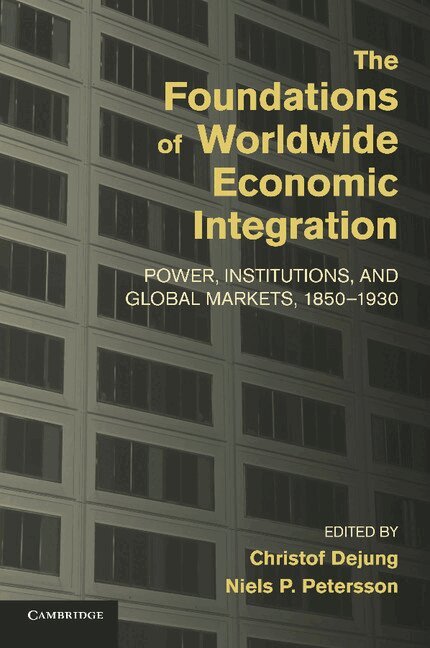
    The Foundations of Worldwide Economic Integration

    Power, Institutions, and Global Markets, 1850-1930

    AvChristof Dejung,Niels P. Petersson

    Häftad, Engelska, 2014

    Del i serien Cambridge Studies in the Emergence of Global Enterprise

    422 kr

    Beställningsvara. Skickas inom 10-15 vardagar. Fri frakt över 249 kr.

    Beskrivning

    The essays in this volume discuss worldwide economic integration between 1850 and 1930, challenging the popular description of the period after 1918 as one of mere deglobalisation. The authors argue that markets were not only places of material exchange, but also socially structured entities, shaped by the agency of individual actors and by complex structures of political and economic power. Economic transactions were supported by an array of different institutions, ranging from formalised regulations to informal relations of personal trust. They argue that these networks were strong enough to prosper even during and after World War I, in a political climate often hostile to foreign trade. The Foundations of Worldwide Economic Integration shows that institutionalism altered its shape in the face of circumstances that increasingly challenged international trade. By presenting case studies from various countries, this book offers a fresh perspective on crucial periods of economic globalisation.

    Produktinformation

    • Utgivningsdatum:2014-08-21
    • Mått:152 x 229 x 17 mm
    • Vikt:440 g
    • Format:Häftad
    • Språk:Engelska
    • Serie:Cambridge Studies in the Emergence of Global Enterprise
    • Antal sidor:296
    • Förlag:Cambridge University Press
    • ISBN:9781107436978

    Utforska kategorier

    • Historia inom Historia och arkeologi

    Mer om författaren

    Christof Dejung is Senior Lecturer and Researcher in the Department of History and Sociology at the University of Konstanz, Germany. Niels P. Petersson is Senior Lecturer in History at Sheffield Hallam University.

    Recensioner i media

    'It has become commonplace to argue that institutions and rules matter greatly to economic performance. But how did these institutions and rules emerge and take the particular shapes that they did? Christof Dejung and Niels P. Petersson's significant collection takes a sustained look at global trade in the late nineteenth and early twentieth centuries and shows how European merchants, Indian peasants, imperial statesmen, and others, constructed these institutions and rules. Far from a definite set of tools, the institutions that enabled global trade were the outcome of sustained social contestation on local marketplaces, in national politics, and across ocean-spanning trade networks. Power is back to the debate on institutions - and this book is a must-read for anyone interested in this important story.' Sven Beckert, Harvard University

    Innehållsförteckning

    • Preface Harold James; Introduction: power, institutions, and global markets - actors, mechanisms, and foundations of worldwide economic integration, 1850–1930 Christof Dejung and Niels P. Petersson; Part I. Legal Institutions and Private Actors: 1. Legal institutions and the world economy, 1900–30; 2. Against globalisation: sovereignty, courts, and the failure to coordinate international bankruptcies (1870–1940) Jérôme Sgard; 3. Credit information, institutions, and international trade: the UK, US, and Germany, 1850–1930 Rowena Olegario; Part II. Colonial Markets and Non-Western Actors: 4. The London Stock Exchange and the colonial market: a study of internationalisation and power Bernard Attard; 5. The London gold market, 1900–31 Bernd-Stefan Grewe; 6. The boundaries of Western power: the colonial cotton economy in India and the problem of quality Christof Dejung; 7. The colonised as global traders: Indian trading networks in the world economy, 1850–1939 Claude Markovits; 8. The international patent system and the global flow of technologies: the case of Japan, 1880–1930 Pierre-Yves Donzé; Part III. World War I and the Consequences for Economic Globalisation: 9. Transnational cooperation in wartime: the international protection of intellectual property rights during the First World War Isabella Löhr; 10. The resilience of globalisation during the First World War: the case of Bunge and Born in Argentina Philip Dehne; 11. Global economic governance and the private sector: the League of Nations' experiment in the 1920s Michele d'Alessandro.