Christof Dejung - Böcker
Visar alla böcker från författaren Christof Dejung. Handla med fri frakt och snabb leverans.
10 produkter
10 produkter
The Primitive Within
The Entanglements Between Anthropology and Folklore Studies in Germany, 1850s–1930s
Inbunden, Engelska, 2026
1 087 kr
Kommande
This book is the first to examine the relation between German folklore studies and colonial anthropology in the age of empire. It expounds how anthropologists and folklorists aimed to compare rural cultures in the European hinterland to supposedly primitive societies in the colonial peripheries in the nineteenth and early twentieth centuries. This allows for a reconsideration of two fields that all too often have been examined in isolation. Whereas folklore studies has been interpreted as an aspect of nation-building, anthropology has been primarily examined in its relation to imperialism. The links between these two areas of research--and their eventual separation--have barely been examined in any detail to date. By taking Germany as an exemplary case, the book addresses the following questions: how did scholars think about comparing traditional cultures that were thousands of kilometres apart? Why were such cultural ties eventually severed at the turn of the twentieth century? How was the study of so-called primitive societies linked to metropolitan class struggles and assertions of territorial sovereignty, such as nationalism and imperialism? How far was the shifting relation between overseas and domestic primitivism caused, or accompanied, by the increasing importance of racial theories after the end of the First World War? And, last but not least, how was the study of primitivism linked to the concept of historical temporality?
Commodity Trading, Globalization and the Colonial World
Spinning the Web of the Global Market
Häftad, Engelska, 2020
632 kr
Skickas inom 10-15 vardagar
Commodity Trading, Globalization and the Colonial World: Spinning the Web of the Global Market provides a new perspective on economic globalization in the nineteenth and twentieth centuries. Instead of understanding the emergence of global markets as a mere result of supply and demand or as the effect of imperial politics, this book focuses on a global trading firm as an exemplary case of the actors responsible for conducting economic transactions in a multicultural business world. The study focuses on the Swiss merchant house Volkart Bros., which was one of the most important trading houses in British India after the late nineteenth century and became one of the biggest cotton and coffee traders in the world after decolonization.The book examines the following questions: How could European merchants establish business contacts with members of the mercantile elite from India, China or Latin America? What role did a shared mercantile culture play for establishing relations of trust? How did global business change with the construction of telegraph lines and railways and the development of economic institutions such as merchant banks and commodity exchanges? And what was the connection between the business interests of transnationally operating capitalists and the territorial aspirations of national and imperial governments?Based on a five-year-long research endeavor and the examination of 24 public and private archives in seven countries and on three continents, Commodity Trading, Globalization and the Colonial World: Spinning the Web of the Global Market goes well beyond a mere company history as it highlights the relationship between multinationally operating firms and colonial governments, and the role of business culture in establishing notions of trust, both within the firm and between economic actors in different parts of the world. It thus provides a cutting-edge history of globalization from a micro-perspective. Following an actor-theoretical perspective, the book maintains that the global market that came into being in the nineteenth century can be perceived as the consequence of the interaction of various actors. Merchants, peasants, colonial bureaucrats and industrialists were all involved in spinning the individual threads of this commercial web. By connecting established approaches from business history with recent scholarship in the fields of global and colonial history, Commodity Trading, Globalization and the Colonial World: Spinning the Web of the Global Market offers a new perspective on the emergence of global enterprise and provides an important addition to the history of imperialism and economic globalization.
291 kr
Skickas inom 7-10 vardagar
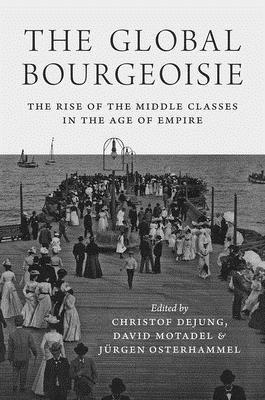
The first global history of the middle class While the nineteenth century has been described as the golden age of the European bourgeoisie, the emergence of the middle class and bourgeois culture was by no means exclusive to Europe. The Global Bourgeoisie explores the rise of the middle classes around the world during the age of empire. Bringing together eminent scholars, this landmark essay collection compares middle-class formation in various regions, highlighting differences and similarities, and assesses the extent to which bourgeois growth was tied to the increasing exchange of ideas and goods. The contributors indicate that the middle class was from its very beginning, even in Europe, the result of international connections and entanglements.Essays are grouped into six thematic sections: the political history of middle-class formation, the impact of imperial rule on the colonial middle class, the role of capitalism, the influence of religion, the obstacles to the middle class beyond the Western and colonial world, and, lastly, reflections on the creation of bourgeois cultures and global social history. Placing the establishment of middle-class society into historical context, this book shows how the triumph or destabilization of bourgeois values can shape the liberal world order.The Global Bourgeoisie irrevocably changes the understanding of how an important social class came to be.
1 814 kr
Skickas inom 3-6 vardagar
The first global history of the middle class While the nineteenth century has been described as the golden age of the European bourgeoisie, the emergence of the middle class and bourgeois culture was by no means exclusive to Europe. The Global Bourgeoisie explores the rise of the middle classes around the world during the age of empire. Bringing together eminent scholars, this landmark essay collection compares middle-class formation in various regions, highlighting differences and similarities, and assesses the extent to which bourgeois growth was tied to the increasing exchange of ideas and goods. The contributors indicate that the middle class was from its very beginning, even in Europe, the result of international connections and entanglements.Essays are grouped into six thematic sections: the political history of middle-class formation, the impact of imperial rule on the colonial middle class, the role of capitalism, the influence of religion, the obstacles to the middle class beyond the Western and colonial world, and, lastly, reflections on the creation of bourgeois cultures and global social history. Placing the establishment of middle-class society into historical context, this book shows how the triumph or destabilization of bourgeois values can shape the liberal world order.The Global Bourgeoisie irrevocably changes the understanding of how an important social class came to be.
The Foundations of Worldwide Economic Integration
Power, Institutions, and Global Markets, 1850-1930
Inbunden, Engelska, 2013
1 282 kr
Skickas inom 7-10 vardagar
The essays in this volume discuss worldwide economic integration between 1850 and 1930, challenging the popular description of the period after 1918 as one of mere deglobalisation. The authors argue that markets were not only places of material exchange, but also socially structured entities, shaped by the agency of individual actors and by complex structures of political and economic power. Economic transactions were supported by an array of different institutions, ranging from formalised regulations to informal relations of personal trust. They argue that these networks were strong enough to prosper even during and after World War I, in a political climate often hostile to foreign trade. The Foundations of Worldwide Economic Integration shows that institutionalism altered its shape in the face of circumstances that increasingly challenged international trade. By presenting case studies from various countries, this book offers a fresh perspective on crucial periods of economic globalisation.
The Foundations of Worldwide Economic Integration
Power, Institutions, and Global Markets, 1850-1930
Häftad, Engelska, 2014
401 kr
Skickas inom 7-10 vardagar
The essays in this volume discuss worldwide economic integration between 1850 and 1930, challenging the popular description of the period after 1918 as one of mere deglobalisation. The authors argue that markets were not only places of material exchange, but also socially structured entities, shaped by the agency of individual actors and by complex structures of political and economic power. Economic transactions were supported by an array of different institutions, ranging from formalised regulations to informal relations of personal trust. They argue that these networks were strong enough to prosper even during and after World War I, in a political climate often hostile to foreign trade. The Foundations of Worldwide Economic Integration shows that institutionalism altered its shape in the face of circumstances that increasingly challenged international trade. By presenting case studies from various countries, this book offers a fresh perspective on crucial periods of economic globalisation.
Commodity Trading, Globalization and the Colonial World
Spinning the Web of the Global Market
Inbunden, Engelska, 2018
2 167 kr
Skickas inom 10-15 vardagar
Commodity Trading, Globalization and the Colonial World: Spinning the Web of the Global Market provides a new perspective on economic globalization in the nineteenth and twentieth centuries. Instead of understanding the emergence of global markets as a mere result of supply and demand or as the effect of imperial politics, this book focuses on a global trading firm as an exemplary case of the actors responsible for conducting economic transactions in a multicultural business world. The study focuses on the Swiss merchant house Volkart Bros., which was one of the most important trading houses in British India after the late nineteenth century and became one of the biggest cotton and coffee traders in the world after decolonization.The book examines the following questions: How could European merchants establish business contacts with members of the mercantile elite from India, China or Latin America? What role did a shared mercantile culture play for establishing relations of trust? How did global business change with the construction of telegraph lines and railways and the development of economic institutions such as merchant banks and commodity exchanges? And what was the connection between the business interests of transnationally operating capitalists and the territorial aspirations of national and imperial governments?Based on a five-year-long research endeavor and the examination of 24 public and private archives in seven countries and on three continents, Commodity Trading, Globalization and the Colonial World: Spinning the Web of the Global Market goes well beyond a mere company history as it highlights the relationship between multinationally operating firms and colonial governments, and the role of business culture in establishing notions of trust, both within the firm and between economic actors in different parts of the world. It thus provides a cutting-edge history of globalization from a micro-perspective. Following an actor-theoretical perspective, the book maintains that the global market that came into being in the nineteenth century can be perceived as the consequence of the interaction of various actors. Merchants, peasants, colonial bureaucrats and industrialists were all involved in spinning the individual threads of this commercial web. By connecting established approaches from business history with recent scholarship in the fields of global and colonial history, Commodity Trading, Globalization and the Colonial World: Spinning the Web of the Global Market offers a new perspective on the emergence of global enterprise and provides an important addition to the history of imperialism and economic globalization.
Del 39 - Schweizerisches Jahrbuch für Wirtschafts- und Sozialgeschichte
Rückkehr des Politischen
Häftad, Franska
442 kr
Skickas inom 3-6 vardagar
1 293 kr
Tillfälligt slut
Was ist Wirtschaft? Wo müsste man sie suchen? Und woran könnte man sie erkennen? Aus historischer Perspektive ist die Annahme einer überzeitlich erkennbaren ökonomischen Sphäre fraglich oder zumindest untersuchungswürdig. Weil nicht nur das Wirtschaftsleben, sondern auch die Konzeption von Wirtschaft einem Wandel untersteht, sind empirisch kompetente Studien vonnöten, die Querbezüge herzustellen vermögen zwischen den Praktiken des Wirtschaftens und der Wirtschaftswissenschaft mit jenen der Politik, der Moral und der Religion. Anhand von elf Begriffen von B wie Beute bis S wie Steuern erkunden die Autor/innen dieses Bandes historisch, inwiefern sich das Verständnis von Ökonomie verändert, wenn der Zugang zur Wirtschaft nicht über die Konzepte der neoklassisch ausgerichteten ökonomischen Theorie, sondern durch die Hintertür der Geschichtswissenschaft erfolgt. Mit der Suche nach der Ökonomie soll ein historisches Gegenmittel zu den vermeintlichen Sachzwängen der aktuellen Wirtschaft erprobt werden.
650 kr
Skickas inom 11-20 vardagar