• Fri frakt över 249 kr
  • •
  • Snabba leveranser
  • •
  • Billiga böcker
Kundservice

Du är på sajten för privatpersoner.

Företag, bibliotek eller offentlig verksamhet?

Du handlar på classic.bokus.com, där alla dina funktioner finns intakta.
Till classic.bokus.com
Bokus logotyp. Gå till startsidan.
  • Erbjudanden
  • Student
  • Topplistor
  • Barn & ungdom
  • Bokus Play
  • E-böcker
  • Ljudböcker
  • Pocketböcker
  • Spel och pussel

5% studentrabatt – använd koden KURSBOK27 →

Sidfot

Mina sidor

    Hjälp

    • Kundservice
    • Vanliga frågor och svar
    • Frakt och leverans
    • Retur vid ångerrätt
    • Reklamera vara
    • Betalning
    • Köpvillkor
    • Allmänna villkor
    • Information om webbplatsens tillgänglighet

    Om Bokus

    • Om oss
    • Pressrum
    • För studenter
    • För företag
    • För bibliotek och offentlig verksamhet
    • För leverantörer
    • Hållbarhet

    Populärt

    • Aktuella erbjudanden
    • Presentkort
    • Studentlitteratur
    • Nya böcker
    • Topplistor
    • Signerade böcker
    • Engelska böcker

    Inspiration

    • Boktips
    • BookTok
    • Barnbokskaraktärer
    • Populära författare
    Logotyp för Bokus
    Följ oss på Facebook (extern länk)Följ oss på Instagram (extern länk)Följ oss på YouTube (extern länk)Följ oss på TikTok (extern länk)
    bokus @ CookiesAnpassa cookiesIntegritetspolicyKöpvillkor
    Till Citymail hemsida (extern länk)Till Budbee hemsida (extern länk)Till Postnord hemsida (extern länk)Till Schenker hemsida (extern länk)Till Early Bird hemsida (extern länk)Till Walleys hemsida (extern länk)
    1. Ekonomi och Ledarskap
    2. Nationalekonomi
    3. Ekonomisk politik

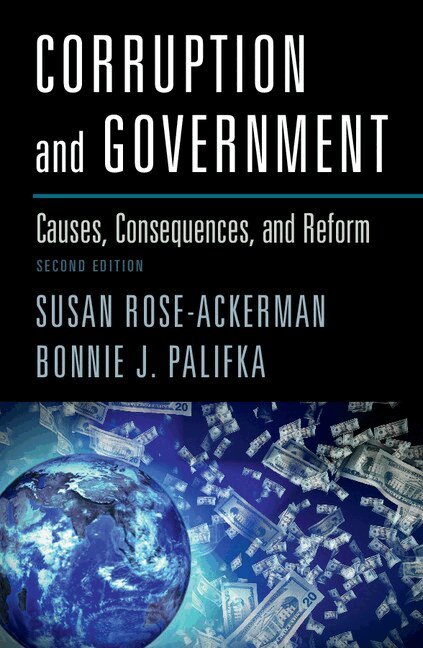
    Corruption and Government

    Causes, Consequences, and Reform

    AvSusan Rose-Ackerman,Bonnie J. Palifka

    Häftad, Engelska, 2016

    546 kr

    . Fri frakt över 249 kr.

    Fler format och utgåvor

    E-bok

    363 kr

    Inbunden

    1 489 kr

    E-bok

    363 kr

    Beskrivning

    The second edition of Corruption and Government updates Susan Rose-Ackerman's 1999 book to address emerging issues and to rethink old questions in light of new data. The book analyzes the research explosion that accompanied the fall of the Berlin Wall, the founding of Transparency International, and the World Bank's decision to give anti-corruption policy a key place on its agenda. Time has vindicated Rose-Ackerman's emphasis on institutional reform as the necessary condition for serious progress. The book deals with routine payoffs and with corruption in contracting and privatization. It gives special attention to political corruption and to instruments of accountability. The authors have expanded the treatment of culture as a source of entrenched corruption and added chapters on criminal law, organized crime, and post-conflict societies. The book outlines domestic conditions for reform and discusses international initiatives - including both explicit anti-corruption policies and efforts to constrain money laundering.

    Produktinformation

    • Utgivningsdatum:2016-03-07
    • Mått:152 x 229 x 33 mm
    • Vikt:863 g
    • Format:Häftad
    • Språk:Engelska
    • Antal sidor:644
    • Upplaga:2
    • Förlag:Cambridge University Press
    • ISBN:9781107441095

    Utforska kategorier

    • Ekonomisk politik inom Ekonomi och Ledarskap

    Mer om författaren

    Susan Rose-Ackerman is the Henry R. Luce Professor of Jurisprudence (Law and Political Science) at Yale University, Connecticut. She is one of the world's leading scholars of the political economy of corruption and one of the first economists to write on the subject. She is the author or editor of seventeen books and numerous articles. The first edition of her book Corruption and Government has been translated into seventeen languages. In addition to her work on corruption, she writes about public law and public policy from a comparative law and political economy perspective. Her most recent book is Due Process of Lawmaking (with Stefanie Egidy and James Fowkes). She has been a visiting researcher at the World Bank and a fellow at the Center for Advanced Study in the Behavioral Sciences, the Paris Institute of Political Studies, and the Wissenschaftskolleg zu Berlin. Bonnie Palifka is an Assistant Professor at the Instituto Tecnológico y de Estudios Superiores de Monterrey (ITESM), Campus Monterrey, Mexico. She has taught a course on corruption based on the first edition of this book since 2004 at ITESM and since 2011 at Yale University. Dr Palifka has spoken on corruption at conferences in the United States, Mexico, Guatemala, St Kitts, and France. Her most recent publication is 'A Review of Drivers of Corruption: A Brief Review, by Tina Søreide' in the journal Crime, Law and Social Change.

    Recensioner i media

    'Susan Rose-Ackerman has been a powerful ally of Transparency International (TI), from its very beginnings more than twenty years ago. Through her writing, teaching, and speaking she accompanied our battle against corruption with her thoughtful, sometimes critical, economist perspective of our activism. The first edition of this book came out just in time, to help strengthen the conceptual framework of fighting corruption in various institutions, and the anti-corruption community will be grateful to Susan and her coauthor, Bonnie J. Palifka, for producing the new edition of this seminal work. The strong conceptual economic framework provided in this book will be needed for practitioners, teachers, scholars, and the media as we continue our battle against the scourge of corruption.' Peter Eigen, Founder and Chairman of the Advisory Council, Transparency International

    Innehållsförteckning

    • Introduction; 1. What is corruption and why does it matter?; Part I. Corruption as an Economic Problem: 2. Bureaucratic corruption; 3. Corruption in procurement and privatization; 4. Reducing incentives and increasing costs; 5. Civil service reform and bureaucratic reorganization; 6. Using the criminal law to deter bribery and extortion; Part II. Corruption as a Cultural Problem: 7. Culture and corruption; Part III. Corruption as a Political Problem: 8. Politics, corruption, and clientelism; 9. Organized crime, corruption, and money laundering; 10. Corruption in post-conflict state building; 11. Democracy: corruption, connections, and money in politics; 12. Accountability beyond the ballot box; Part IV. Reform Agendas - Domestic Political Will and International Influence: 13. Domestic conditions for reform; 14. The role of the international community; 15. The role of international cooperation: states, firms, banks, and organized crime; Part V. Conclusions: 16. Conclusions.