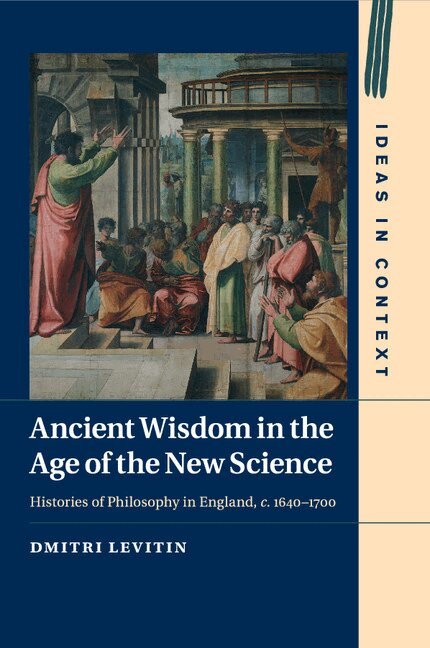
Häftad, Engelska, 2017
Ancient Wisdom in the Age of the New Science
Histories of Philosophy in England, c. 1640-1700
Del 113 i serien Ideas in Context
639 kr
Beställningsvara. Skickas inom 5-8 vardagar. Fri frakt över 249 kr.
Beskrivning
Produktinformation
- Utgivningsdatum: 2017-07-27
- Mått: 153 x 230 x 35 mm
- Vikt: 1 000 g
- Format: Häftad
- Språk: Engelska
- Serie: Ideas in Context
- Antal sidor: 696
- Förlag: Cambridge University Press
- ISBN: 9781107513747
Utforska kategorier
Mer om författaren
Dmitri Levitin is a Fellow of All Souls College, Oxford. Previously, he was a Fellow of Trinity College, Cambridge, and of the Centre for Research in Arts, Social Sciences and Humanities, also in Cambridge. He has also held positions at the Folger Library and at the University of Edinburgh. His research is on the intellectual, religious and cultural history of early modern Europe. Within these fields, he has published work on the history of science, philosophy, scholarship, medicine, theology, church-state relations, and political and legal thought.
Recensioner i media
'Dmitri Levitin's [book] has prodigious virtuosity. It argues that historians of ideas are often too remote from institutional history, and provides a vivid, enriching celebration of the continuing vitality in seventeenth-century England of a trans-European culture of scholarly humanism that radiated beyond scholarly communities. There is a far-reaching discussion of dogmatism, learned authority and experimentalism. Levitin identifies the recession of the ideal of the philosopher-theologian as the greatest transformation of seventeenth-century English intellectual culture. He has an exultant joy in his sources, but never loses mastery of them. His avid glee in reading manuscripts and rare treatises, the insatiability of his learning, are enthralling. I recommend the witty mischief hidden in his index. Ancient Wisdom makes most books I have read this year look like bankrupt stock.' Richard Davenport-Hines, 'Books of the Year 2016,' The Times Literary Supplement
Betyg & recensioner
0 recensioner
Inga recensioner tillgängliga.