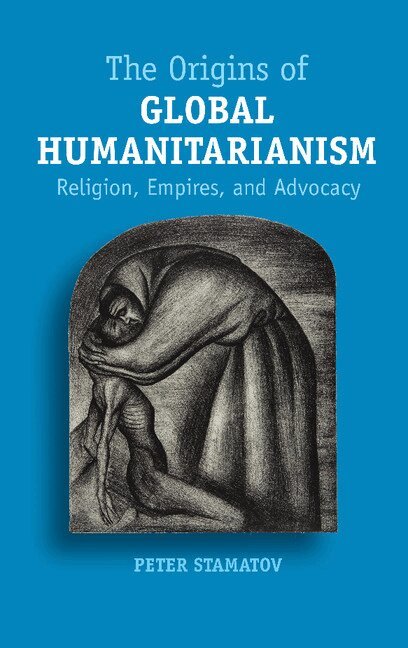
Häftad, Engelska, 2015
The Origins of Global Humanitarianism
Religion, Empires, and Advocacy
Del i serien Cambridge Studies in Social Theory, Religion and Politics
557 kr
Beställningsvara. Skickas inom 5-8 vardagar. Fri frakt över 249 kr.
Beskrivning
Produktinformation
- Utgivningsdatum: 2015-07-09
- Mått: 152 x 228 x 15 mm
- Vikt: 380 g
- Format: Häftad
- Språk: Engelska
- Serie: Cambridge Studies in Social Theory, Religion and Politics
- Antal sidor: 246
- Förlag: Cambridge University Press
- ISBN: 9781107521674
Utforska kategorier
Mer om författaren
Peter Stamatov is currently Associate Professor of Sociology at Yale University. His work has appeared in The American Sociological Review, Theory and Society and Contemporary Sociology, as well as in Hungarian and Brazilian scholarly journals. He is past winner of the Bendix Prize of the Comparative Historical Section of the American Sociological Association and was recipient of Cátedra de Excelencia (Excellence Chair) at the Universidad Carlos III de Madrid.
Recensioner i media
'Peter Stamatov's careful analysis coupled with his theoretical acumen allows him to make an important historical claim: long-distance advocacy was not initially a secular institution, but rather emerged from religious activism among established clergy. However, he does not stop at that point. Stamatov argues that religious activism was highly correlated with the pattern of imperial advance. Thus, empire, religion, and long-distance advocacy develop in relation to each other - but not in any predetermined or uniform way. Rather, it is the interaction between the specific national context and the imperial context that generates the timing and character of the long-distance advocacy. This finding is important on a substantive as well as theoretical level. It will be a path-breaking contribution to the literature on globalization and transnational activism.' Mabel Berezin, Cornell University
Betyg & recensioner
0 recensioner
Inga recensioner tillgängliga.