• Fri frakt över 249 kr
  • •
  • Snabba leveranser
  • •
  • Billiga böcker
Kundservice

Du är på sajten för privatpersoner.

Företag, bibliotek eller offentlig verksamhet?

Du handlar på classic.bokus.com, där alla dina funktioner finns intakta.
Till classic.bokus.com
Bokus logotyp. Gå till startsidan.
  • Erbjudanden
  • Nyheter
  • Student
  • Topplistor
  • Barn & ungdom
  • Bokus Play
  • E-böcker
  • Pocketböcker
  • Spel & pussel

10% rabatt på allt med kod: NYSTART10 →

Sidfot

Mina sidor

    Hjälp

    • Kundservice
    • Vanliga frågor och svar
    • Frakt och leverans
    • Retur vid ångerrätt
    • Reklamera vara
    • Betalning
    • Köpvillkor
    • Allmänna villkor
    • Information om webbplatsens tillgänglighet

    Om Bokus

    • Om oss
    • Pressrum
    • För studenter
    • För företag
    • För bibliotek och offentlig verksamhet
    • För leverantörer
    • Hållbarhet

    Populärt

    • Aktuella erbjudanden
    • Presentkort
    • Studentlitteratur
    • Nya böcker
    • Topplistor
    • Signerade böcker
    • Engelska böcker

    Inspiration

    • Boktips
    • BookTok
    • Populära bokserier
    • Barnbokskaraktärer
    • Populära författare
    Logotyp för Bokus
    Följ oss på Facebook (extern länk)Följ oss på Instagram (extern länk)Följ oss på YouTube (extern länk)Följ oss på TikTok (extern länk)
    bokus @ CookiesAnpassa cookiesIntegritetspolicyKöpvillkor
    Till Citymail hemsida (extern länk)Till Budbee hemsida (extern länk)Till Postnord hemsida (extern länk)Till Schenker hemsida (extern länk)Till Early Bird hemsida (extern länk)Till Walleys hemsida (extern länk)
    1. Skönlitteratur
    2. Litteraturvetenskap
    3. Litteraturvetenskap

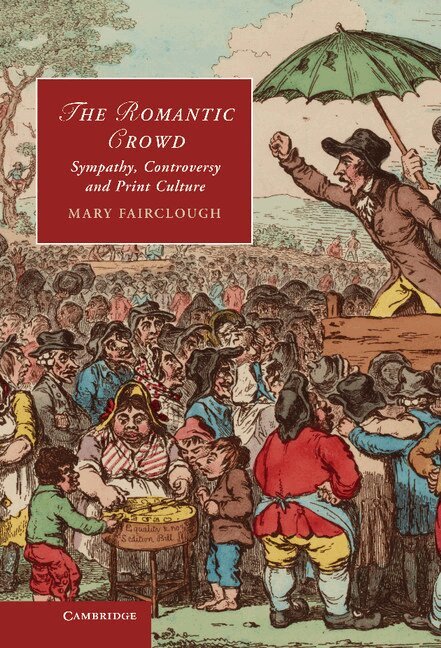
    The Romantic Crowd

    Sympathy, Controversy and Print Culture

    AvMary Fairclough

    Häftad, Engelska, 2015

    Del 97 i serien Cambridge Studies in Romanticism

    533 kr

    Beställningsvara. Skickas inom 10-15 vardagar. Fri frakt över 249 kr.

    Fler format och utgåvor

    Inbunden

    1 473 kr

    Beskrivning

    In the long eighteenth century, sympathy was understood not just as an emotional bond, but also as a physiological force, through which disruption in one part of the body produces instantaneous disruption in another. Building on this theory, Romantic writers explored sympathy as a disruptive social phenomenon, which functioned to spread disorder between individuals and even across nations like a 'contagion'. It thus accounted for the instinctive behaviour of people swept up in a crowd. During this era sympathy assumed a controversial political significance, as it came to be associated with both riotous political protest and the diffusion of information through the press. Mary Fairclough reads Edmund Burke, Mary Wollstonecraft, William Godwin, John Thelwall, William Hazlitt and Thomas De Quincey alongside contemporary political, medical and philosophical discourse. Many of their central questions about crowd behaviour still remain to be answered by the modern discourse of collective psychology.

    Produktinformation

    • Utgivningsdatum:2015-10-01
    • Mått:152 x 230 x 16 mm
    • Vikt:440 g
    • Format:Häftad
    • Språk:Engelska
    • Serie:Cambridge Studies in Romanticism
    • Antal sidor:312
    • Förlag:Cambridge University Press
    • ISBN:9781107566668

    Utforska kategorier

    • Litteraturvetenskap inom Skönlitteratur

    Mer om författaren

    Mary Fairclough is a Lecturer in English Literature at the Centre for Eighteenth Century Studies and the Department of English and Related Literature at the University of York.

    Recensioner i media

    'Detailed and nuanced …' The Times Literary Supplement

    Innehållsförteckning

    • Introduction: collective sympathy; Part I. Sympathetic Communication, 1750–1800: From Moral Philosophy to Revolutionary Crowds: 1. Sympathy and the crowd: eighteenth-century contexts; 2. Sympathetic communication and the French Revolution; Part II. Romantic Afterlives, 1800–50: Sympathetic Communication, Mass Protest and Print Culture: 3. Sympathy and the press: mass protest and print culture in Regency England; 4. 'The contagious sympathy of popular and patriotic emotions': sympathy and loyalism after Waterloo; Afterword: sympathy and the Romantic crowd; Select bibliography; Index.