• Fri frakt över 249 kr
  • •
  • Snabba leveranser
  • •
  • Billiga böcker
Kundservice

Du är på sajten för privatpersoner.

Företag, bibliotek eller offentlig verksamhet?

Du handlar på classic.bokus.com, där alla dina funktioner finns intakta.
Till classic.bokus.com
Bokus logotyp. Gå till startsidan.
  • Erbjudanden
  • Nyheter
  • Student
  • Topplistor
  • Barn & ungdom
  • Bokus Play
  • E-böcker
  • Pocketböcker
  • Spel & pussel

10% rabatt på allt med kod NYSTART10 →

Sidfot

Mina sidor

    Hjälp

    • Kundservice
    • Vanliga frågor och svar
    • Frakt och leverans
    • Retur vid ångerrätt
    • Reklamera vara
    • Betalning
    • Köpvillkor
    • Allmänna villkor
    • Information om webbplatsens tillgänglighet

    Om Bokus

    • Om oss
    • Pressrum
    • För studenter
    • För företag
    • För bibliotek och offentlig verksamhet
    • För leverantörer
    • Hållbarhet

    Populärt

    • Aktuella erbjudanden
    • Presentkort
    • Studentlitteratur
    • Nya böcker
    • Topplistor
    • Signerade böcker
    • Engelska böcker

    Inspiration

    • Boktips
    • BookTok
    • Populära bokserier
    • Barnbokskaraktärer
    • Populära författare
    Logotyp för Bokus
    Följ oss på Facebook (extern länk)Följ oss på Instagram (extern länk)Följ oss på YouTube (extern länk)Följ oss på TikTok (extern länk)
    bokus @ CookiesAnpassa cookiesIntegritetspolicyKöpvillkor
    Till Citymail hemsida (extern länk)Till Budbee hemsida (extern länk)Till Postnord hemsida (extern länk)Till Schenker hemsida (extern länk)Till Early Bird hemsida (extern länk)Till Walleys hemsida (extern länk)
    1. Naturvetenskap och teknik
    2. Matematik och naturvetenskap
    3. Matematik
    4. Topologi

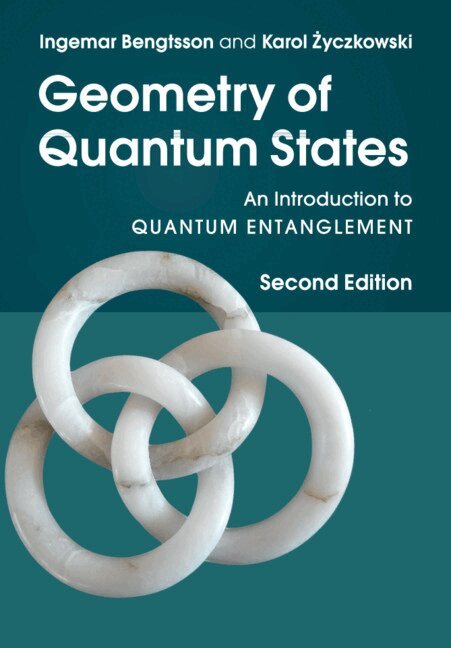
    Geometry of Quantum States

    An Introduction to Quantum Entanglement

    AvIngemar Bengtsson,Karol Życzkowski

    Häftad, Engelska, 2020

    738 kr

    Beställningsvara. Skickas inom 10-15 vardagar. Fri frakt över 249 kr.

    Fler format och utgåvor

    Inbunden

    1 281 kr

    Beskrivning

    Quantum information theory is a branch of science at the frontier of physics, mathematics, and information science, and offers a variety of solutions that are impossible using classical theory. This book provides a detailed introduction to the key concepts used in processing quantum information and reveals that quantum mechanics is a generalisation of classical probability theory. The second edition contains new sections and entirely new chapters: the hot topic of multipartite entanglement; in-depth discussion of the discrete structures in finite dimensional Hilbert space, including unitary operator bases, mutually unbiased bases, symmetric informationally complete generalized measurements, discrete Wigner function, and unitary designs; the Gleason and Kochen-Specker theorems; the proof of the Lieb conjecture; the measure concentration phenomenon; and the Hastings' non-additivity theorem. This richly-illustrated book will be useful to a broad audience of graduates and researchers interested in quantum information theory. Exercises follow each chapter, with hints and answers supplied.

    Produktinformation

    • Utgivningsdatum:2020-03-26
    • Mått:170 x 244 x 33 mm
    • Vikt:999 g
    • Format:Häftad
    • Språk:Engelska
    • Antal sidor:636
    • Upplaga:2
    • Förlag:Cambridge University Press
    • ISBN:9781107656147

    Utforska kategorier

    • Topologi inom Naturvetenskap och teknik
    • Matematik inom Naturvetenskap och teknik
    • Fysik inom Naturvetenskap och teknik

    Mer om författaren

    Ingemar Bengtsson is a professor of physics at Stockholms Universitet. After gaining a Ph.D. in Theoretical Physics from the Göteborgs universitet (1984), he held post-doctoral positions at CERN, Geneva, and the Imperial College of Science, Technology and Medicine, University of London. He returned to Göteborg in 1988 as a research assistant at Chalmers tekniska högskola, before taking up a position as Lecturer in Physics at Stockholms Universitet in 1993. He was appointed Professor of Physics in 2000. Professor Bengtsson is a member of the Swedish Physical Society and a former board member of its Divisions for Particle Physics and for Gravitation. His research interests are related to geometry, in the forms of classical general relativity and quantum theory. Karol Życzkowski is a professor at the Institute of Physics, Uniwersytet Jagiellonski, Kraków, Poland, and also at the Center for Theoretical Physics, Polska Akademia Nauk, Warsaw. He gained his Ph.D. and habilitation in theoretical physics at Uniwersytet Jagiellonski, and has followed this with a Humboldt Fellowship in Essen, a Fulbright Fellowship at the University of Maryland, College Park, and a visiting research position at the Perimeter Institute for Theoretical Physics, Ontario. He has been docent at the Academy of Sciences since 1999 and full professor at Uniwersytet Jagiellonski since 2004. Professor Życzkowski is a member of the Polish Physical Society and Academia Europaea. He works on quantum information, dynamical systems and chaos, quantum and statistical physics, applied mathematics, and theory of voting.

    Recensioner i media

    'True story:  A few years ago my daughter took a break from her usual question, 'Dad, what is your favourite colour?' and asked instead, 'What is your favourite shape?' I was floored! 'What a wonderful question; my favourite shape is Hilbert space!' 'What does it look like?' she asked. My answer: 'I don't know! But every day when I go to work, that's what I think about.' What I was speaking of, of course, is the geometry of quantum-state space. It is as much a mystery today as it was those years ago, and maybe more so as we learn to focus on its most key and mysterious features. This book, the worn first-edition of which I've had on my shelf for 11 years, is the indispensable companion for anyone's journey into that exotic terrain. Beyond all else, I am thrilled about the inclusion of two new chapters in the new edition, one of which I believe goes to the very heart of the meaning of quantum theory.' Christopher A. Fuchs, University of Massachusetts, Boston

    Innehållsförteckning

    • Preface; 1. Convexity, colours, and statistics; 2. Geometry of probability distributions; 3. Much ado about spheres; 4. Complex projective spaces; 5. Outline of quantum mechanics; 6. Coherent states and group actions; 7. The stellar representation; 8. The space of density matrices; 9. Purification of mixed quantum states; 10. Quantum operations; 11. Duality: maps versus states; 12. Discrete structures in Hilbert space; 13. Density matrices and entropies; 14. Distinguishability measures; 15. Monotone metrics and measures; 16. Quantum entanglement; 17. Multipartite entanglement; Appendix 1. Basic notions of differential geometry; Appendix 2. Basic notions of group theory; Appendix 3. Geometry – do it yourself; Appendix 4. Hints and answers to the exercises; Bibliography; Index.