• Fri frakt över 249 kr
  • •
  • Snabba leveranser
  • •
  • Billiga böcker
Kundservice

Du är på sajten för privatpersoner.

Företag, bibliotek eller offentlig verksamhet?

Du handlar på classic.bokus.com, där alla dina funktioner finns intakta.
Till classic.bokus.com
Bokus logotyp. Gå till startsidan.
  • Erbjudanden
  • Nyheter
  • Student
  • Topplistor
  • Barn & ungdom
  • Bokus Play
  • E-böcker
  • Pocketböcker
  • Spel & pussel

Må bättre, för mindre! Upp till 50% rabatt på hälsoböcker

Sidfot

Mina sidor

    Hjälp

    • Kundservice
    • Vanliga frågor och svar
    • Frakt och leverans
    • Retur vid ångerrätt
    • Reklamera vara
    • Betalning
    • Köpvillkor
    • Allmänna villkor
    • Information om webbplatsens tillgänglighet

    Om Bokus

    • Om oss
    • Pressrum
    • För studenter
    • För företag
    • För bibliotek och offentlig verksamhet
    • För leverantörer
    • Hållbarhet

    Populärt

    • Aktuella erbjudanden
    • Presentkort
    • Studentlitteratur
    • Nya böcker
    • Topplistor
    • Signerade böcker
    • Engelska böcker

    Inspiration

    • Boktips
    • BookTok
    • Populära bokserier
    • Barnbokskaraktärer
    • Populära författare
    Logotyp för Bokus
    Följ oss på Facebook (extern länk)Följ oss på Instagram (extern länk)Följ oss på YouTube (extern länk)Följ oss på TikTok (extern länk)
    bokus @ CookiesAnpassa cookiesIntegritetspolicyKöpvillkor
    Till Citymail hemsida (extern länk)Till Budbee hemsida (extern länk)Till Postnord hemsida (extern länk)Till Schenker hemsida (extern länk)Till Early Bird hemsida (extern länk)Till Walleys hemsida (extern länk)
    1. Historia och arkeologi
    2. Historia
    3. Europas historia

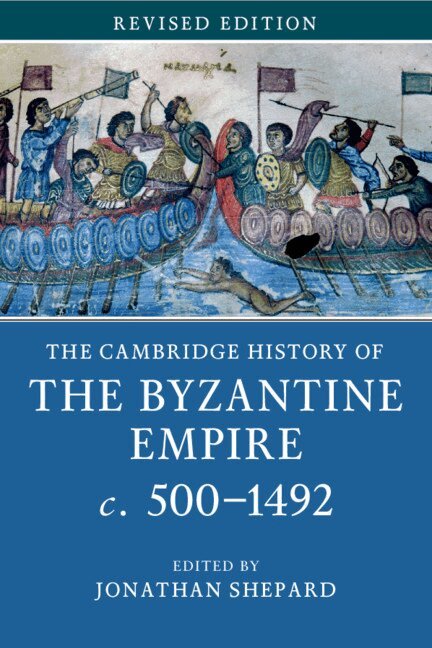
    The Cambridge History of the Byzantine Empire c.500-1492

    AvJonathan Shepard

    Häftad, Engelska, 2019

    678 kr

    Tillfälligt slut

    Beskrivning

    Byzantium lasted a thousand years, ruled to the end by self-styled 'emperors of the Romans'. It underwent kaleidoscopic territorial and structural changes, yet recovered repeatedly from disaster: even after the near-impregnable Constantinople fell in 1204, variant forms of the empire reconstituted themselves. The Cambridge History of the Byzantine Empire c.500-1492 tells the story, tracing political and military events, religious controversies and economic change. It offers clear, authoritative chapters on the main events and periods, with more detailed chapters on outlying regions and neighbouring societies and powers of Byzantium. With aids such as maps, a glossary, an alternative place-name table and references to English translations of sources, it will be valuable as an introduction. However, it also offers stimulating new approaches and important findings, making it essential reading for postgraduates and for specialists. The revised paperback edition contains a new preface by the editor and will offer an invaluable companion to survey courses in Byzantine history.

    Produktinformation

    • Utgivningsdatum:2019-07-04
    • Mått:203 x 224 x 53 mm
    • Vikt:1 907 g
    • Format:Häftad
    • Språk:Engelska
    • Antal sidor:1 120
    • Förlag:Cambridge University Press
    • ISBN:9781107685871

    Utforska kategorier

    • Europas historia inom Historia och arkeologi

    Mer om författaren

    Jonathan Shepard was a University Lecturer in History at the University of Cambridge. Co-author of The Emergence of Rus (1996) with Simon Franklin, with whom he also co-edited Byzantine Diplomacy (1992), some of his many articles appear in Emergent Elites and Byzantium (2011). Edited volumes include The Expansion of Orthodox Europe (2007), Byzantium and the Viking World (with Fedir Androshchuk and Monica White, 2016), Imperial Spheres and the Adriatic (with Mladen Ančić and Trpimir Vedriš, 2017), and Viking-Age Trade (with Jacek Gruszczyński and Marek Jankowiak, 2019), and forthcoming volumes include Muslims on the Volga (with Luke Treadwell) and Political Culture in Three Spheres: Byzantium, Islam and the West (with Catherine Holmes et al.).

    Innehållsförteckning

    • General introduction Jonathan Shepard; Part I. The Earlier Empire (c.500–c.700): 1. Justinian and his legacy (500–600) Andrew Louth; 2. Eastern neighbours; 2.1. Persia and the Sasanian monarchy (224–651) Zeev Rubin; 2.2. Armenia (400–600) R. W. Thomson; 2.3. The Arabs to the time of the Prophet Lawrence I. Conrad; 3. Western approaches (500–600) John Moorhead; 4. Byzantium transforming (600–700) Andrew Louth; Part II. The Middle Empire (c.700–1204): 5. State of emergency (700–850) Marie-France Auzépy; 6. After iconoclasm (850–886) Shaun Tougher; 7. Religious missions Sergey A. Ivanov; 8. Armenian neighbours (600–1045) T. W. Greenwood; 9. Confronting Islam: emperors versus caliphs (641–c.850) Walter E. Kaegi; 10. Western approaches (700–900) Michael McCormick; 11. Byzantine Italy (680–876) Thomas S. Brown; 12. The middle Byzantine economy (600–1204) Mark Whittow; 13. Equilibrium to expansion (886–1025) Jonathan Shepard; 14. Western approaches (900–1025) Jonathan Shepard; 15. Byzantium and southern Italy (876–1000) G. A. Loud; 16. Belle époque or crisis? (1025–1118) Michael Angold; 17. The empire of the Komnenoi (1118–1204) Paul Magdalino; 18. Balkan borderlands (1018–1204) Paul Stephenson; 19. Raiders and neighbours: the Turks (1040–1304) D. A. Korobeinikov; Part III. The Byzantine Lands in the Later Middle Ages (1204–1492): 20. After the Fourth Crusade: 20.1. The Greek rump states and the recovery of Byzantium Michael Angold; 20.2. The Latin empire of Constantinople and the Frankish states David Jacoby; 21. Balkans powers: Albania, Serbia and Bulgaria (1200–1300) Alain Ducellier; 22. The Palaiologoi and the world around them (1261–1400) Angeliki E. Laiou; 23. Latins in the Aegean and the Balkans (1300–1400) Michel Balard; 24. The Roman orthodox world (1393–1492) Anthony Bryer.