• Fri frakt över 249 kr
  • •
  • Snabba leveranser
  • •
  • Billiga böcker
Kundservice

Du är på sajten för privatpersoner.

Företag, bibliotek eller offentlig verksamhet?

Du handlar på classic.bokus.com, där alla dina funktioner finns intakta.
Till classic.bokus.com
Bokus logotyp. Gå till startsidan.
  • Erbjudanden
  • Nyheter
  • Student
  • Topplistor
  • Barn & ungdom
  • Bokus Play
  • E-böcker
  • Pocketböcker
  • Spel & pussel

10% rabatt på allt med kod NYSTART10 →

Sidfot

Mina sidor

    Hjälp

    • Kundservice
    • Vanliga frågor och svar
    • Frakt och leverans
    • Retur vid ångerrätt
    • Reklamera vara
    • Betalning
    • Köpvillkor
    • Allmänna villkor
    • Information om webbplatsens tillgänglighet

    Om Bokus

    • Om oss
    • Pressrum
    • För studenter
    • För företag
    • För bibliotek och offentlig verksamhet
    • För leverantörer
    • Hållbarhet

    Populärt

    • Aktuella erbjudanden
    • Presentkort
    • Studentlitteratur
    • Nya böcker
    • Topplistor
    • Signerade böcker
    • Engelska böcker

    Inspiration

    • Boktips
    • BookTok
    • Populära bokserier
    • Barnbokskaraktärer
    • Populära författare
    Logotyp för Bokus
    Följ oss på Facebook (extern länk)Följ oss på Instagram (extern länk)Följ oss på YouTube (extern länk)Följ oss på TikTok (extern länk)
    bokus @ CookiesAnpassa cookiesIntegritetspolicyKöpvillkor
    Till Citymail hemsida (extern länk)Till Budbee hemsida (extern länk)Till Postnord hemsida (extern länk)Till Schenker hemsida (extern länk)Till Early Bird hemsida (extern länk)Till Walleys hemsida (extern länk)
    1. Språk och ordböcker
    2. Språkvetenskap och lingvistik

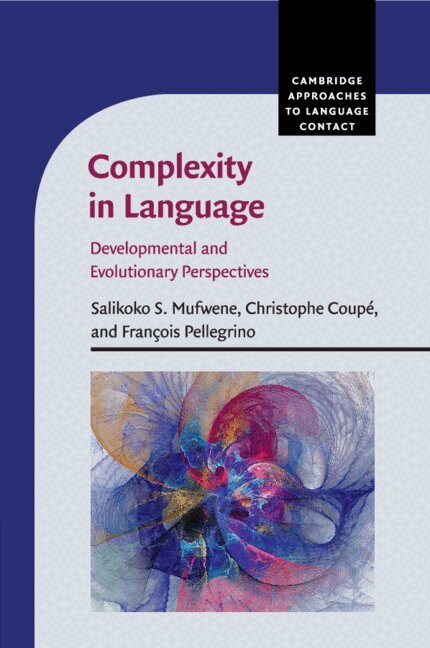
    Complexity in Language

    Developmental and Evolutionary Perspectives

    AvSalikoko S. Mufwene,Christophe Coupé

    Häftad, Engelska, 2019

    Del i serien Cambridge Approaches to Language Contact

    477 kr

    Beställningsvara. Skickas inom 10-15 vardagar. Fri frakt över 249 kr.

    Beskrivning

    The question of complexity, as in what makes one language more 'complex' than another, is a long-established topic of debate amongst linguists. Recently, this issue has been complemented with the view that languages are complex adaptive systems, in which emergence and self-organization play major roles. However, few students of the phenomenon have gone beyond the basic assessment of the number of units and rules in a language (what has been characterized as 'bit complexity') or shown some familiarity with the science of complexity. This book reveals how much can be learned by overcoming these limitations, especially by adopting developmental and evolutionary perspectives. The contributors include specialists of language acquisition, evolution and ecology, grammaticization, phonology, and modeling, all of whom approach languages as dynamical, emergent, and adaptive complex systems.

    Produktinformation

    • Utgivningsdatum:2019-05-30
    • Mått:152 x 230 x 13 mm
    • Vikt:450 g
    • Format:Häftad
    • Språk:Engelska
    • Serie:Cambridge Approaches to Language Contact
    • Antal sidor:264
    • Förlag:Cambridge University Press
    • ISBN:9781107686625

    Utforska kategorier

    • Språkvetenskap och lingvistik inom Språk och ordböcker

    Mer om författaren

    Salikoko S. Mufwene is Professor of Linguistics and member of the Committee on Evolutionary Biology and the Commitee on the Conceptual and Historical Studies of Science, at the University of Chicago. He is the author of The Ecology of Language Evolution (Cambridge, 2001), Créoles, écologie sociale, évolution linguistique (2005), and Language Evolution: Contact, Competition and Change (2008). He has edited several books, including Iberian Imperialism and Language Evolution in Latin America (2014). He is the founding editor of the Cambridge Approaches to Language Contact series. His research includes the emergence of creoles, the phylogenetic emergence of language, and globalization and language vitality. Christophe Coupé is a researcher in cognitive science at the Centre National de la Recherche Scientifique (CNRS), Paris and Université Lumière Lyon II, France. With a background in computer science, cognitive science and psychology, he has been involved in several multidisciplinary programs focusing on language complexity, language origins and language change. His contributions have mostly consisted of the design and analyses of databases, and of statistical or computational models of linguistic evolution and diversity. In 2003, he received the Prize of the Young Researcher of the city of Lyon for his Ph.D. dissertation on the origins of language. In addition to other papers on phonological complexity, information rate and functional load, he has co-edited the collective volume Approaches to Phonological Complexity (2009). François Pellegrino is a senior researcher in linguistics and cognitive science at the Centre National de la Recherche Scientifique (CNRS), Paris and Université Lumière Lyon II, France. He has coordinated several projects on language complexity and has been the coordinator of the 'Laboratory of Excellence' ASLAN (Advanced Studies on Language Complexity) since 2011. For more than ten years, his research has focused on the structure and dynamics of phonological systems in the light of the science of complexity and of Shannon's information theory. He has co-edited the collective volume Approaches to Phonological Complexity (2009) and, over the last fifteen years, he has authored or co-authored about eighty journal articles, book chapters or conference papers.

    Innehållsförteckning

    • 1. Complexity in language: a multifaceted phenomenon Salikoko S. Mufwene, François Pellegrino and Christophe Coupé; 2. How robotic agents agree to communicate Luc Steels and Katrien Beuls; 3. Self-organization in language Bart de Boer; 4. A complex adaptive systems approach to language and brain Tom Schoenemann; 5. Evolutionary complexity of social cognition, semasiographic systems, and language William Croft; 6. Quantitative analyses of phonological datasets Christophe Coupé, Egidio Marsico and François Pellegrino; 7. Phonological acquisition as emergence Barbara Davis; 8. Language choice in a multilingual society: a view from complexity science Lucía Loureiro-Porto and Maxi San Miguel; 9. Complexity in/of language: bases for a dynamic socio-cognitive view Albert Bastardas-Boada.