• Fri frakt över 249 kr
  • •
  • Snabba leveranser
  • •
  • Billiga böcker
Kundservice

Du är på sajten för privatpersoner.

Företag, bibliotek eller offentlig verksamhet?

Du handlar på classic.bokus.com, där alla dina funktioner finns intakta.
Till classic.bokus.com
Bokus logotyp. Gå till startsidan.
  • Erbjudanden
  • Nyheter
  • Student
  • Topplistor
  • Barn & ungdom
  • Bokus Play
  • E-böcker
  • Pocketböcker
  • Spel & pussel

10% rabatt på allt med kod: NYSTART10 →

Sidfot

Mina sidor

    Hjälp

    • Kundservice
    • Vanliga frågor och svar
    • Frakt och leverans
    • Retur vid ångerrätt
    • Reklamera vara
    • Betalning
    • Köpvillkor
    • Allmänna villkor
    • Information om webbplatsens tillgänglighet

    Om Bokus

    • Om oss
    • Pressrum
    • För studenter
    • För företag
    • För bibliotek och offentlig verksamhet
    • För leverantörer
    • Hållbarhet

    Populärt

    • Aktuella erbjudanden
    • Presentkort
    • Studentlitteratur
    • Nya böcker
    • Topplistor
    • Signerade böcker
    • Engelska böcker

    Inspiration

    • Boktips
    • BookTok
    • Populära bokserier
    • Barnbokskaraktärer
    • Populära författare
    Logotyp för Bokus
    Följ oss på Facebook (extern länk)Följ oss på Instagram (extern länk)Följ oss på YouTube (extern länk)Följ oss på TikTok (extern länk)
    bokus @ CookiesAnpassa cookiesIntegritetspolicyKöpvillkor
    Till Citymail hemsida (extern länk)Till Budbee hemsida (extern länk)Till Postnord hemsida (extern länk)Till Schenker hemsida (extern länk)Till Early Bird hemsida (extern länk)Till Walleys hemsida (extern länk)
    1. Ekonomi och Ledarskap
    2. Nationalekonomi
    3. Mikroekonomi

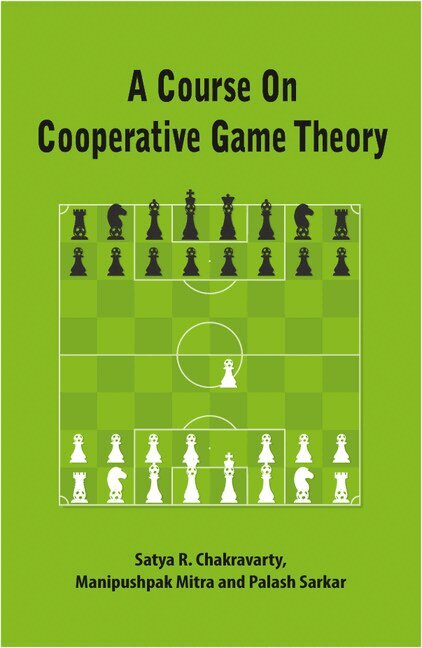
    A Course on Cooperative Game Theory

    AvSatya R. Chakravarty,Manipushpak Mitra

    Häftad, Engelska, 2014

    416 kr

    Tillfälligt slut

    Fler format och utgåvor

    Inbunden

    Tillf. slut

    Beskrivning

    Cooperative game theory deals with situations where objectives of participants of the game are partially cooperative and partially conflicting. It is in the interest of participants to cooperate in the sense of making binding agreements to achieve the maximum possible benefit. When it comes to distribution of benefit/payoffs, participants have conflicting interests. Such situations are usually modelled as cooperative games. While the book mainly discusses transferable utility games, there is also a brief analysis of non-transferable utility games. Alternative solution concepts to cooperative game theoretic problems are presented in chapters 1-9 and the next four chapters present issues related to computations of solutions discussed in the earlier chapters. The proofs of all results presented in the book are quite explicit. Additionally the mathematical techniques employed in demonstrating the results will be helpful to those who wish to learn application of mathematics for solving problems in game theory.

    Produktinformation

    • Utgivningsdatum:2014-10-17
    • Mått:153 x 229 x 13 mm
    • Vikt:350 g
    • Format:Häftad
    • Språk:Engelska
    • Antal sidor:276
    • Förlag:Cambridge University Press
    • ISBN:9781107691322

    Utforska kategorier

    • Mikroekonomi inom Ekonomi och Ledarskap

    Mer om författaren

    Satya R. Chakravarty is a Professor of Economics at the Indian Statistical Institute, Kolkata. He received a bachelor degree in Statistics in 1976, a master degree in economics in 1977 and a doctorate in economics in 1981 from the Indian Statistical Institute. Professor Chakravarty worked as a Visiting Professor at the University of British Columbia, Canada (1984–5), the University of Karlsruhe, Germany (1988–90) with a grant from the German Research Foundation, the Bar Ilan University, Israel (1990, 2004, 2005, 2006 and 2010), the Kagawa University, Japan (1996–7 and 2000), the Paris School of Economics, Paris, France (1997–8) with a grant from the French Ministry of Education, the Chinese University of Hong Kong (1998), the Bocconi University, Milan, Italy (2002–3 and 2006–7) and the Yokohama National University, Japan (2009). Professor Chakravarty's main areas of interest are welfare economics, public economics, mathematical finance, industrial organization and game theory. His work spans theoretical, empirical and policy analysis. Manipushpak Mitra is a Professor of Economics at the Indian Statistical Institute, Kolkata, India. He has articles published in internationally known journals and edited books on cooperative game theory, mechanisms design in allocation problems and in market regulation problems, and industrial organization. Palash Sarkar is a computer scientist and is presently a Professor at the Indian Statistical Institute, Kolkata, India. He has published over one hundred articles in leading journals and conference proceedings. His research and teaching interests range over a wide variety of topics at the interface of computer science and mathematics.

    Innehållsförteckning

    • Preface; 1. Introduction and motivation page; 2. Basics and preliminaries; 3. The core and some related solutions; 4. The bargaining set, kernel and nucleolus; 5. The Shapley value; 6. The core, Shapley value and Weber set; 7. Voting games; 8. Mathematical matching; 9. Non-transferable utility cooperative games; 10. Linear programming; 11. Algorithmic aspects of cooperative game theory; 12. Weighted majority games; 13. Stable matching algorithm; References; Index.