• Fri frakt över 249 kr
  • •
  • Snabba leveranser
  • •
  • Billiga böcker
Kundservice

Du är på sajten för privatpersoner.

Företag, bibliotek eller offentlig verksamhet?

Du handlar på classic.bokus.com, där alla dina funktioner finns intakta.
Till classic.bokus.com
Bokus logotyp. Gå till startsidan.
  • Erbjudanden
  • Student
  • Topplistor
  • Barn & ungdom
  • Bokus Play
  • E-böcker
  • Ljudböcker
  • Pocketböcker
  • Spel och pussel

Pocketfynda! Hundratals böcker för 49 kr/st →

Sidfot

Mina sidor

    Hjälp

    • Kundservice
    • Vanliga frågor och svar
    • Frakt och leverans
    • Retur vid ångerrätt
    • Reklamera vara
    • Betalning
    • Köpvillkor
    • Allmänna villkor
    • Information om webbplatsens tillgänglighet

    Om Bokus

    • Om oss
    • Pressrum
    • För studenter
    • För företag
    • För bibliotek och offentlig verksamhet
    • För leverantörer
    • Hållbarhet

    Populärt

    • Aktuella erbjudanden
    • Presentkort
    • Studentlitteratur
    • Nya böcker
    • Topplistor
    • Signerade böcker
    • Engelska böcker

    Inspiration

    • Boktips
    • BookTok
    • Barnbokskaraktärer
    • Populära författare
    Logotyp för Bokus
    Följ oss på Facebook (extern länk)Följ oss på Instagram (extern länk)Följ oss på YouTube (extern länk)Följ oss på TikTok (extern länk)
    bokus @ CookiesAnpassa cookiesIntegritetspolicyKöpvillkor
    Till Citymail hemsida (extern länk)Till Budbee hemsida (extern länk)Till Postnord hemsida (extern länk)Till Schenker hemsida (extern länk)Till Early Bird hemsida (extern länk)Till Walleys hemsida (extern länk)
    1. Naturvetenskap och teknik
    2. Matematik och naturvetenskap
    3. Astronomi

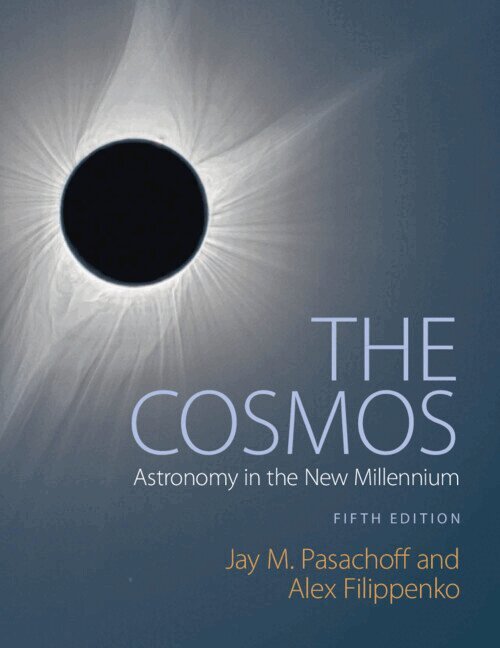
    The Cosmos

    Astronomy in the New Millennium

    AvJay M. Pasachoff,Alex Filippenko

    Häftad, Engelska, 2019

    959 kr

    Beställningsvara. Skickas inom 7-10 vardagar. Fri frakt över 249 kr.

    Beskrivning

    The fifth edition of The Cosmos: Astronomy in the New Millennium provides you with the fundamentals of astronomical knowledge that have been built up over decades, with an expanded discussion of the incredible advances that are now taking place in this fast-paced field, such as New Horizons' flyby of Pluto, exoplanets, 'dark matter', and the direct detection of gravitational waves by the Laser Interferometer Gravitational-Wave Observatory (LIGO). Written in a clear and easily understandable style, this textbook has been thoroughly revised to include updated data and figures, new images from recent space missions and telescopes, the latest discoveries on supernovae, and new observations of the region around the four-million-solar-mass black hole at the center of our Milky Way Galaxy. A rich array of teaching and learning resources is available at http://thecosmos5.com. The website is regularly updated to include the latest discoveries and photographs in the field.

    Produktinformation

    • Utgivningsdatum:2019-07-11
    • Mått:220 x 277 x 31 mm
    • Vikt:2 050 g
    • Format:Häftad
    • Språk:Engelska
    • Antal sidor:732
    • Upplaga:5
    • Förlag:Cambridge University Press
    • ISBN:9781108431385

    Utforska kategorier

    • Astronomi inom Naturvetenskap och teknik

    Mer om författaren

    Jay M. Pasachoff, Field Memorial Professor of Astronomy at Williams College, teaches the astronomy survey course. He is also Director of the Hopkins Observatory there. He received his undergraduate and graduate degrees from Harvard and was then at Caltech, where he has also had recent sabbatical leaves. He has observed 69 solar eclipses. He also studies occultations of stars by Pluto and other objects in the outer Solar System. Pasachoff is Chair of the Working Group on Eclipses of the International Astronomical Union and was Chair of the American Astronomical Society's Historical Astronomy Division. He is also co-editor of Teaching and Learning Astronomy (Cambridge, 2005) and Innovation in Astronomy Education (Cambridge, 2008). He received the American Astronomical Society's Education Prize (2003); the Janssen Prize from the Société Astronomique de France (2012), and the Richtmyer Memorial Lecture Award, American Association of Physics Teachers (2017). In 2019, he was awarded the Klumpke-Roberts Award for his outstanding contribution to the public understanding and appreciation of astronomy. Asteroid (5100) Pasachoff is named after him. Alex Filippenko is a Professor of Astronomy, and the Richard and Rhoda Goldman Distinguished Professor in the Physical Sciences, at the University of California, Berkeley. He received his undergraduate degree from the University of California, Santa Barbara (1979) and his doctorate from the California Institute of Technology (1984). His primary areas of research are exploding stars, gamma-ray bursts, active galaxies, black holes, and observational cosmology. Filippenko was the only person to have been a member of both teams that revealed the Nobel-worthy accelerating expansion of the Universe. He is one of the world's most highly cited astronomers and was elected to the National Academy of Sciences (2009). Filippenko has won many prestigious teaching awards, including the Carnegie/CASE National Professor of the Year among doctoral institutions (2006). He has appeared frequently on science newscasts and television documentaries, especially The Universe series. He received the Carl Sagan Prize for Science Popularization (2004).

    Recensioner i media

    'The Cosmos: Astronomy in the New Millennium, 5th edition, is simply the best-written, introductory astronomy textbook on the market. The instructor will use all of this book. It is comprehensive but brief enough that students' can be reasonably expected to read the entire text in the course of a semester.' Thomas Hockey, University of Northern Iowa

    Innehållsförteckning

    • Preface; About the authors; 1. A grand tour of the heavens; 2. Light, matter, and energy: powering the Universe; 3. Light and telescopes: extending our senses; 4. Observing the stars and planets: clockwork of the Universe; 5. Gravitation and motion: the early history of astronomy; 6. The terrestrial planets: Earth, Moon, and their relatives; 7. The Jovian planets: windswept giants; 8. Pluto, comets, and space debris; 9. Our Solar System and others; 10. Our star: the Sun; 11. Stars: distant suns; 12. How the stars shine: cosmic furnaces; 13. The death of stars: recycling; 14. Black holes: the end of space and time; 15. The Milky Way: our home in the Universe; 16. A universe of galaxies; 17. Quasars and active galaxies; 18. Cosmology: the birth and life of the cosmos; 19. In the beginning; 20. Life in the Universe; Epilogue; Appendices; Selected readings; Glossary; Index.