• Fri frakt över 249 kr
  • •
  • Snabba leveranser
  • •
  • Billiga böcker
Kundservice

Du är på sajten för privatpersoner.

Företag, bibliotek eller offentlig verksamhet?

Du handlar på classic.bokus.com, där alla dina funktioner finns intakta.
Till classic.bokus.com
Bokus logotyp. Gå till startsidan.
  • Erbjudanden
  • Nyheter
  • Student
  • Topplistor
  • Barn & ungdom
  • Bokus Play
  • E-böcker
  • Pocketböcker
  • Spel & pussel

10% rabatt på allt med kod: NYSTART10 →

Sidfot

Mina sidor

    Hjälp

    • Kundservice
    • Vanliga frågor och svar
    • Frakt och leverans
    • Retur vid ångerrätt
    • Reklamera vara
    • Betalning
    • Köpvillkor
    • Allmänna villkor
    • Information om webbplatsens tillgänglighet

    Om Bokus

    • Om oss
    • Pressrum
    • För studenter
    • För företag
    • För bibliotek och offentlig verksamhet
    • För leverantörer
    • Hållbarhet

    Populärt

    • Aktuella erbjudanden
    • Presentkort
    • Studentlitteratur
    • Nya böcker
    • Topplistor
    • Signerade böcker
    • Engelska böcker

    Inspiration

    • Boktips
    • BookTok
    • Populära bokserier
    • Barnbokskaraktärer
    • Populära författare
    Logotyp för Bokus
    Följ oss på Facebook (extern länk)Följ oss på Instagram (extern länk)Följ oss på YouTube (extern länk)Följ oss på TikTok (extern länk)
    bokus @ CookiesAnpassa cookiesIntegritetspolicyKöpvillkor
    Till Citymail hemsida (extern länk)Till Budbee hemsida (extern länk)Till Postnord hemsida (extern länk)Till Schenker hemsida (extern länk)Till Early Bird hemsida (extern länk)Till Walleys hemsida (extern länk)
    1. Naturvetenskap och teknik
    2. Geovetenskap
    3. Miljövetenskap och miljöpolitik

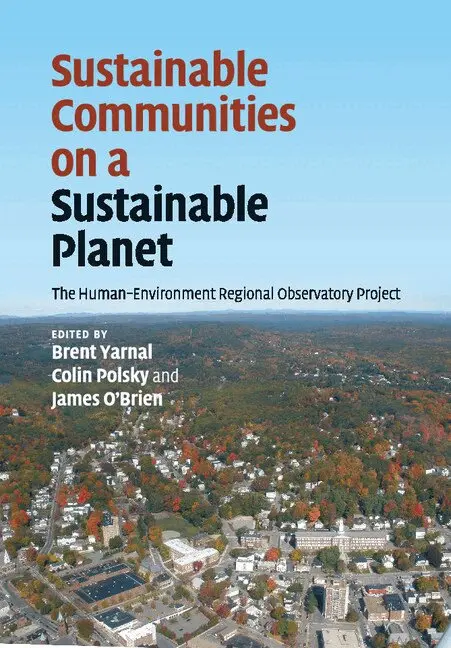
    Sustainable Communities on a Sustainable Planet

    The Human-Environment Regional Observatory Project

    AvBrent Yarnal,Colin Polsky

    Häftad, Engelska, 2018

    584 kr

    Beställningsvara. Skickas inom 10-15 vardagar. Fri frakt över 249 kr.

    Beskrivning

    Scientists and policymakers have realised that localities are central to addressing the causes and consequences of global environmental change. The goal of the Human-Environment Regional Observatory project (HERO) was to develop the infrastructure necessary to monitor and understand the local dimensions of global change. This book presents the philosophy behind HERO, the methods used to put that philosophy into action, its results, and the lessons learned from the project. HERO used three strategies: it developed research protocols and data standards for collecting data; it built a web-based networking environment to help investigators share data, analyses and ideas from remote locations; and investigators field-tested these concepts by applying them in diverse biophysical and socioeconomic settings - central Massachusetts, central Pennsylvania, southwestern Kansas, and the US-Mexico border region of Arizona. The book highlights the unique focus of HERO regarding thinking and acting on complex, integrative, and interdisciplinary global change science at local scales, and is valuable for global change scientists.

    Produktinformation

    • Utgivningsdatum:2018-03-01
    • Mått:171 x 245 x 20 mm
    • Vikt:630 g
    • Format:Häftad
    • Språk:Engelska
    • Antal sidor:350
    • Förlag:Cambridge University Press
    • ISBN:9781108445740

    Utforska kategorier

    • Miljövetenskap och miljöpolitik inom Naturvetenskap och teknik
    • Miljöteknik inom Naturvetenskap och teknik

    Mer om författaren

    Brent Yarnal is Professor of Geography at Pennsylvania State University. His research and teaching interests bridge the physical and social sciences, and integrate climate change, natural hazards, land-use change, water resources, and the use of environmental information in decision making. His research focuses on vulnerability to and adaptation planning for present and future climate change, local and regional greenhouse gas emissions inventories and mitigation planning, and the role of climate information in water resource decision making. He has authored and contributed to numerous books and journal articles, and was the editor of Climate Research - Interactions of Climate with Organisms, Ecosystems and Human Societies from 1996–2001. Colin Polsky is Assistant Professor in the Graduate School of Geography at Clark University, Massachusetts. He is a geographer specialising in the human dimensions of global environmental change. He has explored ways to blend quantitative and qualitative methods for the study of social and ecological vulnerability to environmental changes in the Arctic, the US Great Plains, and central and eastern Massachusetts. This research requires the blending of statistical techniques (such as empirical downscaling and spatial econometrics) with insight gained from qualitative methods (such as interviews and participant observation). Professor Polsky has an extensive range of publications on the subject. James O'Brien is Principal Lecturer in the School of Geography, Geology and the Environment at Kingston University, London. His research and teaching interests include Geographic Information Systems (GIS) enterprise and research, GIS software development, internet GIS, GIS and natural hazards, spatial databases, and geographic semantics. He has co-presented papers at international conferences on geographic semantics and the role of GIS in education.

    Innehållsförteckning

    • 1. Infrastructure for observing local human-environment interactions Brent Yarnal, John Harrington, Jr, Andrew C. Comrie, Colin Polsky and Ola Ahlqvist; 2. Theory: computing with knowledge to represent and share understanding Mark Gahegan, William A. Pike and Junyan Luo; 3. Infrastructure for collaboration Bill Pike, Alan MacEachren and Brent Yarnal; 4. Representing and reasoning with conceptual understanding Ola Ahlqvist and Chaoqing Yu; 5. Establishing vulnerability observatory networks to coordinate the collection and analysis of comparable data Colin Polsky, Rob Neff and Brent Yarnal; 6. Comparative assessment of human-environment landscape change John Harrington, Jr, Brent Yarnal, Diana Liverman, Billie Lee Turner II and Brandi Nagle; 7. Landsat mapping of local landscape change: the satellite-era context Rachel M. Kurtz, Robert Gilmore Pontius, Jr, John Harrington, Jr and Cynthia L. Sorrensen; 8. Assessing local vulnerabilities: methodological approaches and regional contexts Colin Polsky, Cynthia Sorrensen, Jessica Whitehead and Rob Neff; 9. Rapid vulnerability assessments of exposures, sensitivities, and adaptive capacities of the HERO study sites Colin Polsky, Andrew Comrie, Jessica Whitehead, Cynthia Sorrensen, Lisa M. Butler Harrington, Max Lu, Rob Neff and Brent Yarnal; 10. Evaluating vulnerability assessments of the HERO study sites Colin Polsky, Cynthia Sorrensen, Jessica Whitehead, Lisa M. Butler Harrington, Max Lu, Rob Neff and Brent Yarnal; 11. The mounting risk of drought in a humid landscape: structure and agency in suburbanizing Massachusetts Colin Polsky, Sarah Assefa, Kate Del Vecchio, Troy Hill, Laura Merner, Isaac Tercero and Gil Pontius; 12. A diverse human-environment system: traditional agriculture, industrial agriculture, and service economy in central Pennsylvania Brent Yarnal; 13. Fossil water and agriculture in southwestern Kansas Lisa M. Butler Harrington, Max Lu and John A. Harrington, Jr; 14. Urbanization and hydroclimatic challenges in the Sonoran Desert border region Cynthia L. Sorrensen and Andrew C. Comrie; 15. Lessons learned from the HERO project Brent Yarnal, John Harrington, Jr, Andrew C. Comrie, Colin Polsky, Ola Ahlqvist and the HERO Team; References; Index.