• Fri frakt över 249 kr
  • •
  • Snabba leveranser
  • •
  • Billiga böcker
Kundservice

Du är på sajten för privatpersoner.

Företag, bibliotek eller offentlig verksamhet?

Du handlar på classic.bokus.com, där alla dina funktioner finns intakta.
Till classic.bokus.com
Bokus logotyp. Gå till startsidan.
  • Erbjudanden
  • Nyheter
  • Student
  • Topplistor
  • Barn & ungdom
  • Bokus Play
  • E-böcker
  • Pocketböcker
  • Spel & pussel

10% rabatt på allt med kod: NYSTART10 →

Sidfot

Mina sidor

    Hjälp

    • Kundservice
    • Vanliga frågor och svar
    • Frakt och leverans
    • Retur vid ångerrätt
    • Reklamera vara
    • Betalning
    • Köpvillkor
    • Allmänna villkor
    • Information om webbplatsens tillgänglighet

    Om Bokus

    • Om oss
    • Pressrum
    • För studenter
    • För företag
    • För bibliotek och offentlig verksamhet
    • För leverantörer
    • Hållbarhet

    Populärt

    • Aktuella erbjudanden
    • Presentkort
    • Studentlitteratur
    • Nya böcker
    • Topplistor
    • Signerade böcker
    • Engelska böcker

    Inspiration

    • Boktips
    • BookTok
    • Populära bokserier
    • Barnbokskaraktärer
    • Populära författare
    Logotyp för Bokus
    Följ oss på Facebook (extern länk)Följ oss på Instagram (extern länk)Följ oss på YouTube (extern länk)Följ oss på TikTok (extern länk)
    bokus @ CookiesAnpassa cookiesIntegritetspolicyKöpvillkor
    Till Citymail hemsida (extern länk)Till Budbee hemsida (extern länk)Till Postnord hemsida (extern länk)Till Schenker hemsida (extern länk)Till Early Bird hemsida (extern länk)Till Walleys hemsida (extern länk)
    1. Historia och arkeologi
    2. Historia
    3. Europas historia

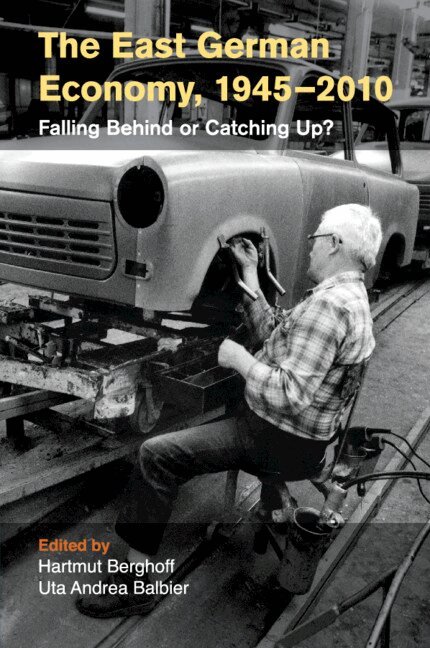
    The East German Economy, 1945-2010

    Falling Behind or Catching Up?

    AvHartmut Berghoff,Uta Andrea Balbier

    Häftad, Engelska, 2020

    Del i serien Publications of the German Historical Institute

    477 kr

    Beställningsvara. Skickas inom 10-15 vardagar. Fri frakt över 249 kr.

    Beskrivning

    By many measures, the German Democratic Republic (GDR) had the strongest economy in the Eastern bloc and was one of the most important industrial nations worldwide. Nonetheless, the economic history of the GDR has been primarily discussed as a failure when compared with the economic success of the Federal Republic and is often cited as one of the pre-eminent examples of central planning's deficiencies. This volume analyzes both the successes and failures of the East German economy. The contributors consider the economic history of East Germany within its broader political, cultural and social contexts. Rather than limit their perspective to the period of the GDR's existence, the essays additionally consider the decades before 1945 and the post-1990 era. Contributors also trace the present and future of the East German economy and suggest possible outcomes.

    Produktinformation

    • Utgivningsdatum:2020-03-26
    • Mått:152 x 228 x 17 mm
    • Vikt:350 g
    • Format:Häftad
    • Språk:Engelska
    • Serie:Publications of the German Historical Institute
    • Antal sidor:260
    • Förlag:Cambridge University Press
    • ISBN:9781108792615

    Utforska kategorier

    • Europas historia inom Historia och arkeologi

    Mer om författaren

    Harmut Berghoff is Director of the German Historical Institute, an independent center for advanced study in Washington, DC, and Professor of Economic and Social History at the University Göttingen in Germany. Dr Berghoff is a member of the editorial boards of the Business History Review and Enterprise and Society. Uta Andrea Balbier is Director of the Institute of North American Studies at King's College London and Lecturer in US History. Her first book, Kalter Krieg auf der Aschenbahn: Deutsch-deutscher Sport, 1950–1972, was a runner-up for the Carl Diem Prize for an outstanding contribution to the field of sports history.

    Recensioner i media

    'This stellar and invaluable volume of essays offers a state-of-the-art integrated narrative from the post-division to post-reunification East German economy. Avoiding a simple 'failure' story, it shows the contradictory qualities of the East German economy that once appeared as a star performer that might 'overtake without catching up' with the West, to use the famous paradoxical promise of Walter Ulbricht. This book reminds us that core parts of Eastern Germany were always 'Central Germany' (Mitteldeutschland) and that understanding the fading trajectory of the East German economic experiment is central to understanding German history more generally.' Jeffrey Fear, University of Glasgow

    Innehållsförteckning

    • Part I. Introduction: 1. From centrally planned economy to capitalist avant-garde? The creation, collapse, and transformation of a socialist economy Harmut Berghoff and Uta Balbier; 2. From the Soviet occupation zone to the new Eastern states: a survey André Steiner; Part II. Beginnings, Crises, and Reforms: The Planned Economy, 1945–71: 3. Winner takes all: the Soviet Union and the beginnings of central planning in Eastern Germany, 1945–9 Burghard Ciesla; 4. National socialist autarky projects and postwar industrial landscape Rainer Kalsch; 5. Innovation and ideology: Werner Hartmann and the failure of the East German electronics industry Dolores L. Augustine; 6. East German workers and the dark side of Eigensinn: divisive shop-floor practices and the failed revolution of June 17, 1953: the political and economic effects of shop-floor practices, 1945 Andrew I. Port; Part III. Living Beyond One's Means: The Long Decline, 1971–89: 7. From schadenfreude to going-out-of-business sale: East Germany and the oil crises of the 1970s Ray Stokes; 8. Innovation in a centrally planned economy: the case of the Filmfabrik Wolfen Silke Fengler; 9. Debt, cooperation, and collapse: East German foreign trade in the Hoenecker years Ralf Ahrens; 10. Ulbricht's and Hoenecker's Volksstaat? The common economic history of militarized regimes Jeffrey Kopstein; Part IV. Transformation, Subvention, and Renewal, 1989–2010: 11. The East German economy in the twenty-first century Michael C. Burda; 12. The social policy of unification and its consequences for the transformation of the economy in the new Eastern states Gerhard A. Ritter; 13. German economic unification: a view through the lens of the postwar recovery Holger C. Wolf.