• Fri frakt över 249 kr
  • •
  • Snabba leveranser
  • •
  • Billiga böcker
Kundservice

Du är på sajten för privatpersoner.

Företag, bibliotek eller offentlig verksamhet?

Du handlar på classic.bokus.com, där alla dina funktioner finns intakta.
Till classic.bokus.com
Bokus logotyp. Gå till startsidan.
  • Erbjudanden
  • Nyheter
  • Student
  • Topplistor
  • Barn & ungdom
  • Bokus Play
  • E-böcker
  • Pocketböcker
  • Spel & pussel

10% rabatt på allt med kod: NYSTART10 →

Sidfot

Mina sidor

    Hjälp

    • Kundservice
    • Vanliga frågor och svar
    • Frakt och leverans
    • Retur vid ångerrätt
    • Reklamera vara
    • Betalning
    • Köpvillkor
    • Allmänna villkor
    • Information om webbplatsens tillgänglighet

    Om Bokus

    • Om oss
    • Pressrum
    • För studenter
    • För företag
    • För bibliotek och offentlig verksamhet
    • För leverantörer
    • Hållbarhet

    Populärt

    • Aktuella erbjudanden
    • Presentkort
    • Studentlitteratur
    • Nya böcker
    • Topplistor
    • Signerade böcker
    • Engelska böcker

    Inspiration

    • Boktips
    • BookTok
    • Populära bokserier
    • Barnbokskaraktärer
    • Populära författare
    Logotyp för Bokus
    Följ oss på Facebook (extern länk)Följ oss på Instagram (extern länk)Följ oss på YouTube (extern länk)Följ oss på TikTok (extern länk)
    bokus @ CookiesAnpassa cookiesIntegritetspolicyKöpvillkor
    Till Citymail hemsida (extern länk)Till Budbee hemsida (extern länk)Till Postnord hemsida (extern länk)Till Schenker hemsida (extern länk)Till Early Bird hemsida (extern länk)Till Walleys hemsida (extern länk)
    1. Samhälle och politik
    2. Politik och statsskick
    3. Statsvetenskap och politisk teori

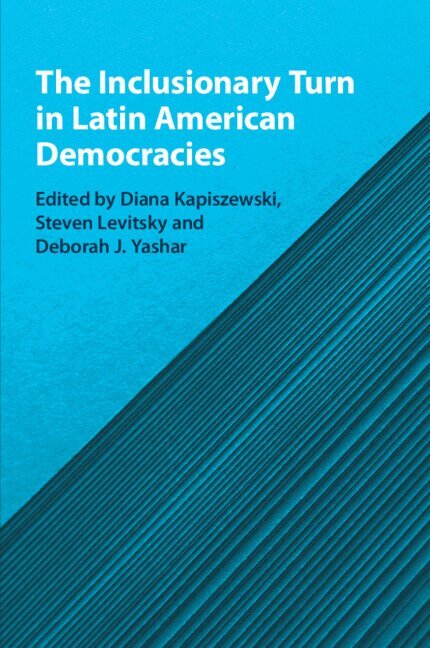
    The Inclusionary Turn in Latin American Democracies

    AvDiana Kapiszewski,Steven Levitsky

    Häftad, Engelska, 2021

    691 kr

    Beställningsvara. Skickas inom 10-15 vardagar. Fri frakt över 249 kr.

    Beskrivning

    Latin American states took dramatic steps toward greater inclusion during the late twentieth and early twenty-first Centuries. Bringing together an accomplished group of scholars, this volume examines this shift by introducing three dimensions of inclusion: official recognition of historically excluded groups, access to policymaking, and resource redistribution. Tracing the movement along these dimensions since the 1990s, the editors argue that the endurance of democratic politics, combined with longstanding social inequalities, create the impetus for inclusionary reforms. Diverse chapters explore how factors such as the role of partisanship and electoral clientelism, constitutional design, state capacity, social protest, populism, commodity rents, international diffusion, and historical legacies encouraged or inhibited inclusionary reform during the late 1990s and early 2000s. Featuring original empirical evidence and a strong theoretical framework, the book considers cross-national variation, delves into the surprising paradoxes of inclusion, and identifies the obstacles hindering further fundamental change.

    Produktinformation

    • Utgivningsdatum:2021-12-30
    • Mått:152 x 229 x 33 mm
    • Vikt:850 g
    • Format:Häftad
    • Språk:Engelska
    • Antal sidor:586
    • Förlag:Cambridge University Press
    • ISBN:9781108816182

    Utforska kategorier

    • Statsvetenskap och politisk teori inom Samhälle och politik

    Mer om författaren

    Diana Kapiszewski is Provost's Distinguished Associate Professor of Government at Georgetown University. She studies legal institutions in comparative perspective, and field and qualitative methods, and has authored, co-authored, or co-edited five books and multiple articles on these topics. Her first book won the APSA Law and Courts Section's C. Herman Pritchett Award. Steven Levitsky is Professor of Government at Harvard University. He studies democratization and authoritarianism, political parties, and weak and informal institutions. He is currently writing a book on the durability of revolutionary regimes. Levitsky is co-author (with Daniel Ziblatt) of How Democracies Die (2018), a New York Times bestseller published in twenty-two languages. Deborah J. Yashar is Professor of Politics and International Affairs at Princeton University and editor of World Politics. She studies democracy and authoritarianism, citizenship, ethnic politics, violence, and immigration. Her last book, Homicidal Ecologies: Illicit Economies and Complicit States in Latin America (Cambridge, 2018), received the 2019 best book prize from APSA's Comparative Democratization section.

    Recensioner i media

    'This remarkable volume on Latin America's recent inclusionary turn brings together a set of terrifically talented and innovative scholars trained by David Collier and Ruth Berins Collier at UC Berkeley over the past several decades. The wide-ranging nature of the chapters is fitting because the breadth of this inclusionary turn, which included informal venders, evangelicals, and indigenous groups, is one of its most distinctive features relative to the earlier incorporation of labor unions. By showcasing the kind of insightful work the Colliers pioneered along with the kind of substantively important questions they trained their students to ask and answer, the volume serves as a superb tribute to their lasting impact on the field.' Kent Eaton, Professor and Chair of Politics, UC Santa Cruz

    Innehållsförteckning

    • Introduction; 1. Inequality, Democracy, and the Inclusionary Turn in Latin America Diana Kapiszewski, Steven R. Levitsky and Deborah J. Yashar; Part I. Extending Social Policy and Participation: 2. Including Outsiders in Latin America Candelaria Garay; 3. Diffusion Dynamics: Shaping Social Policy in Latin America's Inclusionary Turn Wendy Hunter; 4. Inclusion without Power? Limits of Participatory Institutions Benjamin Goldfrank; 5. Brazil's Participatory Infrastructure: Opportunities and Limitations for Inclusion Lindsay Mayka and Jessica Rich; Part II. Inclusion and Partisan Representation: 6. Changing Patterns of Ideology and Partisanship in Latin America Grigore Pop-Eleches; 7. Brokering Inclusion: Intermediaries, Clientelism, and Constraints on Latin America's Left Turn Thad Dunning and Lucas M. Novaes; 8. States of Discontent: State Crises, Party System Change, and Inclusion in South America Samuel Handlin; Part III. New Party-Society Linkages: 9. The Politics of Popular Coalitions: Unions and Territorial Social Movements in Post-Neoliberal Latin America (2000-2015) Sebastián Etchemendy; 10. After Corporatism: Party Linkages with Popular-Sector Organizations in Neoliberal Latin America Brian Palmer-Rubin; 11. Expanding the Public Square: Evangelicals and Electoral Politics in Latin America Taylor C. Boas; Part IV. Inclusion, Populism, and Democracy: 12. Pathways to Inclusion in Latin America Maxwell A. Cameron; 13. Inclusionary Turn, Rentier Populism, and Emerging Legacies: the Propagation Effects of the Commodity Boom Sebastián Mazzuca; 14. Strong Citizens, Strong Presidents: The Constitutional Architecture of the Inclusionary Turn in Latin America Zachary Elkins; 15. Shaping the People: Populism and the Politics of Identity Formation in South America Jason Seawright and Rodrigo Barrenechea; Conclusion: 16. The Inclusionary Turn and its Political Limitations Kenneth M. Roberts.