• Fri frakt över 249 kr
  • •
  • Snabba leveranser
  • •
  • Billiga böcker
Kundservice

Du är på sajten för privatpersoner.

Företag, bibliotek eller offentlig verksamhet?

Du handlar på classic.bokus.com, där alla dina funktioner finns intakta.
Till classic.bokus.com
Bokus logotyp. Gå till startsidan.
  • Erbjudanden
  • Nyheter
  • Student
  • Topplistor
  • Barn & ungdom
  • Bokus Play
  • E-böcker
  • Pocketböcker
  • Spel & pussel

10% studentrabatt med kod TERM26

Sidfot

Mina sidor

    Hjälp

    • Kundservice
    • Vanliga frågor och svar
    • Frakt och leverans
    • Retur vid ångerrätt
    • Reklamera vara
    • Betalning
    • Köpvillkor
    • Allmänna villkor
    • Information om webbplatsens tillgänglighet

    Om Bokus

    • Om oss
    • Pressrum
    • För studenter
    • För företag
    • För bibliotek och offentlig verksamhet
    • För leverantörer
    • Hållbarhet

    Populärt

    • Aktuella erbjudanden
    • Presentkort
    • Studentlitteratur
    • Nya böcker
    • Topplistor
    • Signerade böcker
    • Engelska böcker

    Inspiration

    • Boktips
    • BookTok
    • Populära bokserier
    • Barnbokskaraktärer
    • Populära författare
    Logotyp för Bokus
    Följ oss på Facebook (extern länk)Följ oss på Instagram (extern länk)Följ oss på YouTube (extern länk)Följ oss på TikTok (extern länk)
    bokus @ CookiesAnpassa cookiesIntegritetspolicyKöpvillkor
    Till Citymail hemsida (extern länk)Till Budbee hemsida (extern länk)Till Postnord hemsida (extern länk)Till Schenker hemsida (extern länk)Till Early Bird hemsida (extern länk)Till Walleys hemsida (extern länk)
    1. Juridik
    2. Internationell rätt

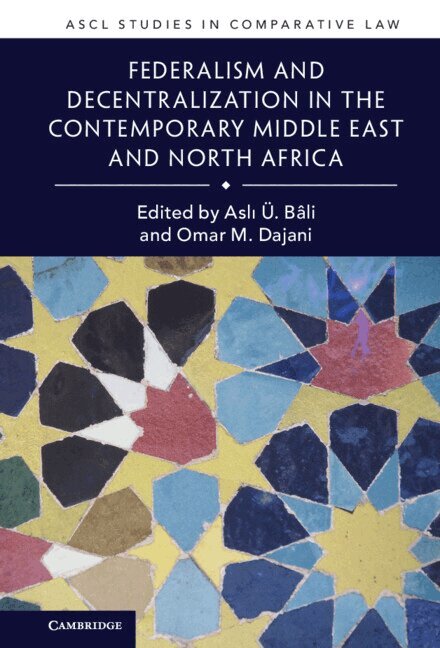
    Federalism and Decentralization in the Contemporary Middle East and North Africa

    AvAslı Ü. Bâli,Omar M. Dajani

    Inbunden, Engelska, 2023

    Del i serien ASCL Studies in Comparative Law

    1 487 kr

    Beställningsvara. Skickas inom 10-15 vardagar. Fri frakt över 249 kr.

    Beskrivning

    This volume, the first of its kind in the English language, examines the law and politics of federalism and decentralization in the Middle East and North Africa. Comprised of eleven case studies examining the experience across the region, together with essays by leading scholars providing comparative and theoretical perspectives and a synthetic conclusion by the co-editors, the volume offers a textured portrait of the dilemmas of decentralization during a period of sweeping transition in the region. The collection addresses an important gap in the comparative decentralization literature, which has largely neglected the MENA region. Both retrospective and forward-looking in orientation, the book is a valuable resource not only for scholars of comparative politics, constitutional design, and Middle East studies, but also for policy makers evaluating the feasibility and efficacy of decentralization as a vehicle for improving governance and responding to identity conflict in any part of the world.

    Produktinformation

    • Utgivningsdatum:2023-01-05
    • Mått:158 x 235 x 28 mm
    • Vikt:790 g
    • Format:Inbunden
    • Språk:Engelska
    • Serie:ASCL Studies in Comparative Law
    • Antal sidor:444
    • Förlag:Cambridge University Press
    • ISBN:9781108831239

    Utforska kategorier

    • Internationell rätt inom Juridik
    • Rättsvetenskap inom Juridik
    • Statsvetenskap och politisk teori inom Samhälle och politik

    Mer om författaren

    Aslı Ü. Bâli co-chairs the Advisory Council for the Middle East division of Human Rights Watch, chairs the Middle East Studies Association's Global Academy and serves as a non-resident fellow at the Quincy Institute for Responsible Statecraft. She is also co-editor of Constitution Writing, Religion and Democracy (Cambridge, 2017). Omar M. Dajani served as legal adviser to the Palestinian negotiating team in peace talks with Israel. He has continued to contribute to peacebuilding and legal infrastructure development projects for think tanks, governments, and international organizations.

    Innehållsförteckning

    • 1. Introduction: from revolution to devolution? Aslı Ü. Bâli and Omar M. Dajani; Part I. Theoretical and Comparative Context: 2. Decentralization to manage identity conflicts Philip G. Roeder; 3. Devolution and the promotion (or evasion) of minority rights Will Kymlicka; 4. Constitutional design options for territorial cleavages in the Middle East Tom Ginsburg; 5. How decentralization efforts have recentralized authority in the Arab world Mona Harb and Sami Atallah; Part II. Decentralization and Governance Reform: 6. Decentralization, ideology, and law in the Islamic Republic of Iran Kian Tajbakhsh; 7. Salvaging state legitimacy in Iraq through decentralization Ali Al-Mawlawi; 8. Decentralization Reforms in post-revolution Tunisia: the struggle between political and bureaucratic elites Intissar Kherigi; Part III. Decentralization and Self-Determination: 9. Autonomy beyond the state Joost Jongerden; 10. The Devil is in the details: Iraqi Kurdistan's evolving autonomy Peter Bartu and Aidan MacEachern; 11. Turkish Kurdistan: decentralization reimagined Aslı Ü. Bâli; 12. Control, responsibility, and the Israeli-Palestinian decentralization debacle Sari Bashi; 13. 'Stuck together': can a two-state confederation end the Israeli-Palestinian conflict Omar M. Dajani and Dahlia Scheindlin; 14. 'Dans ses frontiers authentiques'? Morocco's advanced regionalization and the question of Western Sahara Omar Yousef Shehabi; Part IV. Decentralization, Conflict, and State Fragmentation: 15. Devolution and federalism in collapsed states: constitutional process and design George Anderson and Sujit Choudhry; 16. The promise – and limits – of stabilization through local governance in Libya Karim Mezran and Elissa Miller; 17. Decentralization in state disintegration: an examination of governance experiments in Syria Samer Araabi and Leila Hilal; 18. De-centralization in Yemen: the case of the federalist draft constitution of 2015 Benoît Challand; Part V. Conclusions: 19. Federalism and decentralization in the MENA region: types and trajectories Aslı Ü. Bâli and Omar M. Dajani.