• Fri frakt över 249 kr
  • •
  • Snabba leveranser
  • •
  • Billiga böcker
Kundservice

Du är på sajten för privatpersoner.

Företag, bibliotek eller offentlig verksamhet?

Du handlar på classic.bokus.com, där alla dina funktioner finns intakta.
Till classic.bokus.com
Bokus logotyp. Gå till startsidan.
  • Erbjudanden
  • Nyheter
  • Student
  • Topplistor
  • Barn & ungdom
  • Bokus Play
  • E-böcker
  • Pocketböcker
  • Spel & pussel

10% rabatt på allt med kod NYSTART10 →

Sidfot

Mina sidor

    Hjälp

    • Kundservice
    • Vanliga frågor och svar
    • Frakt och leverans
    • Retur vid ångerrätt
    • Reklamera vara
    • Betalning
    • Köpvillkor
    • Allmänna villkor
    • Information om webbplatsens tillgänglighet

    Om Bokus

    • Om oss
    • Pressrum
    • För studenter
    • För företag
    • För bibliotek och offentlig verksamhet
    • För leverantörer
    • Hållbarhet

    Populärt

    • Aktuella erbjudanden
    • Presentkort
    • Studentlitteratur
    • Nya böcker
    • Topplistor
    • Signerade böcker
    • Engelska böcker

    Inspiration

    • Boktips
    • BookTok
    • Populära bokserier
    • Barnbokskaraktärer
    • Populära författare
    Logotyp för Bokus
    Följ oss på Facebook (extern länk)Följ oss på Instagram (extern länk)Följ oss på YouTube (extern länk)Följ oss på TikTok (extern länk)
    bokus @ CookiesAnpassa cookiesIntegritetspolicyKöpvillkor
    Till Citymail hemsida (extern länk)Till Budbee hemsida (extern länk)Till Postnord hemsida (extern länk)Till Schenker hemsida (extern länk)Till Early Bird hemsida (extern länk)Till Walleys hemsida (extern länk)
    1. Psykologi och pedagogik
    2. Pedagogik

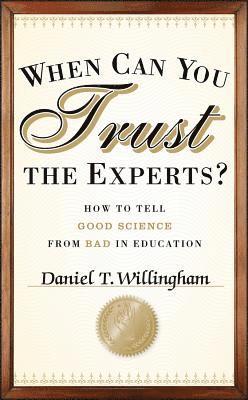
    When Can You Trust the Experts?

    How to Tell Good Science from Bad in Education

    AvDaniel T. Willingham

    Inbunden, Engelska, 2012

    200 kr

    Beställningsvara. Skickas inom 5-8 vardagar. Fri frakt över 249 kr.

    Fler format och utgåvor

    E-bok

    242 kr

    E-bok

    242 kr

    Beskrivning

    Clear, easy principles to spot what's nonsense and what's reliable Each year, teachers, administrators, and parents face a barrage of new education software, games, workbooks, and professional development programs purporting to be "based on the latest research." While some of these products are rooted in solid science, the research behind many others is grossly exaggerated. This new book, written by a top thought leader, helps everyday teachers, administrators, and family members—who don't have years of statistics courses under their belts—separate the wheat from the chaff and determine which new educational approaches are scientifically supported and worth adopting. Author's first book, Why Don't Students Like School?, catapulted him to superstar status in the field of educationWillingham's work has been hailed as "brilliant analysis" by The Wall Street Journal and "a triumph" by The Washington PostAuthor blogs for The Washington Post and Brittanica.com, and writes a column for American EducatorIn this insightful book, thought leader and bestselling author Dan Willingham offers an easy, reliable way to discern which programs are scientifically supported and which are the equivalent of "educational snake oil."

    Produktinformation

    • Utgivningsdatum:2012-08-14
    • Mått:150 x 224 x 18 mm
    • Vikt:431 g
    • Format:Inbunden
    • Språk:Engelska
    • Antal sidor:272
    • Förlag:John Wiley & Sons Inc
    • ISBN:9781118130278

    Utforska kategorier

    • Pedagogik inom Psykologi och pedagogik

    Mer om författaren

    Daniel T. Willingham is professor of psychology at the University of Virginia. His bestselling book, Why Don't Students Like School?, was hailed as "a triumph" by The Washington Post and "brilliant analysis" by The Wall Street Journal; it is recommended by scores of education-related magazines and blogs and is published in ten languages. Willingham writes a regular column called "Ask the Cognitive Scientist" for the American Federation of Teachers' magazine, American Educator.

    Recensioner i media

    "Parents increasingly come face-to-face with important educational decisions that they feel ill prepared to make. Whether they are choosing among schools, math programs or early interventions for a learning disability, this book will help them figure out which options are backed by the best science. (Recommended)"—Scientific American"By my bedtable is Dan Willingham's new book, When Can You Trust the Experts?... This is help we all can use, from one of the most sensible guys around."—John Merrow, The Huffington Post"A brilliant new book... Willingham presents a 'short cut' to assessing the value of a given idea—a set of four steps that will be useful to anyone sizing up an unfamiliar concept.  I’ve read Willingham’s book and I recommend it highly!"—Annie Murphy Paul

    Innehållsförteckning

    • About the Author xiAcknowledgments xiiIntroduction: What are You to Believe? 1Part One Why We So Easily Believe Bad ScienceChapter 1 Why Smart People Believe Dumb Things 31Chapter 2 Science and Belief: A Nervous Romance 57Chapter 3 What Scientists Call Good Science 81Chapter 4 How to Use Science 107Part Two The Shortcut SolutionChapter 5 Step One: Strip It and Flip It 135Chapter 6 Step Two: Trace It 167Chapter 7 Step Three: Analyze It 183Chapter 8 Step Four: Should I Do It? 207Endnotes 223Name Index 237Subject Index 243

    Betyg & recensioner

    5/5