• Fri frakt över 249 kr
  • •
  • Snabba leveranser
  • •
  • Billiga böcker
Kundservice

Du är på sajten för privatpersoner.

Företag, bibliotek eller offentlig verksamhet?

Du handlar på classic.bokus.com, där alla dina funktioner finns intakta.
Till classic.bokus.com
Bokus logotyp. Gå till startsidan.
  • Erbjudanden
  • Nyheter
  • Student
  • Topplistor
  • Barn & ungdom
  • Bokus Play
  • E-böcker
  • Pocketböcker
  • Spel & pussel

10% rabatt på allt med kod NYSTART10 →

Sidfot

Mina sidor

    Hjälp

    • Kundservice
    • Vanliga frågor och svar
    • Frakt och leverans
    • Retur vid ångerrätt
    • Reklamera vara
    • Betalning
    • Köpvillkor
    • Allmänna villkor
    • Information om webbplatsens tillgänglighet

    Om Bokus

    • Om oss
    • Pressrum
    • För studenter
    • För företag
    • För bibliotek och offentlig verksamhet
    • För leverantörer
    • Hållbarhet

    Populärt

    • Aktuella erbjudanden
    • Presentkort
    • Studentlitteratur
    • Nya böcker
    • Topplistor
    • Signerade böcker
    • Engelska böcker

    Inspiration

    • Boktips
    • BookTok
    • Populära bokserier
    • Barnbokskaraktärer
    • Populära författare
    Logotyp för Bokus
    Följ oss på Facebook (extern länk)Följ oss på Instagram (extern länk)Följ oss på YouTube (extern länk)Följ oss på TikTok (extern länk)
    bokus @ CookiesAnpassa cookiesIntegritetspolicyKöpvillkor
    Till Citymail hemsida (extern länk)Till Budbee hemsida (extern länk)Till Postnord hemsida (extern länk)Till Schenker hemsida (extern länk)Till Early Bird hemsida (extern länk)Till Walleys hemsida (extern länk)
    1. Naturvetenskap och teknik
    2. Matematik och naturvetenskap
    3. Kemi

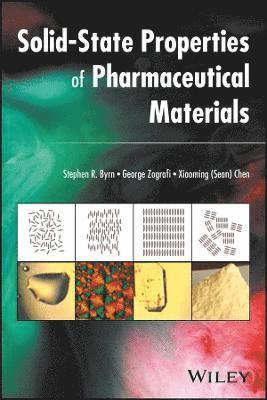
    Solid-State Properties of Pharmaceutical Materials

    AvStephen R. Byrn,George Zografi

    Inbunden, Engelska, 2017

    1 789 kr

    Tillfälligt slut

    Beskrivning

    Presents a detailed discussion of important solid-state properties, methods, and applications of solid-state analysis Illustrates the various phases or forms that solids can assume and discussesvarious issues related to the relative stability of solid forms and tendencies to undergo transformationCovers key methods of solid state analysis including X-ray powder diffraction, thermal analysis, microscopy, spectroscopy, and solid state NMRReviews critical physical attributes of pharmaceutical materials, mainly related to drug substances, including particle size/surface area, hygroscopicity, mechanical properties, solubility, and physical and chemical stabilityShowcases the application of solid state material science in rational selection of drug solid forms, analysis of various solid forms within drug substance and the drug product, and pharmaceutical product developmentIntroduces appropriate manufacturing and control procedures using Quality by Design, and other strategies that lead to safe and effective products with a minimum of resources and time

    Produktinformation

    • Utgivningsdatum:2017-09-26
    • Mått:221 x 282 x 25 mm
    • Vikt:1 225 g
    • Format:Inbunden
    • Språk:Engelska
    • Antal sidor:432
    • Förlag:John Wiley & Sons Inc
    • ISBN:9781118145302

    Utforska kategorier

    • Kemi inom Naturvetenskap och teknik
    • Tillverkningsteknik inom Naturvetenskap och teknik

    Mer om författaren

    Stephen R. Byrn, PhD is Charles B. Jordan Professor of Medicinal Chemistry in the School of Pharmacy, Purdue University. Dr. Byrn has founded and directed several programs at Purdue University including CAMP, the Center for AIDS Research, the Molecules to Market program, and Purdue's graduate programs in regulatory and quality compliance. Dr. Byrn has served as chair of the Pharmaceutical Sciences Advisory Committee to the FDA and Chair of the Drug Substances Technical Committee, Product Quality Research Initiative. Dr. Byrn is co-founder of SSCI, Inc. a cGMP research and information Company. George Zografi, PhD is the Edward Kremers Professor Emeritus of Pharmaceutical Sciences, School of Pharmacy, University of Wisconsin-Madison. He was the recipient of the APhA Ebert Prize in 1984 and 2001, the AAPS Dale E. Wurster Award for Pharmaceutics in 1990 and its Distinguished Scientist Award in 1995, as well as the Volwiler Research Achievement Award of the American Association of Colleges of Pharmacy. Xiaoming (Sean) Chen, PhD is currently the Director of Formulation Development in Antares Pharma Inc. Prior to that, he held various positions in pharmaceutical product development at Schering-Plough, OSI Pharmaceuticals, Astellas Pharma, and Shionogi Inc. He has published over a dozen of papers in peer-reviewed journals and is a co-inventor of four US patents.

    Innehållsförteckning

    • Preface xiAcknowledgments xiii1 Solid-State Properties and Pharmaceutical Development 11.1 Introduction, 11.2 Solid-State Forms, 11.3 ICH Q6A Decision Trees, 61.4 “Big Questions” for Drug Development, 61.5 Accelerating Drug Development, 91.6 Solid-State Chemistry in Preformulation and Formulation, 111.7 Learning Before Doing and Quality by Design, 141.8 Performance and Stability in Pharmaceutical Development, 171.9 Moisture Uptake, 181.10 Solid-State Reactions, 191.11 Noninteracting Formulations: Physical Characterizations, 19References, 202 Polymorphs 222.1 Introduction, 222.2 How are Polymorphs Formed?, 222.3 Structural Aspect of Polymorphs, 232.4 Physical, Chemical, and Mechanical Properties, 242.5 Thermodynamic Stability of Polymorphs, 272.6 Polymorph Conversion, 322.7 Control of Polymorphs, 342.8 Polymorph Screening, 352.9 Polymorph Prediction, 36References, 363 Solvates and Hydrates 383.1 Introduction, 383.2 Pharmaceutical Importance of Hydrates, 383.3 Classification of Pharmaceutical Hydrates, 403.4 Water Activity, 423.5 Stoichiometric Hydrates, 433.6 Nonstoichiometric Hydrates, 443.7 Hydration/Dehydration, 453.8 Preparation and Characterization of Hydrates and Solvates, 45References, 464 Pharmaceutical Salts 484.1 Introduction, 484.2 Importance of Pharmaceutical Salts, 484.3 Weak Acid, Weak Base, and Salt, 494.4 pH-Solubility Profiles of Ionizable Compounds, 514.5 Solubility, Dissolution, and Bioavailability of Pharmaceutical Salts, 534.6 Physical Stability of Pharmaceutical Salts, 564.7 Strategies for Salt Selection, 57References, 595 Pharmaceutical Cocrystals 605.1 Introduction, 605.2 Cocrystals and Crystal Engineering, 605.3 Solubility Phase Diagrams for Cocrystals, 625.4 Preparation of Cocrystals, 635.5 Dissolution and Bioavailability of Cocrystals, 645.6 Comparison of Pharmaceutical Salts and Cocrystals, 66References, 686 Amorphous Solids 696.1 Introduction, 696.2 The Formation of Amorphous Solids, 706.3 Methods of Preparing Amorphous Solids, 716.4 The Glass Transition Temperature, 726.5 Structural Features of Amorphous Solids, 756.6 Molecular Mobility, 776.7 Mixtures of Amorphous Solids, 84References, 877 Crystal Mesophases and Nanocrystals 897.1 Introduction, 897.2 Overview of Crystal Mesophases, 897.3 Liquid Crystals, 907.4 Conformationally Disordered (Condis) Crystals, 957.5 Plastic Crystals, 957.6 Nanocrystals, 96References, 978 X-Ray Crystallography and Crystal Packing Analysis 998.1 Introduction, 998.2 Crystals, 998.3 Miller Indices and Crystal Faces, 998.4 Determination of the Miller Indices of the Faces of a Crystal, 1018.5 Determination of Crystal Structure, 103References, 1069 X-Ray Powder Diffraction 1079.1 Introduction, 1079.2 X-Ray Powder Diffraction of Crystalline Materials, 1079.3 Qualitative Analysis of Crystalline Materials, 1099.4 Phase Transformations, 1109.5 Quantitative Phase Analysis Using XRPD, 1119.6 Solving Crystal Structures Using Powder X-Ray Diffraction, 1149.7 X-Ray Diffraction of Amorphous and Crystal Mesophase Forms, 1169.8 Pair Distribution Function, 1179.9 X-Ray Diffractometers, 1199.10 Variable Temperature XRPD, 121References, 12210 Differential Scanning Calorimetry and Thermogravimetric Analysis 12410.1 Introduction, 12410.2 The Basics of Differential Scanning Calorimetry, 12410.3 Thermal Transitions of Pharmaceutical Materials, 12510.4 DSC Instrumentation, 12810.5 Thermogravimetric Analysis, 13210.6 Operating a TGA Instrument, 13310.7 Evolved Gas Analysis, 13310.8 Applications of DSC and TGA, 13410.9 Summary of Using DSC and TGA, 139References, 14011 Microscopy 14211.1 Introduction, 14211.2 Light Microscopy, 14211.3 Polarized Light Microscopy, 14411.4 Thermal Microscopy, 14411.5 Functionality of the Light Microscope, 14511.6 Digital Microscope, 14611.7 Application of Light Microscopy to Pharmaceutical Materials, 14611.8 Scanning Electron Microscope, 15311.9 Environmental Scanning Electron Microscopy, 15511.10 Atomic Force Microscopy, 155References, 15712 Vibrational Spectroscopy 15912.1 Introduction, 15912.2 The Nature of Molecular Vibrations, 16012.3 Fourier Transformed Infrared Spectroscopy, 16112.4 Material Characterization by FT-IR Spectroscopy, 16212.5 FT-IR Instrumentation, 16412.6 Diffuse Reflectance FT-IR, 16512.7 Attenuated Total Reflectance FT-IR, 16612.8 FT-IR Microscopy, 16712.9 Near Infrared Spectroscopy, 16812.10 Raman Spectroscopy, 17012.11 Raman Instrumentation and Sampling, 17112.12 Raman Microscope, 17312.13 Terahertz Spectroscopy, 17512.14 Comparison of FT-IR, NIR, Raman, and Terahertz Spectroscopy, 176References, 17813 Solid-State NMR Spectroscopy 18013.1 Introduction, 18013.2 An Overview of Solid-State 13C CP/MAS NMR Spectroscopy, 18013.3 Solid-State NMR Studies of Pharmaceuticals, 18513.4 Phase Identification in Dosage Forms, 18613.5 Other Basic Solid-State NMR Experiments Useful for Pharmaceutical Analysis, 18913.6 Determination of the Domain Structure of Amorphous Dispersions UsingSolid-State NMR, 192References, 19614 Particle and Powder Analysis 19714.1 Introduction, 19714.2 Particles in Pharmaceutical Systems, 19714.3 Particle Size and Shape, 19914.4 Particle Size Distribution, 20014.5 Dynamic Light Scattering, 20214.6 Zeta Potential, 20314.7 Laser Diffraction, 20514.8 Dynamic Image Analysis, 20614.9 Sieve Analysis, 20814.10 Bulk Properties of Pharmaceutical Particulates and Powders, 20814.11 Surface Area Measurement, 209References, 21115 Hygroscopic Properties of Solids 21315.1 Introduction, 21315.2 Water Vapor Sorption–Desorption, 21415.3 Water Vapor Sorption Isotherms, Relative Humidity, and Water Activity, 21415.4 Measurement of Water Content and Water Vapor Sorption/Desorption Isotherms, 21615.5 Modes of Water Vapor Sorption, 218References, 22916 Mechanical Properties of Pharmaceutical Materials 23116.1 Introduction, 23116.2 Stress and Strain, 23116.3 Elasticity, 23216.4 Plasticity, 23316.5 Viscoelasticity, 23416.6 Brittleness, 23516.7 Hardness, 23616.8 Powder Compression, 23716.9 Powder Compression Models and Compressibility, 23816.10 Compactibility and Tensile Strength, 23916.11 Effect of Solid Form on Mechanical Properties, 23916.12 Effect of Moisture on Mechanical Properties, 24216.13 Methods for Testing Mechanical Properties: Beam Bending, 24316.14 Nanoindentation, 246References, 24717 Solubility and Dissolution 24917.1 Introduction, 24917.2 Principle Concepts Associated with Solubility, 24917.3 Prediction of Aqueous Drug Solubility, 25017.4 Solubility of Pharmaceutical Solid Forms, 25217.5 Solubility Determination Using the Shake Flask Method, 25317.6 High Throughput Screening of Solubility, 25417.7 Solubility Measurement of Metastable Forms, 25517.8 Kinetic Solubility Measurement, 25617.9 Solubility Determination of Drugs in Polymer Matrices, 25617.10 Dissolution Testing, 25717.11 Nonsink Dissolution Test, 26017.12 Intrinsic Dissolution Studies, 262References, 26318 Physical Stability of Solids 26518.1 Introduction, 26518.2 Underlying Basis for Physical Instability in Pharmaceutical Systems, 26618.3 Disorder in Crystals, 26718.4 Examples of the Role of Process-Induced Disorder in Solid-State Physical Instability in Pharmaceutical Systems, 27418.5 Considerations in Evaluating Solid-State Physical Stability, 276References, 27719 Chemical Stability of Solids 27919.1 Introduction, 27919.2 Examples of Chemical Reactivity in the Solid State, 27919.3 Some General Principles that Establish the Rate of Chemical Reactions in Solution, 28219.4 The Role of Crystal Defects in Solid-State Reactions, 28619.5 Chemical Reactivity in the Amorphous Solid State, 29019.6 Chemical Reactivity and Processed-Induced Disorder, 29219.7 The Effects of Residual Water on Solid-State Chemical Reactivity, 29419.8 Drug–Excipient Interactions, 29819.9 Summary, 300References, 30020 Solid-State Properties of Proteins 30220.1 Introduction, 30220.2 Solution Properties of Proteins, 30220.3 Amorphous Properties of Proteins, 30620.4 Crystalline Properties of Proteins, 30720.5 Local Molecular Motions and the Dynamical Transitional Temperature, Td, 30820.6 Solid-State Physical and Chemical Stability of Proteins, 31020.7 Cryoprotection and Lyoprotection, 311References, 31121 Form Selection of Active Pharmaceutical Ingredients 31321.1 Introduction, 31321.2 Form Selection, 31321.3 Amorphous form Screening, 31521.4 Salt Selection, 31621.5 Cocrystal Screening, 31821.6 Polymorph Screening, 32021.7 Slurrying, 32121.8 High Throughput Screening, 32221.9 Crystallization in Confined Space, 32321.10 Nonsolvent-Based Polymorph Screening, 32521.11 Polymer-Induced Heteronucleation, 32521.12 Physical Characterization, 32621.13 Thermodynamic Stability and form Selection, 327References, 32822 Mixture Analysis 33122.1 Introduction, 33122.2 Limitations of Wet Chemistry, 33122.3 Pharmaceutical Analysis in the Solid State, 33222.4 Measurement of Amorphous Content, 33522.5 Detection of the Degree of Crystallinity, 33722.6 Quantification of Mixtures of Polymorphs, 33922.7 Salt and Free form Composition, 34022.8 Process Analytical Technology, 342References, 34823 Product Development 35123.1 Chemistry, Manufacture, and Control, 35123.2 Preformulation, 35323.3 Drug Excipient Compatibility, 35423.4 Solid Dispersions, 35523.5 Abuse-Deterrent Dosage Forms, 36123.6 Drug-Eluting Stents, 36323.7 Dry Powder Inhalers (DPI), 36523.8 Lyophilization and Biopharmaceutical Products, 368References, 37224 Quality by Design 37524.1 Introduction, 37524.2 Quality by Design Wheel, 37524.3 Learning Before Doing, 37924.4 Risk-Based Orientation, 38024.5 API Attributes and Process Design, 38124.6 Development and Design Space, 38124.7 Process Design: Crystallization, 38524.8 Phase Transformations During Wet Granulation, 38624.9 Dissolution Tests with an IVIVC for Quality by Design, 38724.10 Conclusion, 388References, 388Index 389