• Fri frakt över 249 kr
  • •
  • Snabba leveranser
  • •
  • Billiga böcker
Kundservice

Du är på sajten för privatpersoner.

Företag, bibliotek eller offentlig verksamhet?

Du handlar på classic.bokus.com, där alla dina funktioner finns intakta.
Till classic.bokus.com
Bokus logotyp. Gå till startsidan.
  • Erbjudanden
  • Nyheter
  • Student
  • Topplistor
  • Barn & ungdom
  • Bokus Play
  • E-böcker
  • Pocketböcker
  • Spel & pussel

10% rabatt på allt med kod NYSTART10 →

Sidfot

Mina sidor

    Hjälp

    • Kundservice
    • Vanliga frågor och svar
    • Frakt och leverans
    • Retur vid ångerrätt
    • Reklamera vara
    • Betalning
    • Köpvillkor
    • Allmänna villkor
    • Information om webbplatsens tillgänglighet

    Om Bokus

    • Om oss
    • Pressrum
    • För studenter
    • För företag
    • För bibliotek och offentlig verksamhet
    • För leverantörer
    • Hållbarhet

    Populärt

    • Aktuella erbjudanden
    • Presentkort
    • Studentlitteratur
    • Nya böcker
    • Topplistor
    • Signerade böcker
    • Engelska böcker

    Inspiration

    • Boktips
    • BookTok
    • Populära bokserier
    • Barnbokskaraktärer
    • Populära författare
    Logotyp för Bokus
    Följ oss på Facebook (extern länk)Följ oss på Instagram (extern länk)Följ oss på YouTube (extern länk)Följ oss på TikTok (extern länk)
    bokus @ CookiesAnpassa cookiesIntegritetspolicyKöpvillkor
    Till Citymail hemsida (extern länk)Till Budbee hemsida (extern länk)Till Postnord hemsida (extern länk)Till Schenker hemsida (extern länk)Till Early Bird hemsida (extern länk)Till Walleys hemsida (extern länk)
    1. Ekonomi och Ledarskap
    2. Ledarskapsböcker

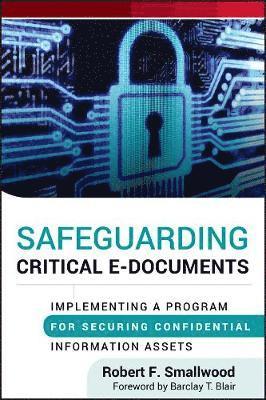
    Safeguarding Critical E-Documents

    Implementing a Program for Securing Confidential Information Assets

    AvRobert F. Smallwood

    Inbunden, Engelska, 2012

    720 kr

    Tillfälligt slut

    Fler format och utgåvor

    E-bok

    701 kr

    E-bok

    701 kr

    Beskrivning

    Practical, step-by-step guidance for corporations, universities and government agencies to protect and secure confidential documents and business records Managers and public officials are looking for technology and information governance solutions to "information leakage" in an understandable, concise format. Safeguarding Critical E-Documents provides a road map for corporations, governments, financial services firms, hospitals, law firms, universities and other organizations to safeguard their internal electronic documents and private communications. Provides practical, step-by-step guidance on protecting sensitive and confidential documents—even if they leave the organization electronically or on portable devicesPresents a blueprint for corporations, governments, financial services firms, hospitals, law firms, universities and other organizations to safeguard internal electronic documents and private communicationsOffers a concise format for securing your organizations from information leakageIn light of the recent WikiLeaks revelations, governments and businesses have heightened awareness of the vulnerability of confidential internal documents and communications. Timely and relevant, Safeguarding Critical E-Documents shows how to keep internal documents from getting into the wrong hands and weakening your competitive position, or possible damaging your organization's reputation and leading to costly investigations.

    Produktinformation

    • Utgivningsdatum:2012-08-10
    • Mått:158 x 236 x 24 mm
    • Vikt:485 g
    • Format:Inbunden
    • Språk:Engelska
    • Antal sidor:288
    • Förlag:John Wiley & Sons Inc
    • Medarbetare:BarclayT. Blair
    • ISBN:9781118159088

    Utforska kategorier

    • Ledarskapsböcker inom Ekonomi och Ledarskap
    • Ledarskap och motivation inom Ekonomi och Ledarskap
    • IT-säkerhet inom Data och IT

    Mer om författaren

    ROBERT F. SMALLWOOD is a Partner and Executive Director of the E-Records Institute at IMERGE Consulting. One of the world's most respected authorities on e-records and document management, he has published more research reports on e-records, e-documents, and e-mail security issues over the past five years than any other person or organization. His research and consulting clients include Johnson & Johnson, IBM, Apple, MillerCoors, Ricoh Americas Corporation, South Carolina Retirement Systems, Dallas Independent School District, U.S. FDA, National Archives and Records Administration, Transportation Safety Board of Canada, Canadian Parliament, Supreme Court of Canada, Canada Mortgage and Housing Corporation, and National Archives of Australia, among others.

    Innehållsförteckning

    • Foreword xiiiPreface xvAcknowledgments xviiPart I The Problem and Basic ToolsChapter 1 The Problem: Securing Confidential Electronic Documents 3WikiLeaks: A Wake-Up Call 3U.S. Government Attempts to Protect Intellectual Property 5Threats Persist across the Pond: U.K. Companies on Guard 5Increase in Corporate and Industrial Espionage 6Risks of Medical Identity Theft 7Why Don’t Organizations Safeguard Their Information Assets? 8The Blame Game: Where Does Fault Lie When Information Is Leaked? 9Consequences of Not Employing E-Document Security 10Notes 11Chapter 2 Information Governance: The Crucial First Step 13First, Better Policies; Then, Better Technology for Better Enforcement 13Defining Information Governance 14Accountability Is Key 16Why IG Is Good Business 17Impact of a Successful IG Program 18Critical Factors in an IG Program 19Who Should Determine IG Policies? 22Notes 23Part II Information Platform Risks and CountermeasuresChapter 3 Managing E-Documents and Records 27Enterprise Content Management 27Document Management Principles 28The Goal: Document Lifecycle Security 29Electronic Document Management Systems 29Records Management Principles 31Electronic Records Management 31Notes 33Chapter 4 Information Governance and Security for E-mail Messages 35Employees Regularly Expose Organizations to E-mail Risk 36E-mail Policies Should Be Realistic and Technology Agnostic 37Is E-mail Encryption the Answer? 38Common E-mail Security Mistakes 39E-mail Security Myths 40E-record Retention: Fundamentally a Legal Issue 41Preserve E-mail Integrity and Admissibility with Automatic Archiving 42Notes 46Chapter 5 Information Governance and Security for Instant Messaging 49Instant Messaging Security Threats 50Best Practices for Business IM Use 51Technology to Monitor IM 53Tips for Safer IM 53Notes 55Chapter 6 Information Governance and Security for Social Media 57Types of Social Media in Web 2.0 57Social Media in the Enterprise 59Key Ways Social Media Is Different from E-mail and Instant Messaging 60Biggest Security Threats of Social Media 60Legal Risks of Social Media Posts 63Tools to Archive Facebook and Twitter 64IG Considerations for Social Media 65Notes 66Chapter 7 Information Governance and Security for Mobile Devices 69Current Trends in Mobile Computing 71Security Risks of Mobile Computing 72Securing Mobile Data 73IG for Mobile Computing 73Building Security into Mobile Applications 75Best Practices to Secure Mobile Applications 78Notes 80Chapter 8 Information Governance and Security for Cloud Computing Use 83Defining Cloud Computing 84Key Characteristics of Cloud Computing 85What Cloud Computing Really Means 86Cloud Deployment Models 87Greatest Security Threats to Cloud Computing 87IG Guidelines: Managing Documents and Records in the Cloud 94Managing E-Docs and Records in the Cloud: A Practical Approach 95Notes 97Part III E-Records ConsiderationsChapter 9 Information Governance and Security for Vital Records 101Defining Vital Records 101Types of Vital Records 103Impact of Losing Vital Records 104Creating, Implementing, and Maintaining a Vital Records Program 105Implementing Protective Procedures 108Auditing the Vital Records Program 111Notes 113Chapter 10 Long-Term Preservation of E-Records 115Defining Long-Term Digital Preservation 115Key Factors in LTDP 116Electronic Records Preservation Processes 118Controlling the Process of Preserving Records 118Notes 121Part IV Information Technology ConsiderationsChapter 11 Technologies That Can Help Secure E-Documents 125Challenge of Securing E-Documents 125Apply Better Technology for Better Enforcement in the Extended Enterprise 128Controlling Access to Documents Using Identity Access Management 131Enforcing IG: Protect Files with Rules and Permissions 133Data Governance Software to Manage Information Access 133E-mail Encryption 134Secure Communications Using Record-Free E-mail 134Digital Signatures 135Document Encryption 137Data Loss Prevention Technology 137The Missing Piece: Information Rights Management 139Notes 144Chapter 12 Safeguarding Confidential Information Assets 147Cyber Attacks Proliferate 147The Insider Threat: Malicious or Not 148Critical Technologies for Securing Confidential Documents 150A Hybrid Approach: Combining DLP and IRM Technologies 154Securing Trade Secrets after Layoffs and Terminations 155Persistently Protecting Blueprints and CAD Documents 156Securing Internal Price Lists 157Approaches for Securing Data Once It Leaves the Organization 157Document Labeling 159Document Analytics 161Confidential Stream Messaging 161Notes 164Part V Rolling It Out: Project and Program IssuesChapter 13 Building the Business Case to Justify the Program 169Determine What Will Fly in Your Organization 169Strategic Business Drivers for Project Justification 170Benefits of Electronic Records Management 173Presenting the Business Case 176Notes 177Chapter 14 Securing Executive Sponsorship 179Executive Sponsor Role 180Project Manager: Key Tasks 181It’s the Little Things 183Evolving Role of the Executive Sponsor 183Notes 185Chapter 15 Safeguarding Confidential Information Assets: Where Do You Start? 187Business Driver Approach 187Classification 188Document Survey Methodology 189Interviewing Staff in the Target Area 190Preparing Interview Questions 192Prioritizing: Document and Records Value Assessment 193Second Phase of Implementation 194Notes 195Chapter 16 Procurement: The Buying Process 197Evaluation and Selection Process: RFI, RFP, or RFQ? 197Evaluating Software Providers: Key Criteria 202Negotiating Contracts: Ensuring the Decision 207More Contract Caveats 210How to Pick a Consulting Firm: Evaluation Criteria 211Chapter 17 Maintaining a Secure Environment for Information Assets 215Monitoring and Accountability 215Continuous Process Improvement 216Why Continuous Improvement Is Needed 216Notes 218Conclusion 219Appendix A: Digital Signature Standard 221Appendix B: Regulations Related to Records Management 223Appendix C: Listing of Technology and Service Providers 227Glossary 241About the Author 247Index 249