• Fri frakt över 249 kr
  • •
  • Snabba leveranser
  • •
  • Billiga böcker
Kundservice

Du är på sajten för privatpersoner.

Företag, bibliotek eller offentlig verksamhet?

Du handlar på classic.bokus.com, där alla dina funktioner finns intakta.
Till classic.bokus.com
Bokus logotyp. Gå till startsidan.
  • Erbjudanden
  • Nyheter
  • Student
  • Topplistor
  • Barn & ungdom
  • Bokus Play
  • E-böcker
  • Pocketböcker
  • Spel & pussel

10% rabatt på allt med kod: NYSTART10 →

Sidfot

Mina sidor

    Hjälp

    • Kundservice
    • Vanliga frågor och svar
    • Frakt och leverans
    • Retur vid ångerrätt
    • Reklamera vara
    • Betalning
    • Köpvillkor
    • Allmänna villkor
    • Information om webbplatsens tillgänglighet

    Om Bokus

    • Om oss
    • Pressrum
    • För studenter
    • För företag
    • För bibliotek och offentlig verksamhet
    • För leverantörer
    • Hållbarhet

    Populärt

    • Aktuella erbjudanden
    • Presentkort
    • Studentlitteratur
    • Nya böcker
    • Topplistor
    • Signerade böcker
    • Engelska böcker

    Inspiration

    • Boktips
    • BookTok
    • Populära bokserier
    • Barnbokskaraktärer
    • Populära författare
    Logotyp för Bokus
    Följ oss på Facebook (extern länk)Följ oss på Instagram (extern länk)Följ oss på YouTube (extern länk)Följ oss på TikTok (extern länk)
    bokus @ CookiesAnpassa cookiesIntegritetspolicyKöpvillkor
    Till Citymail hemsida (extern länk)Till Budbee hemsida (extern länk)Till Postnord hemsida (extern länk)Till Schenker hemsida (extern länk)Till Early Bird hemsida (extern länk)Till Walleys hemsida (extern länk)
    1. Medicin
    2. Medicin: allmänt
    3. Medicinsk utrustning och medicinska tekniker

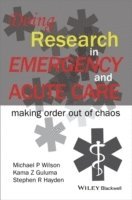
    Doing Research in Emergency and Acute Care

    Making Order Out of Chaos

    AvMichael P. Wilson,Kama Z. Guluma

    Häftad, Engelska, 2015

    739 kr

    Beställningsvara. Skickas inom 5-8 vardagar. Fri frakt över 249 kr.

    Beskrivning

    A practical guide to understanding and navigating the unique challenges faced by physicians and other professionals who wish to undertake research in the ED or other acute care setting.Focusing on the hyper-acute and acute care environment and fulfilling two closely-related needs:1) the need for even seasoned researchers to understand the specific logistics and issues of doing research in the ED; and 2) the need to educate clinically active physicians in research methodology.This new text is not designed to be a complex, encyclopedic resource, but instead a concise, easy-to-read resource designed to convey key “need-to-know” information within a comprehensive framework. Aimed at the busy brain, either as a sit-down read or as a selectively-read reference guide to fill in knowledge gaps, chapters are short, compartmentalized, and are used strategically throughout the text in order to introduce and frame concepts. This format makes it easy - and even entertaining - for the research novice to integrate and absorb completely new (and typically dry) material. The textbook addresses aspects of feasibility, efficiency, ethics, statistics, safety, logistics, and collaboration in acute research. Overall, it grants access for the seasoned researcher seeking to learn about acute research to empathically integrate learning points into his or her knowledge base.As the ED is the primary setting for hyper-acute and acute care, and therefore a prime site for related clinical trial recruitment and interventions, the book presents specific logistical research challenges that researchers from any discipline, including physicians, research nurse coordinators, study monitors, or industry partners, need to understand in order to succeed.

    Produktinformation

    • Utgivningsdatum:2015-11-06
    • Mått:191 x 246 x 15 mm
    • Vikt:499 g
    • Format:Häftad
    • Språk:Engelska
    • Antal sidor:288
    • Förlag:John Wiley and Sons Ltd
    • ISBN:9781118643488

    Utforska kategorier

    • Medicinsk utrustning och medicinska tekniker inom Medicin
    • Olycksfalls- och akutmedicin inom Medicin

    Mer om författaren

    Kama Z. Guluma, MD, is an Associate Professor of Emergency Medicine and the Research Education Coordinator in the UC San Diego Health Systems Department of Emergency Medicine. He is a board-certified and clinically active Emergency Physician with over 10 years of hands on experience in clinical and basic science research, specifically with regards to acute stroke. He has served -- and currently serves as a Principal Investigator in NIH? funded clinical trials, and has published both clinical and pre-clinical research manuscripts. He has been a member of the NIH Stroke Progress Review Group, a national panel convened by the National Institutes of Neurological Diseases and Stroke (NINDS) to identify and outline national research priorities in acute stroke. He is also a reviewer for the Annals of Emergency Medicine, Internal and Emergency Medicine, and the Journal of Emergency Medicine. Michael P. Wilson, PhD, MD, is an Attending Physician in the UC San Diego Health Systems Department of Emergency Medicine, as well as Director of the Department of Emergency Medicine Behavioral Emergencies Research lab. He is a board certified and clinically active Emergency Physician, and brings a "cross-trained" perspective, having received his PhD in Cognitive Neuroscience. He has published numerous articles on both Emergency Medicine research and behavioral emergencies, sits on numerous journal editorial boards, and is a reviewer for both the Journal of Emergency Medicine and Western Journal of Emergency Medicine. Stephen Hayden, MD, is a Professor in the UC San Diego Health Systems Department of Emergency Medicine, is the previous Director of Residency Training and currently serves as Dean of Graduate Medical Education. He is a board-certified and clinically active Emergency Physician, has lectured nationally on evidence-based medicine, and is editor-in-chief of the Journal of Emergency Medicine.

    Innehållsförteckning

    • List of contributors, ixPart 1: Getting ready: Preparing for your research study1 Aspects of research specific to acute care, 3Jarrod M. Mosier and Peter Rosen2 Aspects of feasibility in research, 7Kama Z. Guluma3 How do I formulate a research question?, 13Michael P. Wilson4 Evidence]based medicine: Finding the knowledge gap, 17Eddy Lang and Zubair Bayat5 How to carry out an efficient literature search, 21Aleksandr Tichter, Louise Falzon, and Peter Wyer6 What do I need to know to get started with animal and basic science research?, 31George J. Shaw7 The IRB process: How to write up a human studies protocol, 37Christian Tomaszewski8 Ethics in research: How to collect data ethically, 45Nas Rafi and Brian Snyder9 Safety in research: How to ensure patient safety?, 53Robert Grover and Vicken Y. TottenPart 2: Getting it done: Doing your research study10 How to design a study that everyone will believe: Minimizing bias and confounding, 61Michael Witting11 How to design a study that everyone will believe: An overview of research studies and picking the right design, 65Julian Villar, Jennifer Lanning, and Robert Rodriguez12 How to design a study that everyone will believe: Random selection and allocation of patients to treatment conditions, 71Katie L. Tataris, Mary Mercer, and Prasanthi Govindarajan13 How to design a study that everyone will believe: Surveys, 79Edward M. Castillo and Gary M. Vilke14 How to design a study that everyone will believe: Retrospective reviews, 85Jonathan Auten and Paul Ishimine15 How to design a study that everyone will believe: Prehospital studies, 93Christopher Kahn16 How to design a study that everyone will believe: Ethical concepts for special populations in emergency research, 97Kimberly Nordstrom17 How to design a study that everyone will believe: Industry studies, 105Richard F. Clark and Alicia B. Minns18 How to design a study that everyone will believe: Prospective studies, 115Gary Gaddis19 How to design a study that everyone will believe: effectiveness, safety, and the intention to treat, 121Ashleigh Campillo, Christopher J. Coyne, and Juan A. Luna20 How to design a study that everyone will believe: Emergency department operations and systems, 129Vaishal Tolia21 How to design a study that everyone will believe: The challenges of doing international research, 133Vicken Y. Totten22 The development of clinical prediction rules, 139Benton R. Hunter and Christopher R. Carpenter23 Testing the safety and efficacy of devices: Device safety, as well as obtaining an IDE (investigational device exemption) from the FDA, 149Sean]Xavier Neath24 Privacy in research: How to collect data safely and confidentially, 155Gary M. Vilke and Edward M. Castillo25 How do I establish a research assistant program?, 161Judd E. Hollander26 How to complete a research study well and in a minimum of time: The importance of collaboration, 167Austin Hopper and Michael P. WilsonPart 3: Getting it out there: Analyzing and publishing your study27 Eliminating common misconceptions to enable intelligent use of biostatistics: How can a novice use statistics more intelligently?, 175Gary Gaddis28 Basic statistics: sample size and power: How are sample size and power calculated?, 183Manish Garg, Richard Harrigan, and Gary Gaddis29 Basic statistics: Means, P values, and confidence intervals, 191Daniel del Portal and Richard Harrigan30 Basic statistics: Assessing the impact of therapeutic interventions with odds-ratios, relative risk, and hazard ratios, 199Jesse J. Brennan and Edward M. Castillo31 Basic statistics: Assessing the impact of a diagnostic test; choosing a gold standard, sensitivity, specificity, PPV, NPV, and likelihood ratios, 205Stephen R. Hayden32 Advanced biostatistics: Chi]square, ANOVA, regression, and multiple regression, 213Gary Gaddis33 Can I combine the results of this study with others? An introduction to systematic reviews, 223Brian H. Rowe34 How to write a scientific paper for publication, 231Stephen R. Hayden35 How do I make reviewers happy? The review process: What do reviewers look for in a manuscript? What is the review process?, 239David J. Karras and Jacob W. Ufberg36 How do I write a grant?, 247Zachary D.W. Dezman and Jon Mark Hirshon37 How to make an academic career: Developing a successful path in research, 253Deirdre Anglin and Michael MenchineGlossary, 259Index, 267