• Fri frakt över 249 kr
  • •
  • Snabba leveranser
  • •
  • Billiga böcker
Kundservice

Du är på sajten för privatpersoner.

Företag, bibliotek eller offentlig verksamhet?

Du handlar på classic.bokus.com, där alla dina funktioner finns intakta.
Till classic.bokus.com
Bokus logotyp. Gå till startsidan.
  • Erbjudanden
  • Nyheter
  • Student
  • Topplistor
  • Barn & ungdom
  • Bokus Play
  • E-böcker
  • Pocketböcker
  • Spel & pussel

10% rabatt på allt med kod: NYSTART10 →

Sidfot

Mina sidor

    Hjälp

    • Kundservice
    • Vanliga frågor och svar
    • Frakt och leverans
    • Retur vid ångerrätt
    • Reklamera vara
    • Betalning
    • Köpvillkor
    • Allmänna villkor
    • Information om webbplatsens tillgänglighet

    Om Bokus

    • Om oss
    • Pressrum
    • För studenter
    • För företag
    • För bibliotek och offentlig verksamhet
    • För leverantörer
    • Hållbarhet

    Populärt

    • Aktuella erbjudanden
    • Presentkort
    • Studentlitteratur
    • Nya böcker
    • Topplistor
    • Signerade böcker
    • Engelska böcker

    Inspiration

    • Boktips
    • BookTok
    • Populära bokserier
    • Barnbokskaraktärer
    • Populära författare
    Logotyp för Bokus
    Följ oss på Facebook (extern länk)Följ oss på Instagram (extern länk)Följ oss på YouTube (extern länk)Följ oss på TikTok (extern länk)
    bokus @ CookiesAnpassa cookiesIntegritetspolicyKöpvillkor
    Till Citymail hemsida (extern länk)Till Budbee hemsida (extern länk)Till Postnord hemsida (extern länk)Till Schenker hemsida (extern länk)Till Early Bird hemsida (extern länk)Till Walleys hemsida (extern länk)
    1. Naturvetenskap och teknik
    2. Teknik och industri
    3. Maskinteknik och material

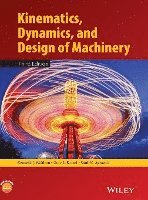
    Kinematics, Dynamics, and Design of Machinery

    AvKenneth J. Waldron,Gary L. Kinzel

    Inbunden, Engelska, 2016

    1 388 kr

    Beställningsvara. Skickas inom 5-8 vardagar. Fri frakt över 249 kr.

    Beskrivning

    Kinematics, Dynamics, and Design of Machinery, Third Edition, presents a fresh approach to kinematic design and analysis and is an ideal textbook for senior undergraduates and graduates in mechanical, automotive and production engineering Presents the traditional approach to the design and analysis of kinematic problems and shows how GCP can be used to solve the same problems more simplyProvides a new and simpler approach to cam designIncludes an increased number of exercise problemsAccompanied by a website hosting a solutions manual, teaching slides and MATLAB® programs

    Produktinformation

    • Utgivningsdatum:2016-06-10
    • Mått:221 x 282 x 48 mm
    • Vikt:2 200 g
    • Format:Inbunden
    • Språk:Engelska
    • Antal sidor:720
    • Upplaga:3
    • Förlag:John Wiley & Sons Inc
    • ISBN:9781118933282

    Utforska kategorier

    • Maskinteknik och material inom Naturvetenskap och teknik

    Mer om författaren

    Kenneth Waldron is Professor at the University of Technology, Sydney and Professor Emeritus of Stanford University. He has taught subjects in machine design and engineering mechanics over a career spanning more than forty years. He has also conducted research in kinematics of machinery, robotics, biomechanics and machine dynamics. He has received a number of awards including the American Society of Mechanical Engineers (ASME) Machine Design, Leonardo da Vinci and Ruth and Joel Spira Outstanding Design Educator Awards, and the Robotics Industries Association Joseph Engelberger Award.Professor Waldron has served as the Technical Editor of the ASME Transactions Journal of Machine Design. He served two terms as President of IFToMM, the International Federation for the Promotion of Machine and Mechanism Science, as well as holding many offices within ASME.Professor Waldron is excited by the many new developments in the field and the challenge of keeping this book up to date. Gary Kinzel is an emeritus professor in the Department of Mechanical and Aerospace Engineering at The Ohio State University. He received his PhD from Purdue in 1973. After graduation, he worked for six years at Battelle and was a regular faculty member at Ohio State until he retired in 2011. His research was in design, education, and manufacturing. He has more than 150 research publications, has coauthored two books, has one patent, and has supervised to completion the research of more than one hundred graduate students. He taught courses in machine design, kinematics, stress analysis and form synthesis and received ten research and teaching awards, including the OSU Alumni Teaching Award, the ASME Ruth and Joel Spira Outstanding Design Educator Award, and the ASEE Ralph Coates Roe Award. Sunil Agrawal has authored more than 175 archival journal papers, 225 refereed conference papers, 2 books, and 13 US patents. His work is well cited by the research community and can be viewed at Google Scholar at (scholar.google.com/citations). He has graduated 20 PhD and 25 MS students. Currently, there are 10 PhD students working under his guidance.

    Innehållsförteckning

    • Preface xiii1 Introduction 11.1 Historical Perspective, 11.2 Kinematics, 31.3 Design: Analysis and Synthesis, 41.4 Mechanisms, 41.5 Planar Linkages, 61.6 Visualization, 91.7 Constraint Analysis, 121.8 Constraint Analysis of Spatial Linkages, 181.9 Idle Degrees of Freedom, 221.10 Overconstrained Linkages, 241.11 Uses of the Mobility Criterion, 281.12 Inversion, 281.13 Reference Frames, 291.14 Motion Limits, 301.15 Continuously Rotatable Joints, 311.16 Coupler-Driven Linkages, 351.17 Motion Limits for Slider-Crank Mechanisms, 351.18 Interference, 381.19 Practical Design Considerations, 41References, 44Problems, 452 Techniques in Geometric Constraint Programming 592.1 Introduction, 592.2 Geometric Constraint Programming, 602.3 Constraints and Program Structure, 612.4 Initial Setup for a GCP Session, 642.5 Drawing a Basic Linkage Using GCP, 662.6 Troubleshooting Graphical Programs Developed Using GCP, 79References, 80Problems, 81Appendix 2A Drawing Slider Lines, Pin Bushings, and Ground Pivots, 852A.1 Slider Lines, 852A.2 Pin Bushings and Ground Pivots, 87Appendix 2B Useful Constructions When Equation Constraints Are Not Available, 882B.1 Constrain Two Angles to Be Integral Multiples of Another Angle, 892B.2 Constrain a Line to Be Half the Length of Another Line, 892B.3 Construction for Scaling, 902B.4 Construction for Square Ratio v2/r, 912B.5 Construction for Function x ˆ yz=r, 913 Planar Linkage Design 933.1 Introduction, 933.2 Two-Position Double-Rocker Design, 963.3 Synthesis of Crank-Rocker Linkages for Specified Rocker Amplitude, 1003.4 Motion Generation, 1143.5 Path Synthesis, 133References, 148Problems, 1504 Graphical Position, Velocity, and Acceleration Analysis for Mechanisms with Revolute Joints or Fixed Slides 1694.1 Introduction, 1694.2 Graphical Position Analysis, 1704.3 Planar Velocity Polygons, 1714.4 Graphical Acceleration Analysis, 1734.5 Graphical Analysis of a Four-Bar Mechanism, 1754.6 Graphical Analysis of a Slider-Crank Mechanism, 1834.7 Velocity Image Theorem, 1864.8 Acceleration Image Theorem, 1894.9 Solution by Geometric Constraint Programming, 194References, 205Problems, 2055 Linkages with Rolling and Sliding Contacts, and Joints on Moving Sliders 2215.1 Introduction, 2215.2 Reference Frames, 2225.3 General Velocity and Acceleration Equations, 2235.4 Special Cases for the Velocity and Acceleration Equations, 2285.5 Linkages with Rotating Sliding Joints, 2305.6 Rolling Contact, 2355.7 Cam Contact, 2435.8 General Coincident Points, 2505.9 Solution by Geometric Constraint Programming, 257Problems, 2636 Instant Centers of Velocity 2796.1 Introduction, 2796.2 Definition, 2806.3 Existence Proof, 2806.4 Location of an Instant Center from the Directions of Two Velocities, 2816.5 Instant Center at a Revolute Joint, 2826.6 Instant Center of a Curved Slider, 2826.7 Instant Center of a Prismatic Joint, 2826.8 Instant Center of a Rolling Contact Pair, 2826.9 Instant Center of a General Cam-Pair Contact, 2826.10 Centrodes, 2836.11 The Kennedy-Aronhold Theorem, 2856.12 Circle Diagram as a Strategy for Finding Instant Centers, 2876.13 Using Instant Centers to Find Velocities: The Rotating-Radius Method, 2876.14 Finding Instant Centers Using Geometric Constraint Programming, 295References, 300Problems, 3007 Computational Analysis of Linkages 3157.1 Introduction, 3157.2 Position, Velocity, and Acceleration Representations, 3167.3 Analytical Closure Equations for Four-Bar Linkages, 3197.4 Analytical Equations for a Rigid Body after the Kinematic Properties of Two Points Are Known, 3267.5 Analytical Equations for Slider-Crank Mechanisms, 3297.6 Other Four-Bar Mechanisms with Revolute and Prismatic Joints, 3387.7 Closure or Loop Equation Approach for Compound Mechanisms, 3417.8 Closure Equations for Mechanisms with Higher Pairs, 3477.9 Notational Differences: Vectors and Complex Numbers, 352Problems, 3548 Special Mechanisms 3618.1 Special Planar Mechanisms, 3618.2 Spherical Mechanisms, 3748.3 Constant-Velocity Couplings, 3818.4 Automotive Steering and Suspension Mechanisms, 3828.5 Indexing Mechanisms, 387References, 392Problems, 3929 Computational Analysis of Spatial Linkages 3959.1 Spatial Mechanisms, 3959.2 Robotic Mechanisms, 4019.3 Direct Position Kinematics of Serial Chains, 4039.4 Inverse Position Kinematics, 4109.5 Rate Kinematics, 4109.6 Closed-Loop Linkages, 4169.7 Lower-Pair Joints, 4189.8 Motion Platforms, 421References, 423Problems, 42310 Profile Cam Design 43110.1 Introduction, 43110.2 Cam-Follower Systems, 43210.3 Synthesis of Motion Programs, 43410.4 Analysis of Different Types of Follower-Displacement Functions, 43610.5 Determining the Cam Profile, 448References, 482Problems, 48211 Spur Gears 48911.1 Introduction, 48911.2 Spur Gears, 49011.3 Condition for Constant-Velocity Ratio, 49111.4 Involutes, 49211.5 Gear Terminology and Standards, 49411.6 Contact Ratio, 49711.7 Involutometry, 50111.8 Internal Gears, 50411.9 Gear Manufacturing, 50511.10 Interference and Undercutting, 50811.11 Nonstandard Gearing, 51011.12 Cartesian Coordinates of an Involute Tooth Generated with a Rack, 514References, 520Problems, 52012 Helical, Bevel, and Worm Gears 52312.1 Helical Gears, 52312.2 Worm Gears, 53612.3 Involute Bevel Gears, 540References, 547Problems, 54713 Gear Trains 54913.1 General Gear Trains, 54913.2 Direction of Rotation, 54913.3 Simple Gear Trains, 55013.4 Compound Gear Trains, 55213.5 Planetary Gear Trains, 55813.6 Harmonic Drive Speed Reducers, 570References, 572Problems, 57214 Static Force Analysis of Mechanisms 57914.1 Introduction, 57914.2 Forces, Moments, and Couples, 58014.3 Static Equilibrium, 58114.4 Free-Body Diagrams, 58214.5 Solution of Static Equilibrium Problems, 58514.6 Transmission Angle in a Four-Bar Linkage, 58714.7 Friction Considerations, 59014.8 In-Plane and Out-of-Plane Force Systems, 59714.9 Conservation of Energy and Power, 60114.10 Virtual Work, 60514.11 Gear Loads, 607Problems, 61315 Dynamic Force Analysis of Mechanisms 62315.1 Introduction, 62315.2 Problems Solvable Using Particle Kinetics, 62515.3 Dynamic Equilibrium of Systems of Rigid Bodies, 63315.4 Flywheels, 639Problems, 64116 Static and Dynamic Balancing 64516.1 Introduction, 64516.2 Single-Plane (Static) Balancing, 64616.3 Multi-Plane (Dynamic) Balancing, 64916.4 Balancing Reciprocating Masses, 65416.5 Expressions for Inertial Forces, 66116.6 Balancing Multi-Cylinder Machines, 66316.7 Static Balancing of Mechanisms, 67116.8 Reactionless Mechanisms, 675References, 676Problems, 67617 Integration of Computer Controlled Actuators 68517.1 Introduction, 68517.2 Computer Control of the Linkage Motion, 68617.3 The Basics of Feedback Control, 68717.4 Actuator Selection and Types, 68817.5 Hands-On Machine-Design Laboratory, 694References, 696Problems, 696Index 699