• Fri frakt över 249 kr
  • •
  • Snabba leveranser
  • •
  • Billiga böcker
Kundservice

Du är på sajten för privatpersoner.

Företag, bibliotek eller offentlig verksamhet?

Du handlar på classic.bokus.com, där alla dina funktioner finns intakta.
Till classic.bokus.com
Bokus logotyp. Gå till startsidan.
  • Erbjudanden
  • Nyheter
  • Student
  • Topplistor
  • Barn & ungdom
  • Bokus Play
  • E-böcker
  • Pocketböcker
  • Spel & pussel

10% rabatt på allt med kod NYSTART10 →

Sidfot

Mina sidor

    Hjälp

    • Kundservice
    • Vanliga frågor och svar
    • Frakt och leverans
    • Retur vid ångerrätt
    • Reklamera vara
    • Betalning
    • Köpvillkor
    • Allmänna villkor
    • Information om webbplatsens tillgänglighet

    Om Bokus

    • Om oss
    • Pressrum
    • För studenter
    • För företag
    • För bibliotek och offentlig verksamhet
    • För leverantörer
    • Hållbarhet

    Populärt

    • Aktuella erbjudanden
    • Presentkort
    • Studentlitteratur
    • Nya böcker
    • Topplistor
    • Signerade böcker
    • Engelska böcker

    Inspiration

    • Boktips
    • BookTok
    • Populära bokserier
    • Barnbokskaraktärer
    • Populära författare
    Logotyp för Bokus
    Följ oss på Facebook (extern länk)Följ oss på Instagram (extern länk)Följ oss på YouTube (extern länk)Följ oss på TikTok (extern länk)
    bokus @ CookiesAnpassa cookiesIntegritetspolicyKöpvillkor
    Till Citymail hemsida (extern länk)Till Budbee hemsida (extern länk)Till Postnord hemsida (extern länk)Till Schenker hemsida (extern länk)Till Early Bird hemsida (extern länk)Till Walleys hemsida (extern länk)
    1. Kultur
    2. Arkitektur

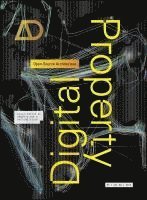
    Digital Property

    Open-source Architecture

    AvWendy W. Fok,Antoine Picon

    Häftad, Engelska, 2016

    Del i serien Architectural Design

    239 kr

    Tillfälligt slut

    Beskrivning

    Even more than authorship, ownership is challenged by the rise of digital and computational methods of design and production. These challenges are simultaneously legal, ethical and economic. How are new methods of fabrication and manufacture going to irreversibly change not only ways of working, but also designers’ ethics and their stance on ownership? In his 2013 second-term State of the Union address, President Obama stated that 3D printing ‘has the potential to revolutionize the way we make almost everything’. Nowhere will the impact of 3D printing be felt greater than in the architectural and design communities. When anyone can print out an object or structure from a digital file, will designers still exert the same creative rights or will they need to develop new practice and payment models? As architecture becomes more collaborative with open-source processes, will the emphasis on signature as the basis of ownership remain relevant? How will wider teams working globally be accredited and compensated? This issue of AD explores this subject; it features the work of designers who are developing wholly new approaches to practice by exploring means of commercialising process-based products rather than objects.Contributors: Phil Bernstein, Mark Garcia, Antoine Picon, Carlo Ratti and David RuyFeatured architects: Francis Bitonti, Marjan Colletti, Wendy W Fok, Panagiotis Michalatos, Jose Sanchez, Thibault Schwartz, Aaron Sprecher, Feng Xu and Philip Yuan

    Produktinformation

    • Utgivningsdatum:2016-09-23
    • Mått:206 x 282 x 10 mm
    • Vikt:590 g
    • Format:Häftad
    • Språk:Engelska
    • Serie:Architectural Design
    • Antal sidor:136
    • Förlag:John Wiley & Sons Inc
    • ISBN:9781118954980

    Utforska kategorier

    • Arkitektur inom Kultur
    • 3D-grafik och modellering inom Data och IT

    Mer om författaren

    Antoine Picon is the G Ware Travelstead Professor of  the History of Architecture and Technology at Harvard GSD. He works on the history of architectural and urban technologies from the 18th century to the present. In his book La Ville territoire des cyborgs (Editions de l'lmprimeur, 1998), he began to investigate the changes brought to cities and architecture by the development of digital tools and digital culture. His three most recent books - Digital Culture in Architecture: An Introduction for the Design Profession (Birkhauser,  2010); Ornament:The Politics of Architecture and Subjectivity (John Wiley & Sons,2013); and Smart Cities: A Spatialised Intelligence (Wiley, 2015) - deal extensively with this question. He received science and engineering degrees from the Ecole Polytechnique and Ecole Nationale des Ponts et Chaussees, an architecture degree from the Ecole d'Architecture de Paris-Villemin, and a PhD in history from the Ecole des Hautes Etudes en Sciences Sociales. Wendy W Fok is the creative director/ founder of WE DESIGNS, which provides creative strategies for the built environment, as well as Resilient Modular Systems, a socially missioned venture and public-benefit corporation that focuses on innovative modular components using hybridised composite materials for the building industry. Her awards include the Autodesk® Pier 9 AiR (2016), Young CAADRIA Award (2015), Digital Kluge Fellowship awarded by the Library of Congress (2014- 15), the Art Directors Club of New York's ADC Young Guns 11 Award (2013), and the American Institute of Architects (AIA) Dallas 'Express Yourself' Women in Architecture Award (2013). She has a Master of Architecture from Princeton University, and a  Bachelor of Arts in Architecture from Barnard College, Columbia University. She is an Assistant Professor of Integrated Design at Parsons, and completed her Doctor of Design at the Harvard GSD. Her doctoral research investigates computational innovation, the ethical/equitable application of technical methods of digital fabrication, and issues of intellectual property law within ownership and authorship property rights for the built environment.

    Recensioner i media

    "... a new edition of a very, very good book, contains deep understanding and valid advice to the designer." (European Transactions on Telecommunications, November 2000)

    Innehållsförteckning

    • About the Guest-Editors 5 Introduction The Ownership Revolution 6 Serving, Owning, Authoring 16Adaptive Knowledge in Architecture: A Few Notes on the Nature of Transdisciplinarity 26From Authorship to Ownership: A Historical Perspective 36A/B Architecture: Publicly Augmented Design 42Massive Re-Patterning of the Urban Landscape 48Fab-Union: A Collective Online to Offline Robotic Design Platform 52Design Instruments of Service in the Era of Connection 60An Art of Connectivity 68Post-Digital Transdisciplinarity 74VULCAN: Closing the Loop in 3D-Printed Architectural Design 82Architectural Patents and Open-Source Architectures: The Globalisation of Spatial Design Innovations (or Learning from ‘E99’) 92When Matter Becomes Media: How Our New Tools Are Reinventing Physicality 100Design Signals: The Role of Software Architecture and Paradigms in Design Thinking and Practice 108Opening Up the Future of Open Source: From Open Innovation to the Internet of Things for the Built Environment 116Counterpoint The Culture of the Copy 126Contributors 134