• Fri frakt över 249 kr
  • •
  • Snabba leveranser
  • •
  • Billiga böcker
Kundservice

Du är på sajten för privatpersoner.

Företag, bibliotek eller offentlig verksamhet?

Du handlar på classic.bokus.com, där alla dina funktioner finns intakta.
Till classic.bokus.com
Bokus logotyp. Gå till startsidan.
  • Erbjudanden
  • Student
  • Topplistor
  • Barn & ungdom
  • Bokus Play
  • E-böcker
  • Ljudböcker
  • Pocketböcker
  • Spel & pussel

Upp till 25% på utvalda nyheter →

Sidfot

Mina sidor

    Hjälp

    • Kundservice
    • Vanliga frågor och svar
    • Frakt och leverans
    • Retur vid ångerrätt
    • Reklamera vara
    • Betalning
    • Köpvillkor
    • Allmänna villkor
    • Information om webbplatsens tillgänglighet

    Om Bokus

    • Om oss
    • Pressrum
    • För studenter
    • För företag
    • För bibliotek och offentlig verksamhet
    • För leverantörer
    • Hållbarhet

    Populärt

    • Aktuella erbjudanden
    • Presentkort
    • Studentlitteratur
    • Nya böcker
    • Topplistor
    • Signerade böcker
    • Engelska böcker

    Inspiration

    • Boktips
    • BookTok
    • Populära bokserier
    • Barnbokskaraktärer
    • Populära författare
    Logotyp för Bokus
    Följ oss på Facebook (extern länk)Följ oss på Instagram (extern länk)Följ oss på YouTube (extern länk)Följ oss på TikTok (extern länk)
    bokus @ CookiesAnpassa cookiesIntegritetspolicyKöpvillkor
    Till Citymail hemsida (extern länk)Till Budbee hemsida (extern länk)Till Postnord hemsida (extern länk)Till Schenker hemsida (extern länk)Till Early Bird hemsida (extern länk)Till Walleys hemsida (extern länk)
    1. Samhälle och politik
    2. Samhälle och kultur
    3. Kultur och medier
    4. Referensverk och tvärvetenskap

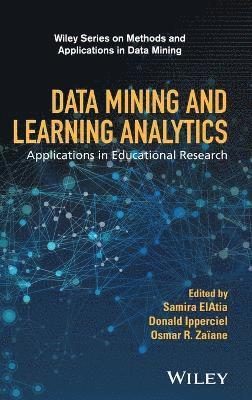
    Data Mining and Learning Analytics

    Applications in Educational Research

    AvSamira ElAtia,Donald Ipperciel

    Inbunden, Engelska, 2016

    Del i serien Wiley Series on Methods and Applications in Data Mining

    1 425 kr

    Beställningsvara. Skickas inom 5-8 vardagar. Fri frakt över 249 kr.

    Beskrivning

    Addresses the impacts of data mining on education and reviews applications in educational research teaching, and learning This book discusses the insights, challenges, issues, expectations, and practical implementation of data mining (DM) within educational mandates. Initial series of chapters offer a general overview of DM, Learning Analytics (LA), and data collection models in the context of educational research, while also defining and discussing data mining’s four guiding principles— prediction, clustering, rule association, and outlier detection. The next series of chapters showcase the pedagogical applications of Educational Data Mining (EDM) and feature case studies drawn from Business, Humanities, Health Sciences, Linguistics, and Physical Sciences education that serve to highlight the successes and some of the limitations of data mining research applications in educational settings. The remaining chapters focus exclusively on EDM’s emerging role in helping to advance educational research—from identifying at-risk students and closing socioeconomic gaps in achievement to aiding in teacher evaluation and facilitating peer conferencing. This book features contributions from international experts in a variety of fields. Includes case studies where data mining techniques have been effectively applied to advance teaching and learningAddresses applications of data mining in educational research, including: social networking and education; policy and legislation in the classroom; and identification of at-risk studentsExplores Massive Open Online Courses (MOOCs) to study the effectiveness of online networks in promoting learning and understanding the communication patterns among users and studentsFeatures supplementary resources including a primer on foundational aspects of educational mining and learning analyticsData Mining and Learning Analytics: Applications in Educational Research is written for both scientists in EDM and educators interested in using and integrating DM and LA to improve education and advance educational research.

    Produktinformation

    • Utgivningsdatum:2016-11-11
    • Mått:158 x 231 x 23 mm
    • Vikt:567 g
    • Format:Inbunden
    • Språk:Engelska
    • Serie:Wiley Series on Methods and Applications in Data Mining
    • Antal sidor:320
    • Förlag:John Wiley & Sons Inc
    • ISBN:9781118998236

    Utforska kategorier

    • Referensverk och tvärvetenskap inom Samhälle och politik
    • Databaser inom Data och IT
    • Pedagogik inom Psykologi och pedagogik

    Mer om författaren

    Samira ElAtia is Associate Professor of Education at The University of Alberta, Canada. She has published numerous articles and book chapters on topics relating to the use of technology to support pedagogical research and education in higher education. Her current research focuses on using e-learning environment and big data for fair and valid longitudinal assessment of, and for, learning within higher education.Donald Ipperciel is Principal and Professor at Glendon College, York University, Toronto, Canada and was the Canadian Research Chair in Political Philosophy and Canadian Studies between 2002 and 2012. He has authored several books and has contributed chapters and articles in more than 60 publications.  Ipperciel has dedicated many years of research on the questions of e-learning and using technology in education. He is co-editor of the Canadian Journal of Learning and Technology since 2010.Osmar R. Zaiane is Professor of Computing Science at the University of Alberta, Canada and Scientific Director of the Alberta Innovates Centre of Machine Learning. A renowned researcher and computer scientist, Dr. Zaiane is former Secretary Treasurer of the Association for Computing Machinery (ACM) Special Interest Group on Knowledge Discovery and Data Mining. He obtained the IEEE ICDM Outstanding Service Aware in 2009 as well as the ACM SIGKDD Service Award the following year.

    Innehållsförteckning

    • Notes on Contributors xiIntroduction: Education At Computational Crossroads xxiiiSamira ElAtia, Donald Ipperciel, and Osmar R. ZaïanePart I At The Intersection of Two Fields: EDM 1Chapter 1 Educational Process Mining: A Tutorial and Case Study Using Moodle Data Sets 3Cristóbal Romero, Rebeca Cerezo, Alejandro Bogarín, and Miguel Sanchez‐Santillán1.1 Background 51.2 Data Description and Preparation 71.2.1 Preprocessing Log Data 71.2.2 Clustering Approach for Grouping Log Data 111.3 Working with ProM 161.3.1 Discovered Models 191.3.2 Analysis of the Models’ Performance 231.4 Conclusion 26Acknowledgments 27References 27Chapter 2 On Big Data And Text Mining in the Humanities29Geoffrey Rockwell and Bettina Berendt2.1 Busa and the Digital Text 302.2 Thesaurus Linguae Graecae and the Ibycus Computer as Infrastructure 322.2.1 Complete Data Sets 332.3 Cooking with Statistics 352.4 Conclusions 37References 38Chapter 3 Finding Predictors in Higher Education41David Eubanks, William Evers Jr., and Nancy Smith3.1 Contrasting Traditional and Computational Methods 423.2 Predictors and Data Exploration 453.3 Data Mining Application: An Example 503.4 Conclusions 52References 53Chapter 4 Educational Data Mining: A MOOC Experience55Ryan S. Baker, Yuan Wang, Luc Paquette, Vincent Aleven, Octav Popescu, Jonathan Sewall, Carolyn Rosé, Gaurav Singh Tomar, Oliver Ferschke, Jing Zhang, Michael J. Cennamo, Stephanie Ogden, Therese Condit, José Diaz, Scott Crossley, Danielle S. McNamara, Denise K. Comer, Collin F. Lynch, Rebecca Brown, Tiffany Barnes, and Yoav Bergner4.1 Big Data in Education: The Course 554.1.1 Iteration 1: Coursera 554.1.2 Iteration 2: edX 564.2 Cognitive Tutor Authoring Tools 574.3 Bazaar 584.4 Walkthrough 584.4.1 Course Content 584.4.2 Research on BDEMOOC 614.5 Conclusion 65Acknowledgments 65References 65Chapter 5 Data Mining and Action Research 67Ellina Chernobilsky, Edith Ries, and Joanne Jasmine5.1 Process 695.2 Design Methodology 715.3 Analysis and Interpretation of Data 725.3.1 Quantitative Data Analysis and Interpretation 735.3.2 Qualitative Data Analysis and Interpretation 745.4 Challenges 755.5 Ethics 765.6 Role of Administration in the Data Collection Process 765.7 Conclusion 77References 77Part II Pedagogical Applications of EDM79Chapter 6 Design of an Adaptive Learning System and Educational Data Mining81Zhiyong Liu and Nick Cercone6.1 Dimensionalities of the User Model in ALS 836.2 Collecting Data for ALS 856.3 Data Mining in ALS 866.3.1 Data Mining for User Modeling 876.3.2 Data Mining for Knowledge Discovery 886.4 ALS Model and Function Analyzing 906.4.1 Introduction of Module Functions 906.4.2 Analyzing the Workflow 936.5 Future Works 946.6 Conclusions 94Acknowledgment 95References 95Chapter 7 The “Geometry” of Naive Bayes: Teaching Probabilities by “Drawing” Them99Giorgio Maria Di Nunzio7.1 Introduction 997.1.1 Main Contribution 1007.1.2 Related Works 1017.2 The Geometry of NB Classification 1027.2.1 Mathematical Notation 1027.2.2 Bayesian Decision Theory 1037.3 Two-Dimensional Probabilities 1057.3.1 Working with Likelihoods and Priors Only 1077.3.2 De‐normalizing Probabilities 1087.3.3 NB Approach 1097.3.4 Bernoulli Naïve Bayes 1107.4 A New Decision Line: Far from the Origin 1117.4.1 De‐normalization Makes (Some) Problems Linearly Separable 1127.5 Likelihood Spaces, When Logarithms make a Difference (or a SUM) 1147.5.1 De‐normalization Makes (Some) Problems Linearly Separable 1157.5.2 A New Decision in Likelihood Spaces 1167.5.3 A Real Case Scenario: Text Categorization 1177.6 Final Remarks 118References 119Chapter 8 Examining the Learning Networks of a MOOC121Meaghan Brugha and Jean‐Paul Restoule8.1 Review of Literature 1228.2 Course Context 1248.3 Results and Discussion 1258.4 Recommendations for Future Research 1338.5 Conclusions 134References 135Chapter 9 Exploring the Usefulness of Adaptive ELearning Laboratory Environments in Teaching Medical Science139Thuan Thai and Patsie Polly9.1 Introduction 1399.2 Software for Learning and Teaching 1419.2.1 Reflective Practice: ePortfolio 1419.2.2 Online Quizzes 1439.2.3 Online Practical Lessons 1449.2.4 Virtual Laboratories 1459.2.5 The Gene Suite 1479.3 Potential Limitations 1529.4 Conclusion 153Acknowledgments 153References 154Chapter 10 Investigating Co‐Occurrence Patterns of Learners’ Grammatical Errors across Proficiency Levels and Essay Topics Based on Association Analysis 157Yutaka Ishii10.1 Introduction 15710.1.1 The Relationship between Data Mining and Educational Research 15710.1.2 English Writing Instruction in the Japanese Context 15810.2 Literature Review 15910.3 Method 16010.3.1 Konan‐JIEM Learner Corpus 16010.3.2 Association Analysis 16210.4 Experiment 1 16210.5 Experiment 2 16310.6 Discussion and Conclusion 164Appendix A: Example of Learner’s Essay (University Life) 164Appendix B: Support Values of all Topics 165Appendix C: Support Values of Advanced, Intermediate, and Beginner Levels of Learners 168References 169Part III EDM and Educational Research 173Chapter 11 Mining Learning Sequences in MOOCs: Does Course Design Constrain Students’ Behaviors Or Do Students Shape Their Own Learning? 175Lorenzo Vigentini, Simon McIntyre, Negin Mirriahi, and Dennis Alonzo11.1 Introduction 17511.1.1 Perceptions and Challenges of MOOC Design 17611.1.2 What Do We Know About Participants’ Navigation: Choice and Control 17711.2 Data Mining in MOOCs: Related Work 17811.2.1 Setting the Hypotheses 17911.3 The Design and Intent of the LTTO MOOC 18011.3.1 Course Grading and Certification 18311.3.2 Delivering the Course 18311.3.3 Operationalize Engagement, Personal Success, and Course Success in LTTO 18411.4 Data Analysis 18411.4.1 Approaches to Process the Data Sources 18511.4.2 LTTO in Numbers 18611.4.3 Characterizing Patterns of Completion and Achievement 18611.4.4 Redefining Participation and Engagement 18911.5 Mining Behaviors and Intents 19111.5.1 Participants’ Intent and Behaviors: A Classification Model 19111.5.2 Natural Clustering Based on Behaviors 19411.5.3 Stated Intents and Behaviors: Are They Related? 19811.6 Closing the Loop: Informing Pedagogy and Course Enhancement 19811.6.1 Conclusions, Lessons Learnt, and Future Directions 200References 201Chapter 12 Understanding Communication Patterns in MOOCs: Combining Data Mining and Qualitative Methods 207Rebecca Eynon, Isis Hjorth, Taha Yasseri, and Nabeel Gillani12.1 Introduction 20712.2 Methodological Approaches to Understanding Communication Patterns in MOOCs 20912.3 Description 21012.3.1 Structural Connections 21112.4 Examining Dialogue 21312.5 Interpretative Models 21412.6 Understanding Experience 21512.7 Experimentation 21612.8 Future Research 217References 218Chapter 13 An Example of Data Mining: Exploring The Relationship Between Applicant Attributes and Academic Measures of Success in a Pharmacy Program 223Dion Brocks and Ken Cor13.1 Introduction 22313.2 Methods 22513.3 Results 22813.4 Discussion 23013.4.1 Prerequisite Predictors 23013.4.2 Demographic Predictors 23213.5 Conclusion 234Appendix A 234References 236Chapter 14 A New Way of Seeing: Using a Data Mining Approach to Understand Children’s Views of Diversity and “Difference” in Picture Books237Robin A. Moeller and Hsin‐liang Chen14.1 Introduction 23714.2 Study 1: Using Data Mining to Better Understand Perceptions of Race 23814.2.1 Background 23814.2.2 Research Questions 23914.2.3 Methods 24014.2.4 Findings 24014.2.5 Discussion 24814.3 Study 2: Translating Data Mining Results to Picture Book Concepts of “Difference” 24814.3.1 Background 24814.3.2 Research Questions 24914.3.3 Methodology 25014.3.4 Findings 25014.3.5 Discussion and Implications 25214.4 Conclusions 252References 252Chapter 15 Data Mining with Natural Language Processing and Corpus Linguistics: Unlocking Access to School Children’s Language in Diverse Contexts to Improve Instructional and Assessment Practices255Alison L. Bailey, Anne Blackstock‐Bernstein, Eve Ryan, and Despina Pitsoulakis15.1 Introduction 25515.2 Identifying the Problem 25615.3 Use of Corpora and Technology in Language Instruction and Assessment 26115.3.1 Language Corpora in ESL and EFL Teaching and Learning 26115.3.2 Previous Extensions of Corpus Linguistics to School‐Age Language 26215.3.3 Corpus Linguistics in Language Assessment 26315.3.4 Big Data Purposes, Techniques, and Technology 26415.4 Creating a School‐Age Learner Corpus and Digital Data Analytics System 26615.4.1 Language Measures Included in DRGON 26715.4.2 The DLLP as a Promising Practice 26815.5 Next Steps, “Modest Data,” and Closing Remarks 269Acknowledgments 271Appendix A: Examples of Oral and Written Explanation Elicitation Prompts 272References 272Index 277