• Fri frakt över 249 kr
  • •
  • Snabba leveranser
  • •
  • Billiga böcker
Kundservice

Du är på sajten för privatpersoner.

Företag, bibliotek eller offentlig verksamhet?

Du handlar på classic.bokus.com, där alla dina funktioner finns intakta.
Till classic.bokus.com
Bokus logotyp. Gå till startsidan.
  • Erbjudanden
  • Nyheter
  • Student
  • Topplistor
  • Barn & ungdom
  • Bokus Play
  • E-böcker
  • Pocketböcker
  • Spel & pussel

10% rabatt på allt med kod NYSTART10 →

Sidfot

Mina sidor

    Hjälp

    • Kundservice
    • Vanliga frågor och svar
    • Frakt och leverans
    • Retur vid ångerrätt
    • Reklamera vara
    • Betalning
    • Köpvillkor
    • Allmänna villkor
    • Information om webbplatsens tillgänglighet

    Om Bokus

    • Om oss
    • Pressrum
    • För studenter
    • För företag
    • För bibliotek och offentlig verksamhet
    • För leverantörer
    • Hållbarhet

    Populärt

    • Aktuella erbjudanden
    • Presentkort
    • Studentlitteratur
    • Nya böcker
    • Topplistor
    • Signerade böcker
    • Engelska böcker

    Inspiration

    • Boktips
    • BookTok
    • Populära bokserier
    • Barnbokskaraktärer
    • Populära författare
    Logotyp för Bokus
    Följ oss på Facebook (extern länk)Följ oss på Instagram (extern länk)Följ oss på YouTube (extern länk)Följ oss på TikTok (extern länk)
    bokus @ CookiesAnpassa cookiesIntegritetspolicyKöpvillkor
    Till Citymail hemsida (extern länk)Till Budbee hemsida (extern länk)Till Postnord hemsida (extern länk)Till Schenker hemsida (extern länk)Till Early Bird hemsida (extern länk)Till Walleys hemsida (extern länk)
    1. Naturvetenskap och teknik
    2. Teknik och industri
    3. Maskinteknik och material

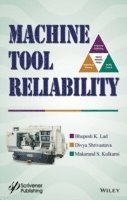
    Machine Tool Reliability

    AvBhupesh K. Lad,Divya Shrivastava

    Inbunden, Engelska, 2016

    Del i serien Performability Engineering Series

    2 266 kr

    Beställningsvara. Skickas inom 5-8 vardagar. Fri frakt över 249 kr.

    Beskrivning

    This book explores the domain of reliability engineering in the context of machine tools. Failures of machine tools not only jeopardize users' ability to meet their due date commitments but also lead to poor quality of products, slower production, down time losses etc.Poor reliability and improper maintenance of a machine tool greatly increases the life cycle cost to the user. Thus, the application area of the present book, i.e. machine tools, will be equally appealing to machine tool designers, production engineers and maintenance managers. The book will serve as a consolidated volume on various dimensions of machine tool reliability and its implications from manufacturers and users point of view.From the manufacturers' point of view, it discusses various approaches for reliability and maintenance based design of machine tools. In specific, it discusses simultaneous selection of optimal reliability configuration and maintenance schedules, maintenance optimization under various maintenance scenarios and cost based FMEA.From the users' point of view, it explores the role of machine tool reliability in shop floor level decision- making. In specific, it shows how to model the interactions of machine tool reliability with production scheduling, maintenance scheduling and process quality control.

    Produktinformation

    • Utgivningsdatum:2016-05-06
    • Mått:158 x 231 x 25 mm
    • Vikt:658 g
    • Format:Inbunden
    • Språk:Engelska
    • Serie:Performability Engineering Series
    • Antal sidor:336
    • Förlag:John Wiley & Sons Inc
    • ISBN:9781119038603

    Utforska kategorier

    • Maskinteknik och material inom Naturvetenskap och teknik

    Mer om författaren

    Bhupesh Kumar Lad is an Assistant Professor in Mechanical Engineering at the Indian Institute of Technology Indore. He is associated with Industrial Engineering Research Group at IIT Indore. He gained his PhD in Reliability Engineering from the Department of Mechanical Engineering at the Indian Institute of Technology Delhi (IITD). Before joining IIT Indore he was working with GE global research center, Bangalore as a research engineer. Divya Shrivastava is an Assistant Professor with in Mechanical Engineering at the Shiv Nadar University, India. She gained her PhD in Industrial Engineering from the Department of Mechanical Engineering at the Indian Institute of Technology Delhi (IITD). Before joining Shiv Nadar University she was working with NIT Hamirpur (H.P). Her area of research includes: Operations Management, Quality Control and Maintenance Management. M. S. Kulkarni is an Associate Professor in the Department of Mechanical Engineering at the Indian Institute of Technology Delhi. He is associated with the Industrial Engineering group of the Department. He gained his PhD in Manufacturing Engineering from the Department of Mechanical Engineering at the Indian Institute of Technology Bombay. His post PhD industry experience includes application of quality and reliability engineering techniques in manufacturing and service industry.

    Innehållsförteckning

    • Preface xi1 Introduction 11.1 Basic Reliability Terms and Concepts 21.2 Machine Tool Failure 61.3 Machine Tool Reliability: Manufacturers' View Point 71.4 Machine Tool Reliability: Users' View Point 111.5 Organization of the Book 122 Basic Reliability Mathematics 172.1 Functions Describing Lifetime as a Random Variable 172.2 Probability Distributions Used in Reliability Engineering 212.2.1 Exponential Distribution 212.2.2 Weibull Distribution 222.2.3 Normal Distribution 232.2.4 The Lognormal Distribution 232.3 Life Data Analysis 242.3.1 Empirical Methods 272.3.2 Unbiased Estimation of Parameters 282.4 Stochastic Models for Repairable Systems 282.5 Simulation Approach for Reliability Engineering 312.6 Use of Bayesian Methods in Reliability Engineering 322.7 Closing Remarks 333 Machine Tool Performance Measures 353.1 Identifying Performance Measures 363.2 Mechanism to Link Users' Operational Measures with Machine Reliability and Maintenance Parameters 413.2.1 Availability Model 423.2.2 Performance Rate Model 453.2.3 Quality Rate Model 463.3 Closing Remarks 534 Expert Judgement Based Parameter Estimation Method for Machine Tool Reliability Analysis 554.1 Expert Judgement as an Alternative Source of Data in Reliability Studies 574.2 Expert Judgement Based Parameter Estimation Methods 584.2.1 Non-Repairable Component 594.2.2 Repairable Assembly 744.3 Some Desirable Properties of A "Good" Estimator 794.4 Closing Remarks 805 Machine Tool Maintenance Scenarios, Models and Optimization 815.1 Overview of Maintenance 825.1.1 Maintenance Models 845.1.2 Maintenance Optimization Techniques 865.2 Machine Tool Maintenance 875.3 Machine Tool Maintenance Scenarios 895.4 Preventive Maintenance Optimization Models for Different Maintenance Scenarios 915.4.1 Preventive Maintenance Optimization in Maintenance Scenario 1 (MSc 1) (Replacement model) 935.4.2 Preventive Maintenance Optimization in Maintenance Scenario 2 (MSc 2) (Repair-Replacement Model) 995.4.3 Preventive Maintenance Optimization in Maintenance Scenario 3 (MSc 3) (Overhauling Model) 1045.5 Closing Remarks 1106 Reliability and Maintenance Based Design of Machine Tools 1136.1 Optimal Reliability Design 1156.2 Optimal reliability design of machine tools 1226.2.1 Machine Tool Functional Design 1266.2.1.1 Special Purpose Machine Tool Design 1266.2.1.2 General Purpose Machine Tool Design 1266.2.1.3 Customized Machine Tool Design 1266.2.2 Simultaneous Optimization of Reliability and Maintenance Under Three Functional Design Scenarios 1276.2.2.1 Simultaneous Optimization for Special Purpose Machine Tool 1276.2.2.2 Simultaneous Optimization for General Purpose Machine Tool Design Scenario 1336.2.2.3 Simultaneous Optimization for Customized Machine Tool Design 1376.3 Failure Mode and Effects Analysis 1396.3.1 Cost Based FMEA Approach 1456.4 Closing Remarks 1557 Machine Tool Maintenance and Process Quality Control 1577.1 Development of Statistical Process Control (SPC) 1587.2 Economic Design of Control Chart 1597.3 Process failure 1657.4 Joint Optimization of Maintenance Planning and Quality Control Policy 1667.4.1 Problem Description 1697.4.2 Assumptions and Conditions 1717.4.3 Integration Approaches 1727.5 Joint Optimization of Maintenance Planning and Quality Control Policy Using X -Control Chart 1727.5.1 Expected Cost Model for Corrective Maintenance due to FC1 1747.5.2 Expected Cost Per Preventive Maintenance for a System 1767.5.3 Determination of the Expected Cost Associated with the Process Quality Control 1777.5.3.1 Expected Process Cycle Length 1787.5.3.2 Expected Process Quality Control Cost (E[Cprocess–failure]) Model 1827.5.4 Numerical Illustration 1857.5.4.1 Sensitivity Analysis 1867.5.5 Comparative Study of Integrated Model with Stand-alone Models 1907.5.5.1 Maintenance Models 1907.5.5.2 Statistical Process Control (SPC) Model 1917.5.5.3 Comparison of Results 1917.6 Joint Optimization of Preventive Maintenance and Quality Policy Incorporating Taguchi Quadratic Loss Function 1927.6.1 Optimization Model 1937.6.2 Numerical Example 1967.6.2.1 Sensitivity Analysis 1987.7 Joint Optimization of Preventive Maintenance and Quality Policy based on Taguchi Quadratic Loss Function Using CUSUM Control Chart 2007.7.1 Optimization Model 2017.7.2 Numerical Example 2037.8 Extension of the Joint Optimization of Maintenance Planning and Quality Control Policy for Multi-component System 2077.8.1 Problem Description 2077.8.2 Joint Optimization of Maintenance Planning and Quality Control Policy Using Taguchi Loss Function Approach for a Multi-component System 2087.8.3 Expected Cost Model for Corrective Maintenance due to FC1 for Multicomponent 2097.8.4 Expected Cost per Preventive Maintenance for Multi-component System 2097.8.5 Expected Cost Model for Quality Loss due to Process Failure (E[TCQ]process-failure)M-C 2107.8.6 Numerical Example 2147.9 Closing Remarks 2168 Joint Optimization of Integrated Maintenance Scheduling and Quality Control Policy with Production Scheduling 2198.1 Production Scheduling 2208.2 Exploring the Link Between Production Scheduling and Maintenance 2268.3 The Optimal Scheduling Problem 2318.3.1 Expression for Expected Penalty Cost Incurred due to Batch Schedule Tardiness 2328.3.2 Expression for Inventory Carrying Cost of Raw Material 2338.3.3 Optimization Problem for Batch Scheduling 2348.4 Joint Optimization of Preventive Maintenance and Quality Control Policy 2358.5 Integration of Production Scheduling with Jointly Optimized Preventive Maintenance and Quality Control Policy2358.5.1 Expression for Expected Penalty Cost Incurred due to Batch and Maintenance Delay 2368.5.2 Expression for Inventory Carrying Cost of Raw Material for an Integrated Model 2408.5.3 Joint Optimization of Preventive Maintenance and Quality Control Policy with Production Scheduling 2418.6 Numerical Illustration 2428.6.1 Solution Procedure for the Integrated Problem 2448.7 Solving Larger Problem 2478.7.1 The Backward Forward Heuristic Algorithm 2478.7.2 Genetic Algorithm 2528.7.3 Numerical Illustration for Integrated Model for Large Number of Batches 2528.8 Extension of the Integrated Approach Multiple Machine in Series 2578.9 Closing Remarks 2639 Machine Tool Reliability: Future Research Directions 2679.1 Moving towards Servitization 2689.2 Multi Agent-Based Systems 2719.3 Closing Remarks 274References 277AppendicesAppendix A1: Java Code for Estimating Expected Number of Failures 297Appendix A2: 'MATLAB' Genetic Algorithm Code for Joint Optimization of Production Scheduling and Maintenance Planning 303Index 309