• Fri frakt över 249 kr
  • •
  • Snabba leveranser
  • •
  • Billiga böcker
Kundservice

Du är på sajten för privatpersoner.

Företag, bibliotek eller offentlig verksamhet?

Du handlar på classic.bokus.com, där alla dina funktioner finns intakta.
Till classic.bokus.com
Bokus logotyp. Gå till startsidan.
  • Erbjudanden
  • Nyheter
  • Student
  • Topplistor
  • Barn & ungdom
  • Bokus Play
  • E-böcker
  • Pocketböcker
  • Spel & pussel

10% rabatt på allt med kod: NYSTART10 →

Sidfot

Mina sidor

    Hjälp

    • Kundservice
    • Vanliga frågor och svar
    • Frakt och leverans
    • Retur vid ångerrätt
    • Reklamera vara
    • Betalning
    • Köpvillkor
    • Allmänna villkor
    • Information om webbplatsens tillgänglighet

    Om Bokus

    • Om oss
    • Pressrum
    • För studenter
    • För företag
    • För bibliotek och offentlig verksamhet
    • För leverantörer
    • Hållbarhet

    Populärt

    • Aktuella erbjudanden
    • Presentkort
    • Studentlitteratur
    • Nya böcker
    • Topplistor
    • Signerade böcker
    • Engelska böcker

    Inspiration

    • Boktips
    • BookTok
    • Populära bokserier
    • Barnbokskaraktärer
    • Populära författare
    Logotyp för Bokus
    Följ oss på Facebook (extern länk)Följ oss på Instagram (extern länk)Följ oss på YouTube (extern länk)Följ oss på TikTok (extern länk)
    bokus @ CookiesAnpassa cookiesIntegritetspolicyKöpvillkor
    Till Citymail hemsida (extern länk)Till Budbee hemsida (extern länk)Till Postnord hemsida (extern länk)Till Schenker hemsida (extern länk)Till Early Bird hemsida (extern länk)Till Walleys hemsida (extern länk)
    1. Samhälle och politik
    2. Samhälle och kultur
    3. Kultur och medier
    4. Referensverk och tvärvetenskap

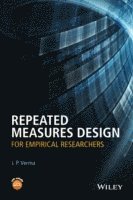
    Repeated Measures Design for Empirical Researchers

    AvJ. P. Verma

    Inbunden, Engelska, 2015

    1 543 kr

    Beställningsvara. Skickas inom 5-8 vardagar. Fri frakt över 249 kr.

    Fler format och utgåvor

    E-bok

    1 798 kr

    E-bok

    1 756 kr

    Beskrivning

    Introduces the applications of repeated measures design processes with the popular IBM® SPSS® softwareRepeated Measures Design for Empirical Researchers presents comprehensive coverage of the formation of research questions and the analysis of repeated measures using IBM SPSS and also includes the solutions necessary for understanding situations where the designs can be used. In addition to explaining the computation involved in each design, the book presents a unique discussion on how to conceptualize research problems as well as identify appropriate repeated measures designs for research purposes.Featuring practical examples from a multitude of domains including psychology, the social sciences, management, and sports science, the book helps readers better understand the associated theories and methodologies of repeated measures design processes. The book covers various fundamental concepts involved in the design of experiments, basic statistical designs, computational details, differentiating independent and repeated measures designs, and testing assumptions. Along with an introduction to IBM SPSS software, Repeated Measures Design for Empirical Researchers includes: A discussion of the popular repeated measures designs frequently used by researchers, such as one-way repeated measures ANOVA, two-way repeated measures design, two-way mixed design, and mixed design with two-way MANOVACoverage of sample size determination for the successful implementation of designing and analyzing a repeated measures studyA step-by-step guide to analyzing the data obtained with real-world examples throughout to illustrate the underlying advantages and assumptionsA companion website with supplementary IBM SPSS data sets and programming solutions as well as additional case studiesRepeated Measures Design for Empirical Researchers is a useful textbook for graduate- and PhD-level students majoring in biostatistics, the social sciences, psychology, medicine, management, sports, physical education, and health. The book is also an excellent reference for professionals interested in experimental designs and statistical sciences as well as statistical consultants and practitioners from other fields including biological, medical, agricultural, and horticultural sciences.J. P. Verma, PhD, is Professor of Statistics and Director of the Center for Advanced Studies at Lakshmibai National Institute of Physical Education, India. Professor Verma is an active researcher in sports modeling and data analysis and has conducted many workshops on research methodology, research designs, multivariate analysis, statistical modeling, and data analysis for students of management, physical education, social science, and economics. He is the author of Statistics for Exercise Science and Health with Microsoft® Office Excel®, also published by Wiley.

    Produktinformation

    • Utgivningsdatum:2015-09-22
    • Mått:163 x 243 x 23 mm
    • Vikt:621 g
    • Format:Inbunden
    • Språk:Engelska
    • Antal sidor:288
    • Förlag:John Wiley & Sons Inc
    • ISBN:9781119052715

    Utforska kategorier

    • Referensverk och tvärvetenskap inom Samhälle och politik

    Mer om författaren

    J. P. Verma, PhD, is Professor of Statistics and Director of the Center for Advanced Studies at Lakshmibai National Institute of Physical Education, India. Professor Verma is an active researcher in sports modeling and data analysis and has conducted many workshops on research methodology, research designs, multivariate analysis, statistical modeling, and data analysis for students of management, physical education, social science, and economics. He is the author of Statistics for Exercise Science and Health with Microsoft® Office Excel®, also published by Wiley.

    Innehållsförteckning

    • Preface xvIllustration Credits xix1 Foundations of Experimental Design 1Introduction 1What is Experimental Research? 2Design of Experiment and its Principles 3Randomization 3Replication 4Blocking 4Statistical Designs 5Completely Randomized Design 5Randomized Block Design 6Matched Pairs Design 8Latin Square designs 8Factorial Experiment 9Terminologies in Design of Experiment 10Subject 11Experimental Unit 11Factor and Treatment 11Criterion Variable 12Variation and Variance 12Experimental Error 12External Validity 13Internal Validity 13Considerations in Designing an Experiment 13Systematic Variance 14Extraneous Variance 14Randomization Method 15Elimination Method 15Matching Group Method 15Adding Additional Independent Variable 16Statistical Control 16Error Variance 17Exercise 17Assignment 18Bibliography 182 Analysis of Variance and Repeated Measures Design 21Introduction 21Understanding Variance and Sum of Squares 22One Way Analysis of Variance for Independent Measures Design 24Assumptions 24Illustration I 25Partitioning of Total Variation in the Design 26Computation 26Explanation 27Partitioning of SS and Degrees of Freedom 27Computation 27Results 29Post-Hoc Analysis 29Means Plot 31Repeated Measures Design 31When to Use Repeated Measures ANOVA 32Assumptions 32Solving Repeated Measures Design with One-Way ANOVA 33Illustration II 34Hypothesis Construction 34Layout Design 35One-Way Repeated Measures ANOVA Model 36Computation in Repeated Measures Design with One-Way ANOVA 36Explanation 37Computation 37Testing Sphericity Assumption 39Correcting for Degrees of Freedom 41Results 43Pair-Wise Comparison of Means 43Bonferroni Correction 44Effect Size 45Exercise 46Assignment 47Bibliography 483 Testing Assumptions in Repeated Measures Design Using SPSS 51Introduction 51First Step in Using SPSS 52Assumptions 54Testing Normality 54Test of Normality 57Q–Q Plot for Normality 57Box-plot for Identifying Outliers 57Testing Sphericity 59Remedial Measures When Assumption Fails 62Transforming Nonnormal Data into Normal 62Choice of Design and Sphericity 63Sample Size Determination 64Important Terms 64Confidence Interval 64Confidence Level 65Power of the Test 66Sample Size Determination on the Basis of Cost 67Sample Size Determination on the Basis of Accuracy Factor 67Sample Size in Estimating Mean 67Sample Size in Hypothesis Testing 68Exercise 68Assignment 69Bibliography 704 One-Way Repeated Measures Design 73Introduction to Design 73Advantage of One-Way Repeated Measures Design 74Weakness of Repeated Measures Design 74Application 74Layout Design 75Case I: When the Levels of Within-Subjects Variable are Different Treatments 75Case II: When the Levels of Within-Subjects Variable are Different Time Durations 76Steps in Solving One-Way Repeated Measures Design 77Illustration 77Testing Assumptions 77Layout Design 78Distribution of Variation and Degrees of Freedom 79Hypothesis Construction 80Level of Significance 80Solving One-Way Repeated Measures Design Using SPSS 81SPSS Output and Interpretation 83Descriptive Statistics 83Testing Sphericity 84Testing Significance of Within-Subjects Effect 86How to Report the Findings 88Inference 88Exercise 88Assignment 89Bibliography 905 Two-Way Repeated Measures Design 91Introduction 91Advantages of Using Two-Way Repeated Measures Design 92Assumptions 92Layout Design 93Case I: When Levels of Within-Subjects Variable are Different Treatment 93Case II: When the Levels of the Within-Subjects Variable are Different Time Durations 94Application 94Steps in Solving Two-Way Repeated Measures Design 95Illustration 97Layout Design 97Distribution of Variation and Degrees of Freedom 98Research Questions 100Hypotheses Construction 100Level of Significance 101Solving Repeated Measures Design with Two-Way ANOVA Using SPSS 101SPSS Output and Interpretation 104Testing Assumptions 105Data Type 106Independence of Measurement 106Normality 106Sphericity 106Descriptive Statistics 106Testing Main Effect of Music (Within-Subjects) 106Pairwise Comparison of Marginal Means of Music Groups 108Means Plot of Music 108Testing Main Effect of Environment (Within-Subjects) 108Testing Significance of Interaction (Environment × Music) 108Type I Error for Simple Effect 110Simple Effect of Environment (Within-Subjects) 110Simple Effect of Music (Within-Subjects) 116How to Report the Findings 120Assumptions 120Testing Main Effects 120Testing Simple Effects 121Inference 121Exercise 122Assignment 122Bibliography 1246 Two-Way Mixed Design 125Introduction 125Advantages of Two-Way Mixed Design 127Assumptions 127Application 128Layout Design 129Case I: When Levels of the Within-Subjects Factor are Different Treatment 129Case II: When Levels of the Within-Subjects Factor are Different Time Durations 130Steps in Solving Mixed Design with Two-Way ANOVA 131Illustration 132Layout Design 132Distribution of Variation and Degrees of Freedom 134Research Questions 135Hypothesis Construction 136Level of Significance 136Solving Mixed Design with Two-Way ANOVA using SPSS 137SPSS Outputs and Interpretation 140Testing Assumptions 141Assumption of Normality 141Homogeneity of Variance Covariance Matrices 142Homogeneity of Variance 142Sphericity Assumption 142Descriptive Statistics 143Testing Main Effect of Movie (within-Subjects) 144Pair-Wise Comparison of Marginal Means of Movie Groups 144Means Plot of Movie 145Testing Main Effect of Age (between-Subjects) 145Pair-Wise Comparison of Marginal Means of Age Groups 146Means Plot of Age 146Testing Significance of Interaction (Movie × Age) 147Simple Effect of Movie (within-Subjects) 147Simple Effect of Age (between-Subjects) 151How to Report the Findings 155Assumptions 155Testing Main Effects 156Testing Simple Effects 156Inference 157Exercise 157Assignment 158Bibliography 1597 One-Way Repeated Measures MANOVA 161Introduction 161When to Use Repeated Measures MANOVA? 162Why to Use Repeated Measures MANOVA? 162Assumptions 163Application 164Layout Design 165Case I: When Levels of Within-Subjects Factor are Different Treatment 165Case II: When Levels of Within-Subjects Factor are Different Time Durations 166Steps in Solving One-Way Repeated Measures MANOVA 166Illustration 167Layout Design 167Research Questions 168Hypotheses Construction 168Level of Significance 170Solving One-Way Repeated Measures MANOVA Design with SPSS 170SPSS Output and Interpretation 173Descriptive Statistics 174Testing Assumptions 174Testing Correlation 174Testing Normality 176Testing Outliers 176Multivariate Testing 178Univariate Testing 181Testing Sphericity 181Pair-Wise Comparison of Marginal Means 181Means Plot of Maths 181Means Plot of English 182Means Plot of Reasoning 182How to Report the Findings 183Assumptions 183Testing Multivariate Effect 183Testing Univariate Effect 184Inference 184Exercise 184Assignment 185Bibliography 1878 Mixed Design with Two-Way MANOVA 189Introduction 189What Happens in MANOVA Experiment 190Assumptions 191Multivariate Analysis 191Univariate Analysis 192Layout Design 192Case I: When the Levels of Within-Subjects Factor are Different Treatment 192Case II: When the Levels of the Within-Subjects Factor are Different Time Durations 193Application 193Steps in Solving Mixed Design with Two-Way MANOVA 194Illustration 196Layout Design 196Research Questions 198Hypotheses Construction 198Level of Significance 200Solving Mixed Design with Two-Way MANOVA Using SPSS 200SPSS Output and Interpretation 204Multivariate Outcome 205Main Effect of Each Dependent Variable 205Simple Effect of Each Dependent Variable 205Testing Assumptions 205Data Type 205Testing Correlations 206Testing Normality 207Testing Outliers 210Homogeneity of Variances 211Homogeneity of Variance Covariance Matrices 211Sphericity Assumption for Within-Subjects Conditions 211Multivariate Testing 211Univariate Testing 213Main Effect of Between-Subjects Factor (Sex) 215Main Effect of Within-Subjects Factor (Chocolate) 215Level of Significance for Simple Effect 219Simple Effect on Taste 219Simple Effect on Crunchiness 226Simple Effect on Flavor 230Means Plots (Sex × Chocolate) 232How to Report Findings 234Assumptions 234Multivariate Effects 236Univariate Main Effects 236Univariate Simple Effects 237Inference 237Exercise 238Assignment 238Bibliography 240Appendix 243Index 255