• Fri frakt över 249 kr
  • •
  • Snabba leveranser
  • •
  • Billiga böcker
Kundservice

Du är på sajten för privatpersoner.

Företag, bibliotek eller offentlig verksamhet?

Du handlar på classic.bokus.com, där alla dina funktioner finns intakta.
Till classic.bokus.com
Bokus logotyp. Gå till startsidan.
  • Erbjudanden
  • Nyheter
  • Student
  • Topplistor
  • Barn & ungdom
  • Bokus Play
  • E-böcker
  • Pocketböcker
  • Spel & pussel

10% studentrabatt med kod TERM26

Sidfot

Mina sidor

    Hjälp

    • Kundservice
    • Vanliga frågor och svar
    • Frakt och leverans
    • Retur vid ångerrätt
    • Reklamera vara
    • Betalning
    • Köpvillkor
    • Allmänna villkor
    • Information om webbplatsens tillgänglighet

    Om Bokus

    • Om oss
    • Pressrum
    • För studenter
    • För företag
    • För bibliotek och offentlig verksamhet
    • För leverantörer
    • Hållbarhet

    Populärt

    • Aktuella erbjudanden
    • Presentkort
    • Studentlitteratur
    • Nya böcker
    • Topplistor
    • Signerade böcker
    • Engelska böcker

    Inspiration

    • Boktips
    • BookTok
    • Populära bokserier
    • Barnbokskaraktärer
    • Populära författare
    Logotyp för Bokus
    Följ oss på Facebook (extern länk)Följ oss på Instagram (extern länk)Följ oss på YouTube (extern länk)Följ oss på TikTok (extern länk)
    bokus @ CookiesAnpassa cookiesIntegritetspolicyKöpvillkor
    Till Citymail hemsida (extern länk)Till Budbee hemsida (extern länk)Till Postnord hemsida (extern länk)Till Schenker hemsida (extern länk)Till Early Bird hemsida (extern länk)Till Walleys hemsida (extern länk)
    1. Samhälle och politik
    2. Politik och statsskick
    3. Internationella relationer

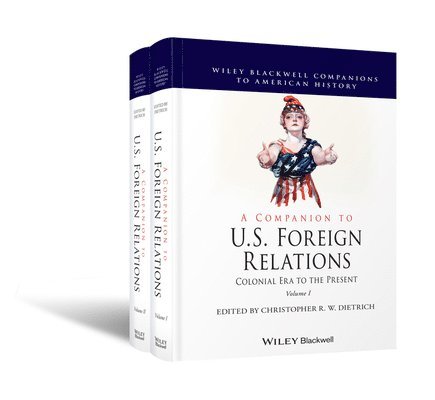
    Companion to U.S. Foreign Relations

    Colonial Era to the Present

    AvChristopher R. W. Dietrich

    Inbunden, Engelska, 2020

    Del i serien Wiley Blackwell Companions to American History

    4 799 kr

    Beställningsvara. Skickas inom 5-8 vardagar. Fri frakt över 249 kr.

    Beskrivning

    Covers the entire range of the history of U.S. foreign relations from the colonial period to the beginning of the 21st century.A Companion to U.S. Foreign Relations is an authoritative guide to past and present scholarship on the history of American diplomacy and foreign relations from its seventeenth century origins to the modern day. This two-volume reference work presents a collection of historiographical essays by prominent scholars. The essays explore three centuries of America’s global interactions and the ways U.S. foreign policies have been analyzed and interpreted over time. Scholars offer fresh perspectives on the history of U.S. foreign relations; analyze the causes, influences, and consequences of major foreign policy decisions; and address contemporary debates surrounding the practice of American power.The Companion covers a wide variety of methodologies, integrating political, military, economic, social and cultural history to explore the ideas and events that shaped U.S. diplomacy and foreign relations and continue to influence national identity. The essays discuss topics such as the links between U.S. foreign relations and the study of ideology, race, gender, and religion; Native American history, expansion, and imperialism; industrialization and modernization; domestic and international politics; and the United States’ role in decolonization, globalization, and the Cold War. A comprehensive approach to understanding the history, influences, and drivers of U.S. foreign relation, this indispensable resource: Examines significant foreign policy events and their subsequent interpretationsPlaces key figures and policies in their historical, national, and international contextsProvides background on recent and current debates in U.S. foreign policyExplores the historiography and primary sources for each topicCovers the development of diverse themes and methodologies in histories of U.S. foreign policy Offering scholars, teachers, and students unmatched chronological breadth and analytical depth, A Companion to U.S. Foreign Relations: Colonial Era to the Present is an important contribution to scholarship on the history of America’s interactions with the world.

    Produktinformation

    • Utgivningsdatum:2020-06-25
    • Mått:175 x 254 x 48 mm
    • Vikt:1 905 g
    • Format:Inbunden
    • Språk:Engelska
    • Serie:Wiley Blackwell Companions to American History
    • Antal sidor:1 184
    • Förlag:John Wiley and Sons Ltd
    • ISBN:9781119166108

    Utforska kategorier

    • Internationella relationer inom Samhälle och politik

    Mer om författaren

    Christopher R. W. Dietrich is Associate Professor of History and Director of American Studies at Fordham University. The author of Oil Revolution (2017), he specializes in the history of U.S. foreign relations, intellectual history, the history of decolonization, and the history of capitalism. Professor Dietrich has won fellowships and awards from the National History Center, the Woodrow Wilson Foundation, the Society for Historians of American Foreign Relations, and the American Historical Association.

    Innehållsförteckning

    • Volume I: Colonial Era to the Twentieth CenturyChapter 1 Imperial Crisis, Revolution, and a New Nation, 1763 to 1803David Narrett, The University of Texas at ArlingtonChapter 2 The Early Republic in a World of Empire, 1787 to 1848Emily Conroy-Krutz, Michigan State UniversityChapter 3 Time, Talent, and Treasure: Philanthropy in the Early RepublicAnnelise Hanson Shrout, University of California FullertonChapter 4 The Articles of Confederation State-System, Early American International Systems, and Antebellum Foreign Policy Analytical FrameworksRobbie J. Totten, American Jewish UniversityChapter 5 Natural Rights: Haitian-American Diplomacy in the Age of Atlantic RevolutionsRonald Angelo Johnson, Texas State UniversityChapter 6 Towards a “New Indian History” of Foreign Relations: U.S.-American Indian Diplomacy from Greenville to Wounded Knee, 1795-1890Elspeth Martini, Montclair State UniversityChapter 7 Many Manifest DestiniesBrian Rouleau, Texas A&M UniversityChapter 8 New Research Avenues: U.S. Foreign Relations in the Late Antebellum and the Civil War EraPhil Magness, American Institute for Economic ResearchChapter 9 Ideology and Interest: The Civil War, U.S. Foreign Affairs, and the WorldAndre Fleche, Castleton UniversityChapter 10 The United States: Imperium in Imperio in an Age of Imperialism, 1865-1886Daniel Margolies, Virginia Wesleyan UniversityChapter 11 New Frontiers Beyond the Seas: The Culture of American Empire and Expansion at the Turn of the Twentieth CenturySarah Steinbock-Pratt, University of AlabamaChapter 12 Connection and Disruption: American Industrialization and the World, 1865-1917Peter A. Shulman, Case Western Reserve UniversityChapter 13 The Open Door EmpireMarc-William Palen, University of ExeterChapter 14 The Statecraft of Theodore Roosevelt and America’s Rise to World PowerCharles Laderman, King’s College – LondonChapter 15 Wilson's Wartime Diplomacy: The United States and the First World War, 1914 to 1918Ross Kennedy, Illinois State UniversityChapter 16 Responding to a Revolution: The “Mexican Question” in the United StatesChristy Thornton, Johns Hopkins UniversityChapter 17 Chrysalis of Power: United States Foreign Policy and the Retreat from Isolationism, 1919-1941B.J.C. McKercher, University of VictoriaChapter 18 Insulation: The Presidency of Franklin D. Roosevelt during the Years from 1933 to 1941Kirin Klaus Patel, Maastricht UniversityChapter 19 The United States and International Law, 1776 to 1939Benjamin A. Coates, Wake Forest UniversityChapter 20 U.S. Foreign Relations during World War IIAndrew Johnstone, University of LeicesterChapter 21 Rival and Parallel Missions: America and Soviet Russia, 1917 to 1945David S. Fogelsong, Rutgers UniversityChapter 22 The United States, Transnationalism, and the Jewish Question, 1917 to 1948Sonja Wentling, Concordia UniversityChapter 23 Migrants and Transnational Networks in Sino-American Relations in the Nineteenth and Twentieth CenturiesMeredith Oyen, University of Maryland – Baltimore CountyChapter 24 The Burden of Empire: The US in the Philippines, 1898 to 1965Colleen Woods, University of Maryland – Baltimore CountyChapter 25 A History of U.S. International PolicingKatherine Unterman, Texas A&M UniversityVolume II: The Twentieth and Twenty-First CenturiesChapter 26 Black Internationalism from Berlin to Black Lives MatterBrandon R. Byrd, Vanderbilt UniversityChapter 27 Drugs, Empire, and U.S. Foreign PolicyApril Merleaux, Hampshire CollegeChapter 28 Military Bases and Overseas Occupation in 20th Century U.S. Foreign RelationsZach Fredman, Duke Kunshan UniversityChapter 29 Remaking the World: The United States and International Development, 1898 to 2015Stephen Macekura, University of IndianaChapter 30 The Early Cold War: Studies of Cold War America in the 21st CenturyMasuda Hajimu, National University of SingaporeChapter 31 United States Power in a Material WorldAndrew Friedman, Haverford CollegeChapter 32 Propaganda in the Best Sense of the Word? Public Diplomacy and U.S. Diplomatic History since World War ISarah Ellen Graham, U.S. Studies Centre, University of SydneyChapter 33 Waging War with Words, 1945 to 1963Lori Clune, California State University, FresnoChapter 34 Between Two Ages: United States, Decolonization, and Globalization in the Long SixtiesRyan Irwin, University at Albany – SUNYChapter 35 Foreign Policy in the “Backyard”: The Historiography of US-Latin American Relations in the Mid-Twentieth CenturyJames F. Siekmeier, West Virginia UniversityChapter 36 U.S. Culture and the Cuban RevolutionJohn A. Gronbeck-Tedesco, Ramapo CollegeChapter 37 After the Panic: Writing the History of U.S.-Japan Relations since the OccupationAndrew McKevitt, Louisiana Tech UniversityChapter 38 The Nuclear Revolution in American Foreign Policy during the Cold WarJonathan Reid Hunt, Southampton UniversityChapter 39 Against the Bomb: Nuclear Disarmament and Domestic PoliticsPaul Rubinson, Bridgewater CollegeChapter 40 Interminable: The Historiography of the Vietnam War, 1945 to 1975Simon Toner, University of SheffieldChapter 41 The Cold War in Sub-Saharan AfricaPhillip Muehlenbeck, George Washington UniversityChapter 42 The United States and the Arab-Israeli Conflict, 1948 to 1982Craig Daigle, City College of New YorkChapter 43 Mineral Frontiers in the Twentieth CenturyMegan Black, London School of EconomicsChapter 44 Oil and U.S. Foreign RelationsVictor McFarland, University of MissouriChapter 45 Oil, Empire, and Covert Action: New Directions in the Historiography of US-Iraqi RelationsBrandon Wolfe-Hunnicutt, California State University, StanislausChapter 46 Iran and the Academy: Intellectual Paths to and from Revolution in the United StatesMatthew K. Shannon, Emory & Henry CollegeChapter 47 The United States and Afghanistan: Ambiguity and Impasse, 1945-2015Elisabeth Leake, Leeds UniversityChapter 48 Ambivalent Partnerships, Enduring Dilemmas: The United States, India, and Pakistan after PartitionRobert Rakove, Stanford UniversityChapter 49 Transnational Activism in U.S.-Central America Relations  in the 1980sTheresa Keeley, University of LouisvilleChapter 50 The Reagan Administration and the World, 1981-1988James Graham Wilson, Historian’s Office, Department of StateChapter 51 The Changing History of the End of the Cold WarSarah B. Snyder, American UniversityChapter 52 The Obama Era: Retrenchment and the Challenge of a “Post-American” World, 2009-2017Robert S. Singh, University of London