• Fri frakt över 249 kr
  • •
  • Snabba leveranser
  • •
  • Billiga böcker
Kundservice

Du är på sajten för privatpersoner.

Företag, bibliotek eller offentlig verksamhet?

Du handlar på classic.bokus.com, där alla dina funktioner finns intakta.
Till classic.bokus.com
Bokus logotyp. Gå till startsidan.
  • Erbjudanden
  • Student
  • Topplistor
  • Barn & ungdom
  • Bokus Play
  • E-böcker
  • Ljudböcker
  • Pocketböcker
  • Spel och pussel

Upp till 25% på utvalda nyheter →

Sidfot

Mina sidor

    Hjälp

    • Kundservice
    • Vanliga frågor och svar
    • Frakt och leverans
    • Retur vid ångerrätt
    • Reklamera vara
    • Betalning
    • Köpvillkor
    • Allmänna villkor
    • Information om webbplatsens tillgänglighet

    Om Bokus

    • Om oss
    • Pressrum
    • För studenter
    • För företag
    • För bibliotek och offentlig verksamhet
    • För leverantörer
    • Hållbarhet

    Populärt

    • Aktuella erbjudanden
    • Presentkort
    • Studentlitteratur
    • Nya böcker
    • Topplistor
    • Signerade böcker
    • Engelska böcker

    Inspiration

    • Boktips
    • BookTok
    • Barnbokskaraktärer
    • Populära författare
    Logotyp för Bokus
    Följ oss på Facebook (extern länk)Följ oss på Instagram (extern länk)Följ oss på YouTube (extern länk)Följ oss på TikTok (extern länk)
    bokus @ CookiesAnpassa cookiesIntegritetspolicyKöpvillkor
    Till Citymail hemsida (extern länk)Till Budbee hemsida (extern länk)Till Postnord hemsida (extern länk)Till Schenker hemsida (extern länk)Till Early Bird hemsida (extern länk)Till Walleys hemsida (extern länk)
    1. Naturvetenskap och teknik
    2. Teknik och industri
    3. Maskinteknik och material

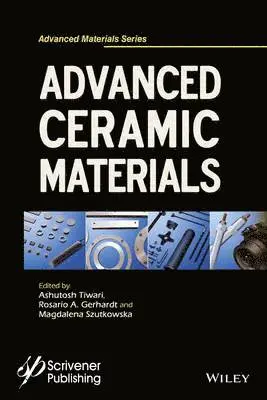
    Advanced Ceramic Materials

    AvAshutosh Tiwari,Rosario A. Gerhardt

    Inbunden, Engelska, 2016

    Del i serien Advanced Material Series

    2 329 kr

    Beställningsvara. Skickas inom 5-8 vardagar. Fri frakt över 249 kr.

    Beskrivning

    Ceramic materials are inorganic and non-metallic porcelains, tiles, enamels, cements, glasses and refractory bricks. Today, "ceramics" has gained a wider meaning as a new generation of materials influence on our lives; electronics, computers, communications, aerospace and other industries rely on a number of their uses. In general, advanced ceramic materials include electro-ceramics, optoelectronic-ceramics, superconductive ceramics and the more recent development of piezoelectric and dielectric ceramics. They can be considered for their features including mechanical properties, decorative textures, environmental uses, energy applications, as well as their usage in bio-ceramics, composites, functionally graded materials, intelligent ceramics and so on.Advanced Ceramic Materials brings together a group of subject matter experts who describe innovative methodologies and strategies adopted in the research and development of the advanced ceramic materials. The book is written for readers from diverse backgrounds across chemistry, physics, materials science and engineering, medical science, pharmacy, environmental technology, biotechnology, and biomedical engineering. It offers a comprehensive view of cutting-edge research on ceramic materials and technologies.Divided into 3 parts concerning design, composites and functionality, the topics discussed include: Chemical strategies of epitaxial oxide ceramics nanomaterialsBiphasic, triphasic and multiphasic calcium orthophosphatesMicrowave assisted processing of advanced ceramic compositesContinuous fiber reinforced ceramic matrix compositesYytria and magnesia doped alumina ceramicOxidation induced crack healingSWCNTs vs MWCNTs reinforcement agentsOrganic and inorganic wastes in clay brick productionFunctional tantalum oxidesApplication of silver tin research on hydroxyapatite

    Produktinformation

    • Utgivningsdatum:2016-09-27
    • Mått:160 x 236 x 28 mm
    • Vikt:726 g
    • Format:Inbunden
    • Språk:Engelska
    • Serie:Advanced Material Series
    • Antal sidor:448
    • Förlag:John Wiley & Sons Inc
    • ISBN:9781119242444

    Utforska kategorier

    • Maskinteknik och material inom Naturvetenskap och teknik

    Mer om författaren

    Ashutosh Tiwari is Secretary General, International Association of Advanced Materials; Chairman and Managing Director of Tekidag AB (Innotech); Associate Professor and Group Leader, Smart Materials and Biodevices at the world premier Biosensors and Bioelectronics Centre, IFM-Linköping University; Editor-in-Chief, Advanced Materials Letters; a materials chemist and docent in the Applied Physics with the specialization of Biosensors and Bioelectronics from Linköping University, Sweden. He has more than 100 peer-reviewed primary research publications in the field of materials science and nanotechnology and has edited/authored more than 35 books on advanced materials and technology. He is the founder member and chair of American, Asian, European and Advanced Materials World Congress, Smart Materials and Surfaces, Global & European Graphene Forum, International Conference on Smart Energy Technologies, International Conference on Material Science and Technology and World Technology Forum.Rosario A. Gerhardt is currently Professor of Materials Science and Engineering at the Georgia Institute of Technology, where she has taught introductory materials science to over 2000 undergraduates over the years. She was named Goizueta Foundation Faculty Chair in 2015 in recognition of her teaching, research and service contributions.  She was also the recipient of an IAAM Medal in 2015. Her research group has characterized the properties and microstructure of many materials including porous silica, bulk ferroelectrics and thin film heterostructures, as well as numerous ceramic matrix and polymer matrix composites as a function of size, shape and distribution of the fillersMagdalena Szutkowska isaProfessor at the Institute of Advanced Manufacturing Technology and head of the Materials Testing Laboratory, Cracow, Poland. She also served for six years as the Head of the Department of Engineering and Materials Technology at the Pedagogical University of Cracow. She is currently involved in the manufacturing and testing of new composite ceramics based on alumina, hard metals and superhard materials in order to improve the fracture toughness of ceramics designed for cutting tools. She is the author and co-author of more than 120 papers, three monographs, a few chapters in books and the co-author of 5 patents. She has been awarded the Golden Cross of Merit by the President of the Polish Republic and honoured with the prestigious "IAAM Scientist Award".

    Innehållsförteckning

    • Preface xiiiPart 1 Design, Processing, and Properties1 Development of Epitaxial Oxide Ceramics Nanomaterials Based on Chemical Strategies on Semiconductor Platforms 3A. Carretero-Genevrier, R. Bachelet, G. Saint-Girons, R. Moalla, J. M. Vila-Fungueiriño, B. Rivas-Murias, F. Rivadulla, J. Rodriguez-Carvajal, A. Gomez, J. Gazquez, M. Gich and N. Mestres1.1 Introduction 41.2 Integration of Epitaxial Functional Oxides Nanomaterials on Silicon Entirely Performed by Chemical Solution Strategies 81.2.1 Integration of Piezoelectric Quartz Thin Films on Silicon by Soft Chemistry 101.2.2 Controllable Textures of Epitaxial Quartz Thin Films 131.2.3 Integration of Functional Oxides by Quartz Templating 171.2.4 Highly Textured ZnO Thin Films 211.3 Integration of Functional Oxides by Combining Soft Chemistry and Physical Techniques 221.4 Conclusions 23Acknowledgments 26References 262 Biphasic, Triphasic, and Multiphasic Calcium Orthophosphates 33Sergey V. Dorozhkin2.1 Introduction 342.2 General Definitions and Knowledge 382.3 Various Types of Biphasic, Triphasic, and Multiphasic CaPO4 402.4 Stability 422.5 Preparation 442.6 Properties 512.7 Biomedical Applications 532.8 Conclusions 59References 603 An Energy Efficient Processing Route for Advance Ceramic Composites Using Microwaves 97Satnam Singh, Dheeraj Gupta and Vivek Jain3.1 Introduction 983.2 Historical Developments in Materials Processing by Microwaves 993.3 Introduction to Microwave Heating Process 1013.3.1 Microwave–materials Interaction Theory 1023.3.2 Microwave Heating Mechanisms 1043.4 Heating Methods by Microwaves 1073.4.1 Direct Microwave Heating 1073.4.2 Microwave Hybrid Heating 1083.4.3 Selective Heating 1093.4.4 Microwave-assisted Processing of Materials 1093.5 Advantages/Limitations of Microwave Material Processing 1103.5.1 Highly Energy Efficient Processing Method 1103.5.2 Better Quality of Processed Materials 1133.5.3 Cleaner Energy Processing 1143.5.4 Compact Processing Unit 1143.5.5 Restriction in Processing of All Varieties of Materials 1153.5.6 Restrictions in Processing of Complex Shapes 1153.5.7 Non-uniformity in Heating 1153.5.8 Human Safety Issues 1153.6 Application of Microwave Heating inComposite Processing 1163.6.1 Recent Review of Work Carried Out in MMC/CMC/Alloys/Ceramic Processing by Microwaves 1193.6.2 Microwave Melting/Casting of Metals/Metal Matrix Composites 1273.7 Future Prospectives 1303.8 Conclusion 133References 133Part 2 Composites: Fundamentals and Frontiers4 Continuous Fiber-reinforced Ceramic Matrix Composites 147Rebecca Gottlieb, Shannon Poges, Chris Monteleone and Steven L. Suib4.1 Introduction 1484.2 Parts of a CMC 1494.2.1 Fibers 1504.2.2 Interphase 1514.2.3 Matrix 1524.3 Modern Uses of CMCs 1544.4 History 1554.5 Ceramic Fibers 1584.5.1 Oxide Fibers 1584.5.1.1 Alumina Fibers 1594.5.1.2 Stabilized Alumina Fibers 1604.5.1.3 Alumina Silicate Fibers 1604.5.1.4 Other Oxide Fibers 1644.5.2 Non-oxide Fibers (SiC) 1644.5.2.1 Oxidation 1644.5.2.2 Irradiation 1654.5.2.3 Sintering 1654.5.3 Carbon Fibers 1664.5.3.1 Polyacrylonitrile 1674.5.3.2 Pitch 1674.6 Interface/Interphase 1684.6.1 Requirements 1694.6.2 Non-oxide 1704.6.3 Oxide 1714.7 Matrix Materials 1724.7.1 Carbon 1724.7.2 Silicon Carbide 1754.7.3 Oxides 1784.8 Matrix Fabrication Techniques 1794.8.1 Polymer Impregnation and Pyrolysis 1804.8.2 Chemical Vapor Infiltration 1814.8.3 Melt Infiltration 1834.8.4 Slurry Infiltration 1844.8.5 Metal Oxidation 1854.9 Toughness of CMCs 1854.9.1 Fiber/Matrix Interface 1864.9.2 Modes of Failure 1864.9.3 Energy-Absorbing Mechanisms 1874.9.4 Stress Testing of Composites 1884.10 Applications 1884.10.1 Brakes and Friction 1904.10.2 Biomedical Applications 191Acknowledgments 193References 1935 Yytria- and Magnesia-doped Alumina Ceramic Reinforced with Multi-walled Carbon Nanotubes 201Iftikhar Ahmad and Yanqiu Zhu5.1 Introduction 2025.2 Dispersions and Stability of MWCNTs 2025.3 Influence of Yytria (Y2O3) Doping on MWCNT/Al2O3 Nanocomposites 2055.3.1 Densification and Microstructure Development 2055.3.2 Mechanical Performance and Toughening Mechanism 2105.4 Magnesia (MgO)-Tuned MWCNT/Al2O3 Nanocomposites 2155.4.1 Role of MgO on the Densification and Microstructural Features 2155.4.2 Effect of MgO on the Grain Size and Fracture Behavior 2175.4.3 Mechanical Response of MgO-Doped MWCNT/Al2O3   Nanocomposite 2215.5 Conclusions 225Acknowledgments 226References 2276 Oxidation-induced Crack Healing in MAX Phase Containing Ceramic Composites 231Guoping Bei and Peter Greil6.1 History of Crack Healing in Ceramics 2326.2 High-temperature Crack Healing in MAX Phases 2336.2.1 MAX Phases 2336.2.2 Crack Healing in Al-contained MAX Phases 2346.2.2.1 Ti3AlC2 2346.2.2.2 Ti2AlC 2356.2.2.3 Cr2AlC 2386.3 Lower-temperature Crack Healing in MAX Phase-based Ceramics 2416.3.1 Oxidation Behavior of Ti2Al(1–x)SnxC MAX Phase Solid-solution Powders 2416.3.2 Oxidation-induced Crack Healing in Thermal-shocked Ti2SnC MAX Phase 2446.3.3 Crack Healing in Ti2Al0.5Sn0.5C–Al2O3 Composites 2496.4 Conclusions 255Acknowledgments 256References 2567 SWCNTs versus MWCNTs as Reinforcement Agents in Zirconia- and Alumina-based Nanocomposites: Which One to Use 261M.H. Bocanegra-Bernal, C. Dominguez-Rios, A. Garcia-Reyes, A. Aguilar-Elguezabal and J. Echeberria7.1 Introduction 2627.2 Single-walled Carbon Nanotubes 2667.3 Multi-walled Carbon Nanotubes 2697.4 The Effects of CNTs Types on the Mechanical Properties of Al2O3- and ZrO2-based Ceramics 2747.5 Why SWCNTs? or Why MWCNTs? 2857.6 Conclusions 287Acknowledgments 289References 289Part 3 Functional and Applied Ceramics8 Application of Organic and Inorganic Wastes in Clay Brick Production: A Chemometric Approach 301Milica V. Vasić, Zagorka Radojević, and Lato Pezo8.1 Introduction 3028.2 Materials and Methods 3058.2.1 Raw Materials and Laboratory Brick Samples 3058.2.2 Macro Oxides Content of the Used Raw Materials 3068.2.3 Response Surface Method 3078.2.4 Fuzzy Synthetic Evaluation Algorithm 3088.2.5 Artificial Neural Network modeling 3098.3 Results and Discussion 3128.3.1 Characteristics of Raw Materials 3128.3.2 Changes Observed in Shaping and Drying in the Air 3148.3.3 Characteristics of Fired Products 3188.3.4 RSM and ANOVA Analysis 3218.3.5 Neurons in the ANN Hidden Layer 3238.3.6 Simulation of the ANNs 3258.3.7 Principal Component Analysis 3288.3.8 Optimization 3308.4 Conclusions 331Acknowledgments 332References 3329 Functional Tantalum-based Oxides: From the Structure to the Applications 337Sebastian Zlotnik, Alexander Tkach and Paula M. Vilarinho9.1 Functional Materials: Current Needs 3389.2 Importance of Tantalum and Tantalum-based Oxides 3429.3 Properties of Alkali Tantalates 3439.3.1 Crystal and Electronic Structures 3439.3.2 Thermochemistry 3479.4 Processing of Alkali Tantalate Ceramics for Electronic Applications 3519.5 Potential Applications of Alkali Tantalates 3589.5.1 Sodium Tantalate as a Photocatalyst 3589.5.2 Lithium Tantalate as a Piezoelectric Biomaterial 3669.6 Conclusions 370Acknowledgement 371References 37110 Application of Silver Tin Research on Hydroxyapatite 385Ewa Skwarek10.1 Introduction 38610.1.1 Properties of Silver 38610.1.2 Application of Silver 38710.1.3 Hydroxyapatite (HAP)–Silver 39110.2 Materials and Methods 39910.2.1 Synthesis of Hydroxyapatite Using the Co-precipitation  Method 39910.2.2 Synthesis of Silver-doped Hydroxyapatite 40010.2.3 Characteristics of Surfaces of Obtained Materials 40010.3 Results and Discussion 40210.3.1 The Results of XRD and Surface 40210.3.2 Zeta Potential at the Hydroxyapatite/NaNO3 Electrolyte Solution Interface 40410.3.3 Surface Charge Density 40810.3.4 Adsorption of Silver Ions on Hydroxyapatite 41010.3.5 Kinetics of Ag+ Ions Adsorption on the Hydroxyapatite Surface 41310.4 Conclusion 414References 415Index 419