• Fri frakt över 249 kr
  • •
  • Snabba leveranser
  • •
  • Billiga böcker
Kundservice

Du är på sajten för privatpersoner.

Företag, bibliotek eller offentlig verksamhet?

Du handlar på classic.bokus.com, där alla dina funktioner finns intakta.
Till classic.bokus.com
Bokus logotyp. Gå till startsidan.
  • Erbjudanden
  • Nyheter
  • Student
  • Topplistor
  • Barn & ungdom
  • Bokus Play
  • E-böcker
  • Pocketböcker
  • Spel & pussel

10% rabatt på allt med kod NYSTART10 →

Sidfot

Mina sidor

    Hjälp

    • Kundservice
    • Vanliga frågor och svar
    • Frakt och leverans
    • Retur vid ångerrätt
    • Reklamera vara
    • Betalning
    • Köpvillkor
    • Allmänna villkor
    • Information om webbplatsens tillgänglighet

    Om Bokus

    • Om oss
    • Pressrum
    • För studenter
    • För företag
    • För bibliotek och offentlig verksamhet
    • För leverantörer
    • Hållbarhet

    Populärt

    • Aktuella erbjudanden
    • Presentkort
    • Studentlitteratur
    • Nya böcker
    • Topplistor
    • Signerade böcker
    • Engelska böcker

    Inspiration

    • Boktips
    • BookTok
    • Populära bokserier
    • Barnbokskaraktärer
    • Populära författare
    Logotyp för Bokus
    Följ oss på Facebook (extern länk)Följ oss på Instagram (extern länk)Följ oss på YouTube (extern länk)Följ oss på TikTok (extern länk)
    bokus @ CookiesAnpassa cookiesIntegritetspolicyKöpvillkor
    Till Citymail hemsida (extern länk)Till Budbee hemsida (extern länk)Till Postnord hemsida (extern länk)Till Schenker hemsida (extern länk)Till Early Bird hemsida (extern länk)Till Walleys hemsida (extern länk)
    1. Data och IT
    2. Systemvetenskap och AI

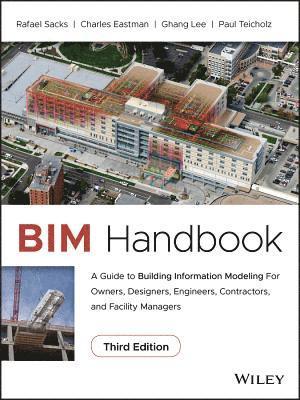
    BIM Handbook

    A Guide to Building Information Modeling for Owners, Designers, Engineers, Contractors, and Facility Managers

    AvRafael Sacks,Charles Eastman

    Inbunden, Engelska, 2018

    1 177 kr

    Beställningsvara. Skickas inom 5-8 vardagar. Fri frakt över 249 kr.

    Fler format och utgåvor

    Inbunden

    1 169 kr

    Beskrivning

    Discover BIM: A better way to build better buildings Building Information Modeling (BIM) offers a novel approach to design, construction, and facility management in which a digital representation of the building product and process is used to facilitate the exchange and interoperability of information in digital format. BIM is beginning to change the way buildings look, the way they function, and the ways in which they are designed and built.The BIM Handbook, Third Edition provides an in-depth understanding of BIM technologies, the business and organizational issues associated with its implementation, and the profound advantages that effective use of BIM can provide to all members of a project team. Updates to this edition include: Information on the ways in which professionals should use BIM to gain maximum valueNew topics such as collaborative working, national and major construction clients, BIM standards and guidesA discussion on how various professional roles have expanded through the widespread use and the new avenues of BIM practices and servicesA wealth of new case studies that clearly illustrate exactly how BIM is applied in a wide variety of conditionsPainting a colorful and thorough picture of the state of the art in building information modeling, the BIM Handbook, Third Edition guides readers to successful implementations, helping them to avoid needless frustration and costs and take full advantage of this paradigm-shifting approach to construct better buildings that consume fewer materials and require less time, labor, and capital resources.

    Produktinformation

    • Utgivningsdatum:2018-10-02
    • Mått:191 x 239 x 36 mm
    • Vikt:1 474 g
    • Format:Inbunden
    • Språk:Engelska
    • Antal sidor:688
    • Upplaga:3
    • Förlag:John Wiley & Sons Inc
    • ISBN:9781119287537

    Utforska kategorier

    • Systemvetenskap och AI inom Data och IT
    • Byggnadsindustri och tung industri inom Ekonomi och Ledarskap

    Mer om författaren

    Rafael Sacks is a Professor of Civil Engineering and leads the Virtual Construction Lab at the Technion - Israel Institute of Technology. Charles Eastman is Professor Emeritus in the College of Architecture at Georgia Tech. He founded the Digital Building Laboratory. Ghang Lee is a Professor and the Director of the Building Informatics Group at Yonsei University in Seoul, Korea. Paul Teicholz is Professor Emeritus at Stanford University. He founded the Center for Integrated Facility Engineering at Stanford University.

    Innehållsförteckning

    • Foreword to the Third Edition xviiPreface xxiCHAPTER 1 Introduction 11.0 Executive Summary 11.1 Introduction 21.2 The Current AEC Business Model 21.3 Documented Inefficiencies of Traditional Approaches 91.4 BIM: New Tools and New Processes 131.5 BIM as a Lifecycle Platform 181.6 What Is Not a BIM Platform? 191.7 What Are the Benefits of BIM? What Problems Does It Address? 201.8 BIM and Lean Construction 251.9 What Challenges Can be Expected? 281.10 Future of Designing and Building With BIM 301.11 Case Studies 30Chapter 1 Discussion Questions 31CHAPTER 2 Core Technologies and Software 322.0 Executive Summary 322.1 The Evolution to Object-Based Parametric Modeling 332.2 Beyond Parametric Shapes 482.3 BIM Environments, Platforms, and Tools 572.4 BIM Model Quality and Model Checking 622.5 BIM Platforms 642.6 Design Review Applications 762.7 Conclusion 82Chapter 2 Discussion Questions 83CHAPTER 3 Collaboration and Interoperability 853.0 Executive Summary 853.1 Introduction 863.2 Different Kinds of Data Exchange Methods 883.3 Background of Product Data Models 953.4 Other Efforts Supporting Standardization 1073.5 The Evolution from File-Based Exchange to BIM Servers 1123.6 Interfacing Technologies 124Chapter 3 Discussion Questions 128CHAPTER 4 BIM for Owners and Facility Managers 1304.0 Executive Summary 1304.1 Introduction: Why Owners Should Care About BIM 1314.2 Owner’s Role in a BIM Project 1334.3 Cost and Time Management 1424.4 An Owner and Facility Manager’s Building Model 1544.5 Leading the BIM Implementation on a Project 1604.6 Barriers to Implementing BIM: Risks and Common Myths 1674.7 Issues for Owners to Consider when Adopting BIM 171Chapter 4 Discussion Questions 173CHAPTER 5 BIM for Architects and Engineers 1755.0 Executive Summary 1755.1 Introduction 1775.2 Scope of Design Services 1795.3 BIM Use in Design Processes 1865.4 Building Object Models and Libraries 2155.5 Considerations in Adoption for Design Practice 223Chapter 5 Discussion Questions 226CHAPTER 6 BIM for Contractors 2286.0 Executive Summary 2286.1 Introduction 2306.2 Types of Construction Firms 2316.3 Information Contractors Want from BIM 2326.4 BIM-Enabled Process Change 2346.5 Developing a Construction Building Information Model 2376.6 Using a Contractor Building Information Model 2416.7 3D: Visualization and Coordination 2436.8 4D: Construction Analysis and Planning 2456.9 5D: Quantity Takeoff and Cost Estimating 2556.10 Production Planning and Control 2606.11 Off-site Fabrication and Modular Construction 2616.12 BIM in the Field 2636.13 Cost and Schedule Control and Other Management Functions 2706.14 Commissioning and Turnover 272Chapter 6 Discussion Questions 273CHAPTER 7 BIM for Subcontractors and Fabricators 2757.0 Executive Summary 2757.1 Introduction 2767.2 Types of Subcontractors and Fabricators 2787.3 The Benefits of a BIM Process for Subcontractor Fabricators 2837.4 Generic BIM System Requirements for Fabricators 2987.5 Specific BIM Requirements for Fabrication 3057.6 Adopting BIM in a Fabrication Operation 317Chapter 7 Discussion Questions 322CHAPTER 8 Facilitators of BIM Adoption and Implementation 3238.0 Executive Summary 3238.1 Introduction 3248.2 BIM Mandates 3248.3 BIM Roadmaps, Maturity Models, and Measures 3308.4 BIM Guides 3408.5 BIM Education and Training 3458.6 Legal, Security, and Best Practice Issues 358Chapter 8 Discussion Questions 362CHAPTER 9 The Future: Building with BIM 3649.0 Executive Summary 3649.1 Introduction 3669.2 BIM Before 2000: Predicting Trends 3679.3 Development and Impact of BIM: 2000 to 2017 3709.4 Current Trends 3769.4.1 Process Trends 3779.4.2 Technology Trends 3819.4.3 Integrative Process and Technology Trends 3829.4.4 Trends in BIM Research 3839.4.5 Obstacles to Change 3859.5 Vision 2025 3869.6 Beyond 2025 394Acknowledgment 397Chapter 9 Discussion Questions 397CHAPTER 10 BIM Case Studies 39810.0 Introduction 398Acknowledgments 40110.1 National Children’s Hospital, Dublin 405Acknowledgments 41910.2 Hyundai Motorstudio Goyang, South Korea 419Acknowledgments 43710.3 Fondation Louis Vuitton, Paris 437Acknowledgments 45110.4 Dongdaemun Design Plaza, Seoul, South Korea 451Acknowledgments 46810.5 Saint Joseph Hospital, Denver 468Acknowledgments 481Online Sources 48110.6 Victoria Station, London Underground 482Acknowledgments 49810.7 Nanyang Technological University Student Residence Halls, Singapore 499Acknowledgments 52210.8 Mapletree Business City II, Singapore 522Acknowledgments 55410.9 Prince Mohammad Bin Abdulaziz International Airport, Medina, UAE 554Acknowledgments 57410.10 Howard Hughes Medical Institute, Chevy Chase, Maryland 574Acknowledgments 58310.11 Stanford Neuroscience Health Center, Palo Alto, California 584Acknowledgments 613Glossary 614References 623Index 639