• Fri frakt över 249 kr
  • •
  • Snabba leveranser
  • •
  • Billiga böcker
Kundservice

Du är på sajten för privatpersoner.

Företag, bibliotek eller offentlig verksamhet?

Du handlar på classic.bokus.com, där alla dina funktioner finns intakta.
Till classic.bokus.com
Bokus logotyp. Gå till startsidan.
  • Erbjudanden
  • Nyheter
  • Student
  • Topplistor
  • Barn & ungdom
  • Bokus Play
  • E-böcker
  • Pocketböcker
  • Spel & pussel

10% rabatt på allt med kod: NYSTART10 →

Sidfot

Mina sidor

    Hjälp

    • Kundservice
    • Vanliga frågor och svar
    • Frakt och leverans
    • Retur vid ångerrätt
    • Reklamera vara
    • Betalning
    • Köpvillkor
    • Allmänna villkor
    • Information om webbplatsens tillgänglighet

    Om Bokus

    • Om oss
    • Pressrum
    • För studenter
    • För företag
    • För bibliotek och offentlig verksamhet
    • För leverantörer
    • Hållbarhet

    Populärt

    • Aktuella erbjudanden
    • Presentkort
    • Studentlitteratur
    • Nya böcker
    • Topplistor
    • Signerade böcker
    • Engelska böcker

    Inspiration

    • Boktips
    • BookTok
    • Populära bokserier
    • Barnbokskaraktärer
    • Populära författare
    Logotyp för Bokus
    Följ oss på Facebook (extern länk)Följ oss på Instagram (extern länk)Följ oss på YouTube (extern länk)Följ oss på TikTok (extern länk)
    bokus @ CookiesAnpassa cookiesIntegritetspolicyKöpvillkor
    Till Citymail hemsida (extern länk)Till Budbee hemsida (extern länk)Till Postnord hemsida (extern länk)Till Schenker hemsida (extern länk)Till Early Bird hemsida (extern länk)Till Walleys hemsida (extern länk)
    1. Naturvetenskap och teknik
    2. Geovetenskap
    3. Geografi

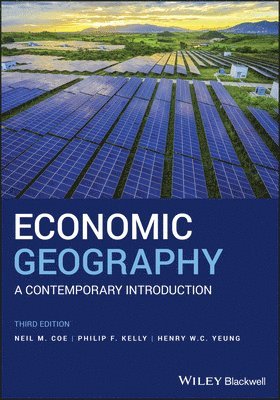
    Economic Geography

    A Contemporary Introduction

    AvNeil M. Coe,Philip F. Kelly

    Häftad, Engelska, 2019

    554 kr

    Beställningsvara. Skickas inom 5-8 vardagar. Fri frakt över 249 kr.

    Beskrivning

    A revised and updated edition of the leading introductory text on the geography of economic life, from the local to the globalEconomic Geography is an engaging and accessible introduction to the different ways modern economic geographers understand, analyze, and interpret economic processes. This comprehensive text addresses significant questions relevant to contemporary economic life, from the activities of transnational corporations to issues surrounding workplaces and consumption. It encourages readers to explore how spatial patterns, places, networks, and territories shape large-scale economic processes. Accessible, highly-illustrated material presents fresh insights from the field—complemented by relatable, real-world examples that help students understand the social, cultural, and political contexts underpinning global economic processes.Now in its third edition, this extensively revised and updated textbook retains the features and thematic structure that have proved popular with students and instructors alike, while adding exciting new content. New chapters explore how the global economy and global development are institutionalized and governed, the economic geographies of global climate change, economic practices outside the capitalist mainstream, the role of migrants in labour markets, global production networks, and more.  Introduces economic geography with a thematic approach including major concepts, current debates, and case studiesRevised and updated to enhance international coverage, including three entirely new chapters on international development, alternative economies, and global climate changeSubstantial new content on labour migration, global production networks, and recent intellectual trends such as evolutionary economic geographyHighly illustrated with diagrams and photographs closely integrated into the textPedagogical aids including key case studies, learning objectives, text boxes, chapter essay questions, summaries, and further readingCore geographical concepts – such as place, networks and territory – are closely integrated into all chapters.Economic Geography: A Contemporary Introduction is an invaluable source of up-to-date knowledge for students new to the field, for those requiring a solid foundation, as well as for a broader academic and public readership with interest in this area of study.

    Produktinformation

    • Utgivningsdatum:2019-12-26
    • Mått:178 x 254 x 33 mm
    • Vikt:1 179 g
    • Format:Häftad
    • Språk:Engelska
    • Antal sidor:576
    • Upplaga:3
    • Förlag:John Wiley and Sons Ltd
    • ISBN:9781119389552

    Utforska kategorier

    • Geografi inom Naturvetenskap och teknik

    Mer om författaren

    NEIL M. COE is Professor of Economic Geography at the National University of Singapore PHILIP F. KELLY is Professor of Geography at York University, Canada HENRY W.C. YEUNG is Distinguished Professor at the National University of Singapore

    Recensioner i media

    “This will be an exciting new edition and conceptually right up to date. It will weave together new thinking with essential knowledge of the field in a highly successful way. Students will find the structuring of the chapters around major topics attractive. Economic geography has been undergoing an intellectual transformation as it moves to incorporate new approaches and what is proposed here is very much in line with that. It will be highly suitable as a required text.”Nancy Ettlinger, Ohio State University  “I like the changes proposed for the latest edition. This text blends together a culturally aware analysis of economic geography with a clear sense of what the discipline is about and the international range of case studies is impressive. I have no doubts about the quality of this author team. Individually they are scholars and writers of distinction. Collectively they complement each other and work together extremely well.”Adam Tickell, University of Sussex

    Innehållsförteckning

    • List of Figures xiList of Tables xvList of Boxes xviiPreface to the Third Edition xixAcknowledgements xxviPart I Conceptual Foundations 11 Geography: How do we think spatially? 31.1 Introduction: Message in a Bottle 31.2 Bottled Water: A Contentious Commodity 71.3 Location and Patterns in Space 111.4 The Uniqueness of Place 151.5 Connecting Across Space Through Networks 201.6 Defining and Controlling Space Through Territory 261.7 Summary 302 The Economy: What does it mean? 362.1 Introduction 362.2 What ‘Counts’ as the Economy? 382.3 A Brief History of ‘the Economy’ 442.4 Basic Economic Processes 502.5 From Economics to Economic Geography 552.6 Summary 653 Dynamics of Capitalism: Why is economic growth so uneven? 693.1 Introduction 693.2 Uneven Development – Naturally! 733.3 Fundamentals of the Capitalist System 743.4 The Spaces and Scales of Uneven Geographical Development 823.5 Can Places and Regions Chart Their Own Futures? 933.6 Summary 984 Networks: How is the world economy interconnected? 1024.1 Introduction 1024.2 The Missing Relations Between Producers and Consumers? 1054.3 Production Networks: Connecting Distant Places and Economies 1084.4 Bringing Commodities Together: The Logistics Revolution 1234.5 Where Does a Production Network End? From Waste to Commodities Again 1274.6 Summary 129Part II Key Economic Actors 1355 Transnational Corporations: How do they keep it all together? 1375.1 Introduction 1375.2 The Myth of Being Everywhere, Effortlessly 1395.3 The Changing Organization of TNCs 1425.4 Organizing Transnational Economic Activities 1 – Intra‐firm Relationships 1465.5 Organizing Transnational Economic Activities 2 – Inter‐firm Relationships 1555.6 The Risks of Global Presence 1645.7 Summary 1676 Labour: Are migrant workers the new normal? 1716.1 Introduction 1716.2 Are Migrants the Problem? 1746.3 Territorial Power and Migrant Types 1786.4 Migrant Labour and Places of Settlement 1836.5 Migrant Labour and Places of Origin 1896.6 Organizing Migrant Labour 1926.7 The Migration Industry 1976.8 Summary 2007 Consumers: Who decides what we buy? 2067.1 Introduction 2067.2 Towards Viewing Consumption as a Sociocultural Process 2097.3 The Shifting Spatial Patterns of Retailing 2137.4 Uneven Geographies of Consumption 2327.5 Consuming Places: Travel and Tourism 2387.6 Summary 2438 Finance: How has capital become so powerful? 2478.1 Introduction 2478.2 How is the Real Economy Financed? 2518.3 Deregulation and the Rise of Global Finance 2538.4 Putting Global Finance in Its Place 2578.5 Financialization: Circulating Global Capital 2638.6 A Different Kind of Finance? 2738.7 Summary 276Part III Governing the Economy 2819 States: Who runs the economy? 2839.1 Introduction 2839.2 Neo‐liberal Globalization and the End of the State? 2869.3 The State as the Architect of the National Economy 2899.4 Varieties of Capitalisms and States 3019.5 Graduated Sovereignty and the State 3099.6 Summary 30910 International Institutions: How do they govern and foster global development? 31410.1 Introduction 31410.2 A Market Mechanism for the ‘Global South’? 31710.3 Governing the Global Economy 31910.4 Fostering Development in the Global South 33110.5 Bottom‐Up? The Rise of Community‐Based Development 33910.6 Summary 34011 Environment: Does global climate change change everything? 34511.1 Introduction 34511.2 Climate Complacency 34811.3 Causes and Sources of Climate Change 35111.4 The Impacts and Costs of Climate Change 35611.5 Regulating Emissions 36011.6 Geographies of the Green Economy 36811.7 Should this Change Everything? 37311.8 Summary 375Part IV Social and Cultural Dimensions 38112 Clusters: Why does proximity matter? 38312.1 Introduction 38312.2 Industrial Location Theory 38712.3 Towards a Typology of Clusters? 39012.4 Binding Clusters Together: Agglomeration Economies 39812.5 Untraded Interdependencies and Regional Cultures of Production 40212.6 A Dynamic Approach to Clusters 40912.7 Can Clusters Be Temporary? 41212.8 Summary 41513 Identities: Are economies gendered and racialized? 42013.1 Introduction 42013.2 Seeing Gender and Race in the Economy 42213.3 Uneven Geographies of Gender and Work 42513.4 Gender, Race, and the Labour Market 43213.5 Identity and the Workplace 43313.6 Ethnic Clusters and Networks 43713.7 Intersecting Identities 44613.8 Summary 44814 Alternatives: Can we create diverse economies? 45314.1 Introduction 45314.2 Beyond a ‘Capitalocentric’ View of the Economy 45614.3 Alternative Markets 46114.4 Alternative Enterprises 46514.5 Alternative Working 47314.6 Alternative Property 47714.7 The Limits to Diverse Economies? 48114.8 Summary 485Part V Conclusion 48915 Economic Geography: Intellectual journeys and future horizons 49115.1 Introduction 49115.2 A Changing Field 49315.3 A Changing World 50515.4 Summary 510Index 515